The Dickason family: a snapshot of black history and culture in Monroe County – part two
By Jeffrey Kanode, RealWV
AUTHOR’S NOTE: This is the second piece on Becky Crabtree’s work on the history of the black community in Monroe County. The ancestors, lifework, and legacy of Dr. Henry Lake Dickason centers
Crabtree’s work. In this installment, we finish our conversation about Dr. Dickason, and focus on the rich legacy he left behind—inspiration and experience that continues to reverberate across Monroe County, West Virginia, and beyond.
The other piece of magic originated in Crabtree’s own family. Her aunt had been a nurse in Mercer County, and she served on the county tuberculosis committee, a group tasked with bringing awareness and education about the deadly disease. From her scrapbook she found notes listing the committee’s members, including one Dr. Henry Lake Dickason. Crabtree recalled that Lake’s brother and sister, Bernie and Hattie, had died of tuberculosis.
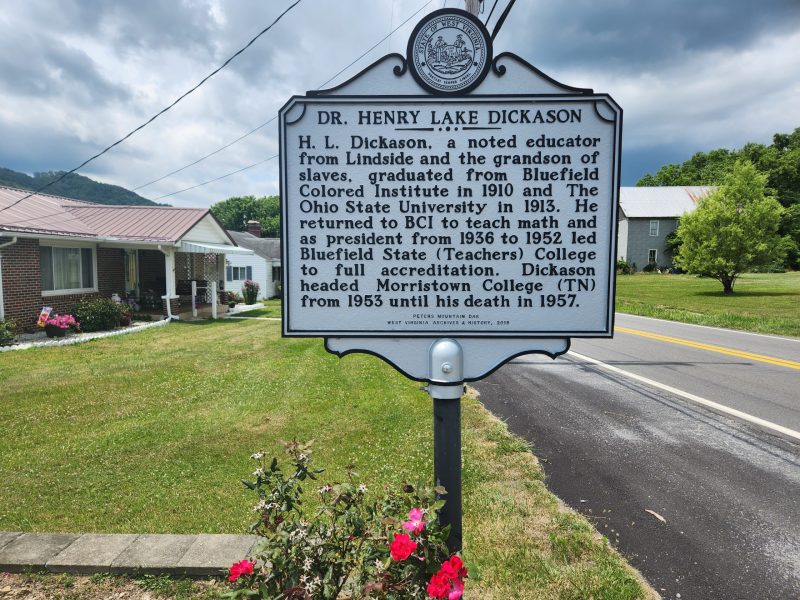
When he retired from Bluefield State, Dickason attempted to live a quiet life on the old family farm in Lindside, but he just couldn’t do it. He and his second wife, Flossie, moved to Tennessee where he assumed the presidency of Morristown College. The college has long since been closed, its campus now a shell, but Becky Crabtree and a group of her friends felt deeply compelled to travel there, to pay their respects to Henry Lake Dickason. “The school is beautiful, made from bricks fired by enslaved people in an oven just behind the school, built on ground that once auctioned off people, so you know, the feeling is there,” Crabtree reflected.
Crabtree also discovered Henry Lake Dickason’s name in A Beautiful Mind, Sylvia Nasar’s book about Nobel Prize winner John Nash, of Bluefield. Dickason served on the draft board in Bluefield during World War II. He was instrumental in getting Nash a student deferment, without which he perhaps couldn’t have completed his high scholarship in mathematics.
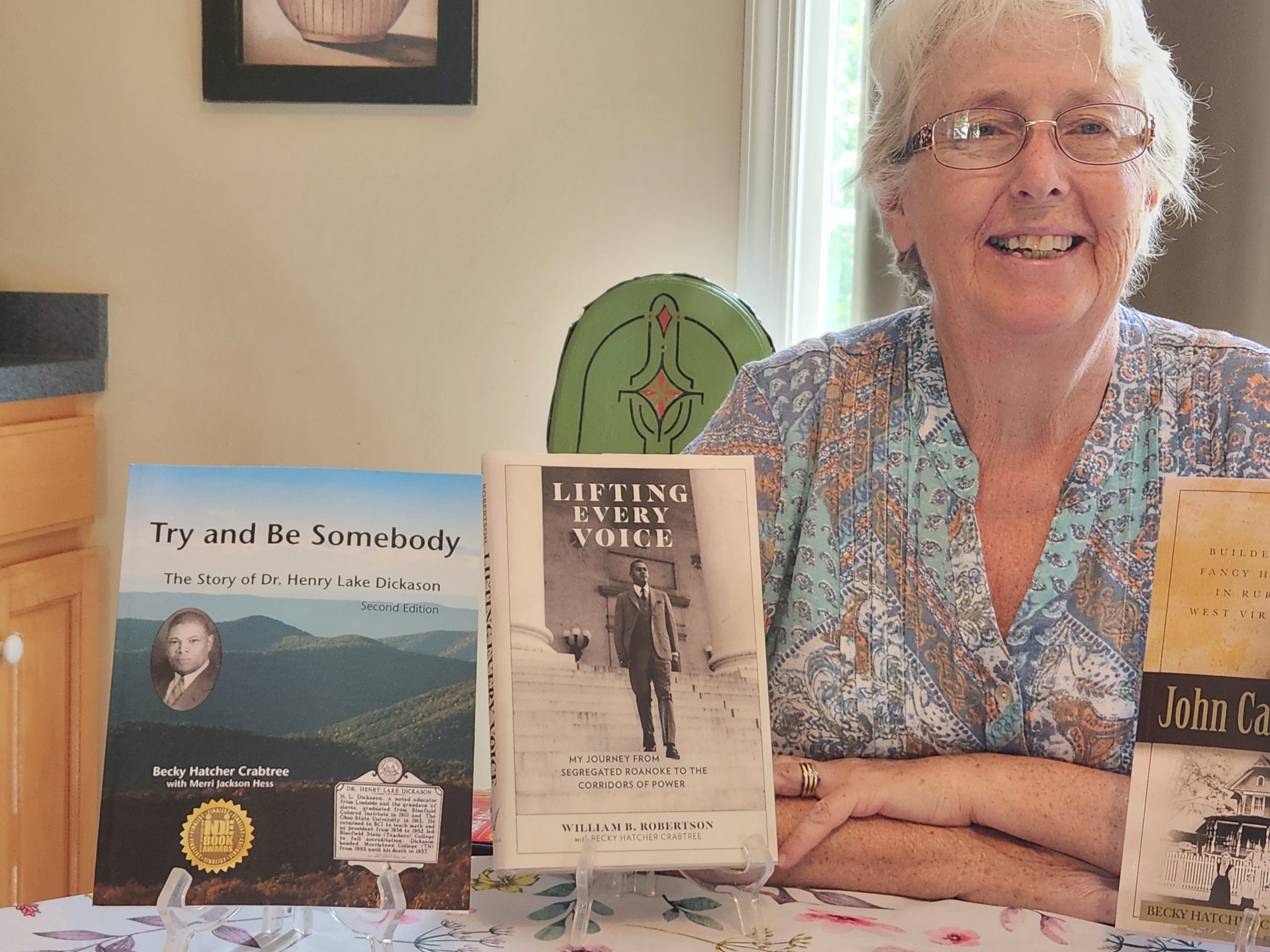
Crabtree’s intense, prolific work on Henry Lake Dickason culminated in her book Try and Be Somebody: The Story of Dr. Henry Lake Dickason (with Merri Jackson Hess.) That work also brought her into conversation and friendship with the next central figure of her historic work, William B. Robertson.
Robertson served as one of Crabtree’s sources on her book about Dickason. Crabtree met Robertson late in his life when she attended the dedication service when the college named their library after Robertson, their esteemed alumnus. “He wanted me to be sure to bring a copy of the Dr. Dickason book for his library, to make sure they had one,” Crabtree said with a laugh.
After the dedication, she continued, Robertson motioned for her to come out and talk to him. A librarian captured the moment forever in a photo: “He was asking me what I knew he was going to ask me, because he had hinted at it several times. I knew what I was going to say. I had my answer all ready. I was in the middle of another book. I was coaching. I was teaching. I was going to decline…I couldn’t do it. I was just spread too thin. And he asked me. And he took my hand. And he looked at me. And I don’t know why it came out of my mouth but I said, ‘It would be an honor.’”
Thus, Becky Crabtree worked with William B Robertson on his memoir, Lift Every Voice and Sing: My Journey From Segregated Roanoke To the Corridors of Power.
Robertson became the first black person to serve on the staff of a governor of Virginia when he accepted a position with Governor Linwood Holton. Holton, a pro-Civil Rights Republican walked hand-in-hand with his daughter, Anne, as they ambled to the integrated school she attended. Some counties in Virginia shut down all their schools rather than change to come into compliance with the Supreme Court ruling in Brown Versus Board of Education, the 1954 ruling that said segregated schools are unconstitutional. The governor’s little girl Anne would go on to marry U.S. Senator Tim Kaine, who was the Democratic nominee for the Vice Presidency, as Hillary Clinton’s running mate in 2016.
Robertson served in the administrations of five U.S. presidents, Crabtree noted. “In the end, he was staying alive to finish our book. He never got to hold a copy, but he knew it was done. He died ten days after we finished it,” she said.
Years after her work on Henry Lake Dickason and William B. Robertson have been completed, published and received with acclaim, Becky Crabtree continues her research and writing on black history in Monroe County. Recently, she has become passionate about a black cemetery which may be buried many feet below fill dirt in Peterstown.
According to Crabtree, Johnny Carman, a native of Peterstown, contacted Craig Mohler of The Monroe Watchman. Carman, now living in Nebraska, was familiar with Crabtree’s work on the Dickason cemetery and Dickason family legacy. Mohler put him in touch with Crabtree.
“Johnny Carman grew up in the Orchard section of Peterstown. He walked through a cemetery everyday in the 1940s going to Peterstown High School. It’s a vacant lot now,” Crabtree said. “Johnny Carman and his brother remembered that cemetery being filled with the tombstones of enslaved people.” Crabtree said that Carman told her he also remembers black women decorating that cemetery every Decoration Day, now Memorial Day.
Concerned that the very land he and his brother remember as a black cemetery is now a vacant lot, Johnny Carman asked Becky Crabtree to research and find out what happened. “We had Virginia Tech come in and scan the lot. The results weren’t conclusive, but they showed anomalies. Then we learned that when the street was built, Givens Street, all the fill-dirt went to that lot, on top of the graves,” Crabtree said. She reported that she and other people who have joined her in the project have tried employing underground scanning technology to prove the graves are there, but those too are inconclusive. Crabtree believes the graves have probably sunk lower than the depths the scanners can reach.
As a new strategy, today Crabtree collects statements from elderly people who remember the cemetery, just as Johnny Carman remembers it. Ultimately, Crabtree says, she hopes a historic marker can be erected on the ground where the black cemetery once stood, where now the graves of enslaved people and their children exist invisible, buried under tons of dirt from road construction.
From the lost cemetery to a remarkable family of slaves whose descendants included an educator whose positive influence molded both a Nobel Prize laureate and a man who worked for presidents, Becky Crabtree the science teacher returns to words employed by dreamers and poets. “The past is full of magic and mystery. Maybe someday we can explain it all. But the things that defy science are as beautiful.”