
SUNDAY SERMON: Corrective Conversations
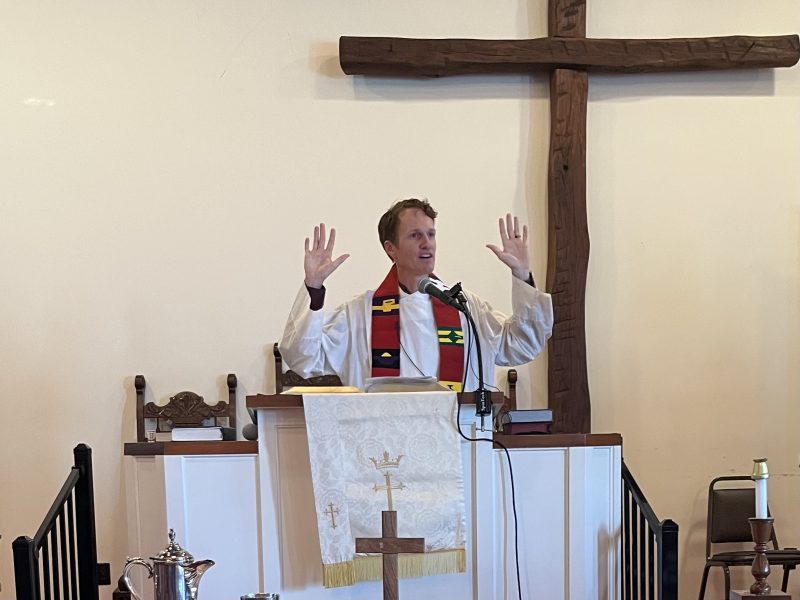
By Rev. Stephen Baldwin
OT: 2 Samuel 11:26 – 12:13a
Getting caught red-handed doing something you know you shouldn’t do is bad. When your 7-year old is the one who catches you, it’s worse.
So here’s what happened. Our puppy, Rocket, eats everything. Literally everything. He especially likes to steal things out of the trash and eat them. One day this week, I got home after a long day and threw some trash away in the kitchen. Rocket goes right behind me, opens the trash can, steals something wrapped in plastic, and darts outside to eat it.
I hollered, “You little…”, followed by a cuss word, and tell Rocket to stop right there, because I’m afraid he’s going to choke himself. I take it out of his mouth, head towards the trash can, again…and see our 7-year old son with his eyes opened wide as a big grin opens across his face.
“Daddy, did you just call Rocket a…”
And then he said the cuss word back to me.
As Ralphie from A Christmas Story might say, I thought to myself, “Oh fudge.”
Harrison asked me aren’t we not supposed to say words like that? I apologized and told him he was exactly right.
David also got caught red-handed after being a very bad boy. The name I called our dog would actually be appropriate for David considering all the bad things he did of late. In case you don’t remember the backstory, David slept with his general’s wife, had his general killed, and then lied about it.
His friend Nathan cared enough about him to confront him, like Harrison cared enough to confront me, and set him back on the right path. He said, “There was a rich man and a poor man. The rich man had everything he could ever want, including flocks upon flocks of sheep. The poor man hardly had anything, and only one sheep which he raised and was like one of his children in the family. A traveler came to town and they needed to provide him hospitality. The rich man didn’t want to share one of his sheep for the traveler, so he took the poor man’s sheep and slaughtered it for the traveler.”
David was livid. He said to his friend Nathan, “The man who did this deserves to die!”
Nathan replied, “You are the man!” You did the same thing to Uriah and his family. You took his wife and slaughtered him. He was your loyal general. Don’t you see? You are the man!
David then sees the err of his way, admits his guilt, and confesses. He said, “I have sinned against the Lord.”
The thing that amazes me about this scripture is that as brazen and hurtful as David’s sin is, he is blind to it. When Nathan tells him the story about the rich man and the poor man, it’s obvious from the outside that David is the rich man who did wrong. It’s obvious to everyone, except David. He honestly doesn’t see it. He is blind to his own sin, were it not for his friend Nathan who is brave enough to confront his friend.
Isn’t that true for all of us? We can be blind to our own sin. One time I was playing in a golf tournament early one morning. There was a thick fog, so thick you couldn’t see where your ball went once you hit it. My shot felt good and it sounded solid, so I walked right down the middle expecting to find my ball in perfect position. Ten minutes of searching later, I found it 40 yards right. I once was blind, and now I see…my ball right behind a tree.
It’s a lot easier to point out the faults of others than to address our own. This story teaches us the importance of surrounding ourselves with Nathans and Harrisons, people with whom we can have corrective conversations. We all need that. We all need someone who can show us the err of our ways, in love and in truth.
Because entering the space around someone else’s sin can go very badly. Sometimes when we see someone doing wrong, we may want to try and manipulate their sin for our own agenda. There’s a word for that these days. It’s called gaslighting. It’s a form of manipulation where a person will cause another to question what is true and what is real. Nathan could’ve used David’s sin for his own good, to gain a favor from the king or a position of importance. But he chose the noble way.
Sometimes when we have a hard thing to say, we are tempted to either use it to our advantage or say nothing at all. Neither does any good, though. If we have a hard thing to say, we should say it softly. In love. In truth. Just like Nathan did.
It happens to all of us. Sometimes we say something in front of our kids we tell them they can’t say. Sometimes it’s more serious, and we do things like David that are completely out of character. Either way, we pray for enough self-awareness and good friends to lead us to a place of repentance. Amen.