After Legislative snow day, lawmakers hear updates regarding class sizes, adult education programs
By Matthew Young, RealWV
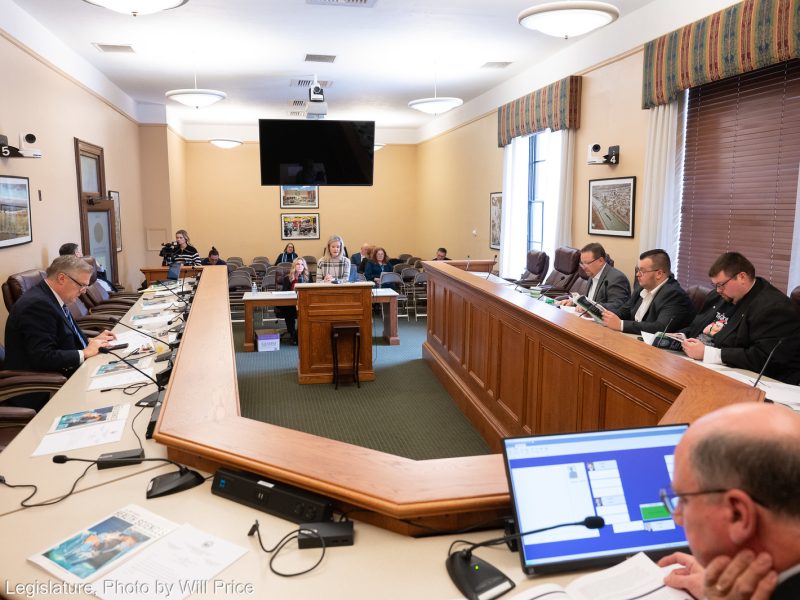
CHARLESTON, W.Va. – Lawmakers got back in the swing on Tuesday, after a statewide snow day pulled the plug on the first day of January’s interim session. And while West Virginia’s school children may have enjoyed the afternoon out riding in a wonderland of snow, the Legislature’s Oversight Commission on Education Accountability (LOCEA) was busy being updated on class sizes, staffing needs, and adult learning programs.
According to Dr. Sonya White, deputy superintendent with the West Virginia Department of Education (WVDE), as of the 2023-2024 school year, class sizes are “pretty close” to what they were the previous year. The update White provided, she further explained, tracked student-counts within mathematics and reading/language arts classes, for grades seven through 12.
“In the reading/language arts numbers, we saw a slight increase in the average class size,” White said. “Less than one student from last year.”
For mathematics, White said, the average class size is between 15 and 18 students, once again noting that, “This is pretty close to what we had last year.”
Shifting topics then toward staffing, White provided commission-members with an overview of the critical needs shortage report.
“During the last school year, we had 234 retired teachers employed as substitute teachers in areas of critical need across the state, in 49 counties,” White said. “Additionally, 22 of those counties adopted policies to utilize retired bus drivers as well.”
According to White, as these retirees are employed within “critical needs areas,” they are permitted by state code to work beyond the standard 140 days, with no impact to their retirement benefits.
“We are thankful that 300 of our retired teachers are assisting us in the classroom,” White added, before noting that the current state code which allows retirees to staff critical needs areas is set to expire on June 30.
“We would request that the statute be amended to allow for the continued use of retired teachers and bus operators,” White said.
Next before the commission was Mendy Marshall, director of the Office of Adult Education within the WVDE, to discuss the Adult Education Taskforce report.
“The taskforce that was created to represent the various aspects of our adult education community, and some of the workforce that is supported by the adult education centers,” Marshall explained. “Clinton Burch led this taskforce on my behalf. They had their first meeting in June and finished their report in October.”
“I think it’s important to note […] that the students that this program serves, it is available to our adult learners at no cost, and it’s individualized, in many cases, to meet the career path that those students are trying to pursue,” Marshall added.
According to Marshall, 873 adult learners have thus far earned high school credentials, with 4,534 adult learners earning industry-recognized credentials.
“We have a lot of people going into the adult education to get those industry-recognized credentials so that they can pursue employment,” Marshall said.
The last item before the commission was a presentation of the 2024 WV Health Sciences and Rural Health report, delivered by Jordyn Reed, administrator, Center for Nursing, HEPC, CTCC.
“Among the state’s three medical schools, collectively they have enrolled 381 students in their first year of classes,” Reed told commission members. “Of those 381 students, 168 were in-state students. This is an increase of 30 students from last year’s data.”
According to Reed, at under an average of $35,000 per year, in-state tuition is still “among the most affordable in the nation.” Licensure passage-rates on the first attempt for the state’s three medical schools, Reed added, remains “at or above 94%.”
“Medical school indebtedness among the programs – for West Virginia University was $185,000, for Marshall University was $189,000, and for the Osteopathic School was $242,000 for the class of 2024,” Reed further noted. “For the graduating classes of 2014 through 2019, who have now completed residency training, 22% of them have been retained to practice in West Virginia – 12% are practicing in primary care, and six percent are practicing in rural areas of the state.”
Location of a student’s residency, Reed added, often influences where they will choose to practice after completing their training, noting that, “Upon completing their residencies, 77% of those who completed in-state residency were retained in West Virginia to practice, while only seven percent of graduates who have completed out-of-state primary care residencies returned to West Virginia to practice.”
The next Interim Session is scheduled for February 9 – 11, with the Regular Session set to begin on Wednesday, February 12.