Death Penalty bill moving forward in West Virginia Senate
By Autumn Shelton, RealWV
CHARLESTON, W.Va. – A bill that would partially reinstate the death penalty in West Virginia is moving forward in the Senate.
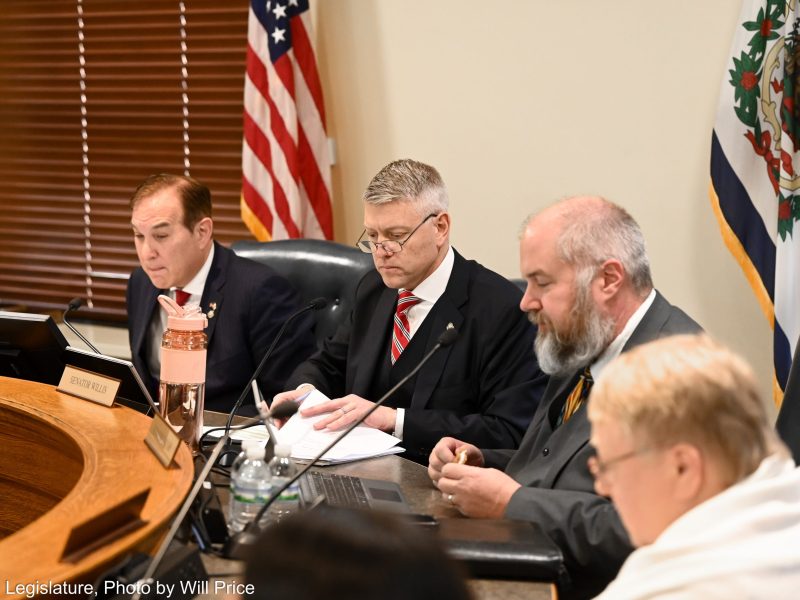
On Thursday, the committee substitute for Senate Bill 264 was passed by members of the Senate Judiciary Committee, with one amendment. The bill would repeal the current statutory prohibition on the death penalty in West Virginia and add eleven new sections to West Virginia State Code.
According to the bill, which was introduced on Feb. 12 by lead sponsor Sen. Mike Stuart, R-Kanawha, if a person is convicted of first degree murder in the intentional killing of a law enforcement officer or first responder, while he/she is serving in their official duty, that person would face the death penalty. Current West Virginia Code states that a person found guilty of first degree murder faces life incarceration.
The bill sets forth two sentencing procedures in death penalty requirements. Those are procedures for jury trials and for non-jury trials and guilty pleas.
In a jury trial, if a person is convicted of the first degree murder of a member of law enforcement or first responder, the jury must determine if the person “shall be sentenced to death or life imprisonment.”
Before imposing a sentence, the jury must be instructed to consider aggravating circumstances, such as if the victim was a law enforcement officer or first responder and “intentionally” killed in the line of duty. Also, a “finding of aggravated circumstances may not be based on circumstantial evidence but requires some physical evidence, such as forensic DNA evidence, or an uncoerced confession,” the bill states.
The jury must also consider mitigating circumstances, such as if the defendant was under “extreme mental or emotional disturbance,” was 17 years old or younger, or if the defendant’s participation in the murder was “relatively minor.”
“Aggravating circumstances must be proved by the state beyond a reasonable doubt. Mitigating circumstances must be proved by the defendant by a preponderance of the evidence,” the bill continues.
In the event a jury cannot reach a unanimous decision, the court must sentence the defendant to life imprisonment, according to the bill’s text.
For non-jury trials and guilty pleas, “the sentencing proceeding shall be conducted before a jury impaneled for that purpose unless waived by the defendant with the consent of the state, in which latter case the trial judge shall hear the evidence and determine the penalty in the same manner as would a jury.”
In any case where the death penalty is imposed, the West Virginia Supreme Court of Appeals shall automatically review the sentence.
The bill allows for the Department of Corrections to create rules defining the method of execution, including lethal injection and firing squad, and noted that the execution must be carried out in West Virginia.
A fiscal note attached to the bill, states that approximately $25 million would be needed to construct a 75-person death row facility in the state.
In response to questioning by Sen. Stuart, committee counsel stated that 21 law enforcement officers have been murdered in West Virginia since 1980.
Sen. Ryan Weld, R-Brooke, made an amendment to the bill that clarifies that aggravating factors must be proven before the death sentence may be imposed. He also stated that he will work on an amendment that would provide executive clemency (granting the governor power to provide pardons or commutations) and have it ready before the bill reaches the Senate Finance Committee.
Assistant Minority Leader Sen. Joey Garcia, D-Marion, said that he was surprised to see a death penalty bill move forward in the Senate.
“One of the things I’ve been proud of as a West Virginian . . . I’ve always thought, ‘We don’t have the death penalty,’ because I think our morals and our values have aligned that it’s not the right thing to do for the state to put somebody to death,” Garcia said. He added that he believes this bill “is morally repugnant.”
“This is a bill that has been introduced for a long period of time . . . every year you’d see this bill would come up and I’ve never seen it run,” Garcia said. “I’m a little bit shocked.”
He continued that, although the bill has been “narrowly tailored in this instance,” his fear is that it could “just be the beginning” and expand.
Garcia ended his comments by stating two words, “Fred Zain.”
According to WVU’s WV Innocence Project, Zain was a forensic scientist employed in the serology department in West Virginia’s State Police forensic lab in the 1970s and 1980s. However, it was discovered that he lied about his credentials and manipulated evidence, ultimately sending hundreds to prison.
Majority Whip Sen. Jay Taylor, R-Taylor, also provided comments during the meeting.
Taylor said that he spoke to his pastor prior to the committee meeting, wanting to know the correct thing to do.
Taylor stated that his pastor provided him with the quotes that guided him toward his decision: “It is a life for a life,” and “If it wasn’t for the sentence of death, the thief on the cross would have never been saved.”
“So, Mr. Chairman, I am a yes vote today on this,” Taylor stated.
Stuart concluded the meeting by stating that law enforcement officers in West Virginia need support.
“First responders face extreme challenges in the field today,” Stuart said. “We see across the country, and even here in West Virginia, like never before. . . . They need to know, I believe, that these public servants, who serve the public so selflessly on our behalf, that we hold them in such regard that those folks who knowingly and intentionally place them at death and remove them from their families and their communities and their public service – that is the most heinous of crimes.”
Senate Bill 264 is now headed before the Senate Finance Committee.