
Morrisey lobbies legislature to pass ‘Power Generation and Consumption Act’
By Autumn Shelton, RealWV
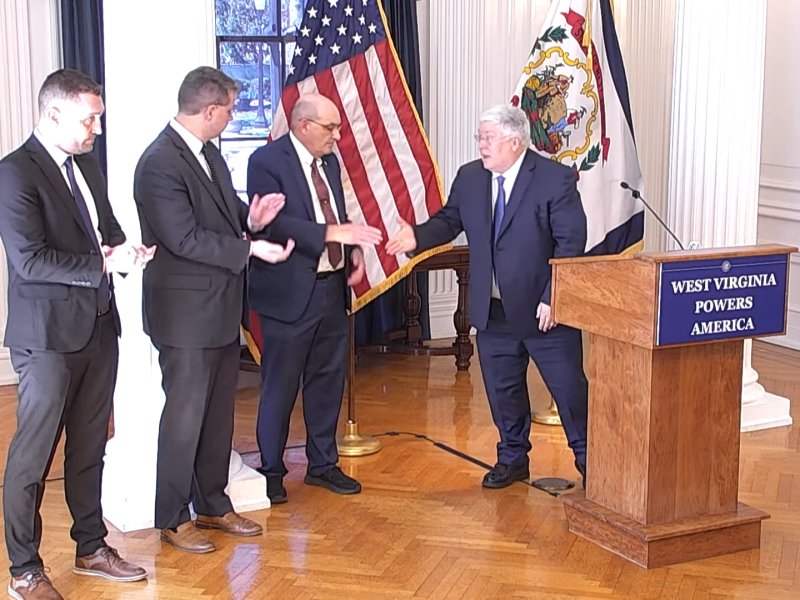
CHARLESTON, W.Va. – Governor Patrick Morrisey held a press conference on Tuesday, where he asked members of the state’s legislature to pass House Bill 2014 – the Power Generation and Consumption Act of 2025.
Morrisey first discussed this possible legislation during his State of the State address back in February.
At that time, Morrisey stated, “Right now, there is a ferocious competition going on between the United States and China. The winner will be the country which powers the enormous data needs of tomorrow.”
He reiterated those comments once again on Tuesday.
“China already generates half of the world’s coal-fired power, which gives it a huge advantage in the arms race for computing power and intelligence,” Morrisey said. “America is going to have to find a way to dramatically increase its power footprint or China is going to eclipse our nation in a technological battle that determines our national security. West Virginia is going to play a critical role in this competition.”
Because of the state’s abundance of natural resources like coal, natural gas, oil and water, and room for infrastructure, Morrisey said that West Virginia is a prime location for the expansion of microgrids for data centers, artificial intelligence processing and cloud computing.
“A microgrid is a self-contained power network that operates separate from the main power grid,” Morrisey explained. “Right now, the West Virginia Code allows for two microgrids in the entire state. Our bill seeks to change that, and to accommodate the demand of the data centers that are so desperate to be hooked up to get closer to the power source.”
Additionally, Morrisey said that current law requires those microgrids to be powered by renewable energy sources, but that requirement will go away with this bill.
“West Virginia will be the most attractive state in the country for data centers after this bill is passed,” Morrisey said.
Joining Morrisey were Senate President Randy Smith, R-Preston, House Speaker Roger Hanshaw, R-Clay, and House Majority Leader Pat McGeehan, R-Hancock.
Smith began by saying this has been a “team effort.”
“We’ve worked hard to change the business climate in West Virginia, the regulatory climate, and tort reform has been a plan that has taken several years to get together. But, this proves today that it’s working and West Virginia is on the grow,” Smith said.
Hanshaw added that members of the House are “happy to participate in any conversation” on how to make West Virginia an energy leader.
“We drilled the first gas well in America here in West Virginia. We tamed the rivers that turned sawmill blades in West Virginia since before our state became a state and we’re proud of that history, but we’re also excited about our future,” Hanshaw stated. “We’re excited about how we utilize energy, as the Governor’s discussing here, in collaboration with our partners in industry, in energy production, in higher education, in manufacturing, in the 21st Century economy at large to grow new job opportunities here in our state.”
McGeehan said he was excited for this policy.
“I’m just really excited for this particular policy because it has a chance to open up and develop more of the vocational trades for our youth. I think that’s something that’s been lost and we really need to push going forward because, you know, vocational trades can sort of develop what’s been the old classical forgotten virtues like self-control and temperance.”
In a press release issued by the Governor’s office following the press conference, it stated that the Power Generation and Consumption Act of 2025:
- Allows any plant or facility to participate in the business expansion development program.
- Removes the requirement that microgrid development districts be located on certain lands.
- Eliminates the requirement that electrical service to business development districts be generated from renewable sources.
- Regulates the production of electricity within microgrid districts to foster new energy production while protecting longstanding utilities.
- Provides for the certification and regulation of high impact data centers.
- Reapportions tax revenue to reinvest in West Virginia.
- Establishes the Electronic Grid Stabilization and Security Fund.
- Establishes the Personal Income Tax Reduction Fund.
- Requires the Public Service Commission to take steps to future-proof West Virginia’s grid.
According to Morrisey, this legislation, if passed, would help provide the state’s residents with the lowest income taxes of surrounding states as part of the “Backyard Brawl” initiative.
Additionally, Morrisey said that as revenue begins to enter the state as a result of this legislation, after county excess levy’s are addressed, 60% of the revenue would go into the Personal Income Tax Reduction Fund, 15% would go into the Economic Development Closing and Promotion fund, which does not currently have a dedicated revenue stream, 15% would go toward the Electric Grid Stabilization and Security Fund and 10% would go into the state’s general revenue fund.
Morrisey concluded by stating that this new policy would be “an incredible opportunity” for the state, and he encouraged swift passage through both chambers.
“This is our chance, let’s take full advantage of it,” Morrisey said.
House Bill 2014 is currently pending in the House Energy and Public Works Committee. It was introduced on March 18.