Gov. Morrisey signs Power Generation and Consumption Act of 2025, says West Virginia is ready to “Win, baby”
By Autumn Shelton, RealWV
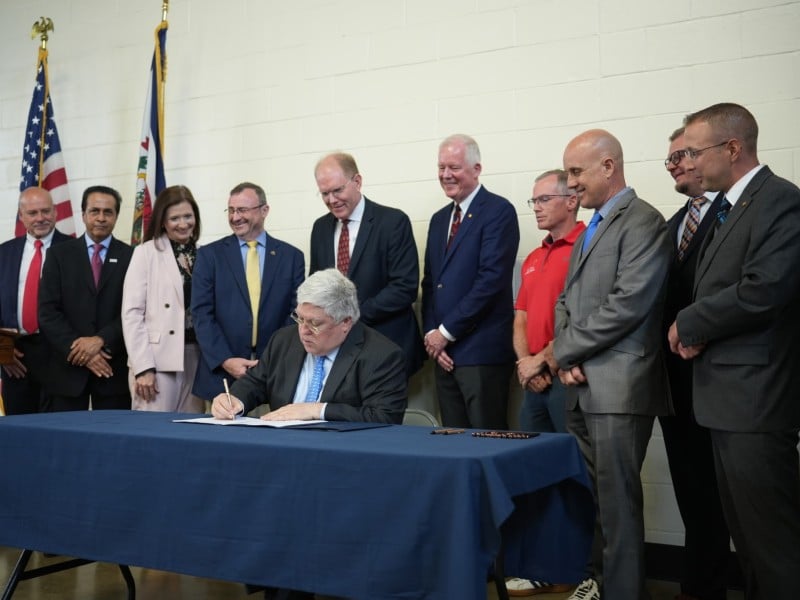
POINT PLEASANT, W.Va. – On Wednesday, Gov. Patrick Morrisey signed House Bill 2014, also known as the Power Generation and Consumption Act of 2025, into law. This bill, requested by the Governor, will allow for the expansion of certified microgrid districts and, ultimately, the construction of high-impact data centers in West Virginia.
During a bill signing ceremony in Mason County, near the future home of the Fidelis Monarch AI Data Center System, Morrisey said that this law will show the rest of the nation that West Virginia is “America’s energy state.”
“We’re gonna be leveraging our natural resources in a way you’ve never seen before,” Morrisey said. “And it’s gonna lead to the betterment of our citizens – higher standard of living, more take home pay, broader educational attainment, and West Virginia will be better positioned to compete compared to all the state’s that we touch. This is how we win the ‘Backyard Brawl’ that I’ve been talking about the last couple of years.”
“We are gonna win, baby,” Morrisey said of his ‘Backyard Brawl.’ “We’re gonna win, win, win.”
In addition to providing the state’s residents with future opportunities, Morrisey continued that this law will also increase national security.
“We’re in a very important competition, a strategic arms race if you will, between the United States and China,” according to Morrisey. “The winner of this contest is gonna be the country that powers the enormous data needs of tomorrow.”
Morrisey said that America must increase its coal and gas power generation or China will “win the technological battle that will determine our future.”
“[West Virginia] has a lot of competitive advantages,” Morrisey added, citing reasons why the state is well-positioned to play a key role in the technological battle. “We have abundant resources like coal and natural gas and water. We have strategic locations for data security, like where we are today. We have a regulatory framework that’s gonna be second to none. We’re gonna cut red tape more than any other state in the country.”
Additionally, Morrisey said that this law has the power to transform West Virginia’s financial future.
“If revenue comes in, and at even conservative estimate, we have an ability to lop off a large percentage of our state’s income tax,” Morrisey said, adding that time will tell.
“This is a once in a generation opportunity,” Morrisey continued. “I think it’s gonna drive economic growth and manufacturing and bring a lot of high-skilled jobs into the state. It’s gonna strengthen our economy . . . and there’s a dedicated economic development portion . . . five percent of the total revenues. We’ve always needed a dedicated economic development revenue source. This is gonna provide that.”
According to the bill, which sets forth property tax distribution rules for microgrid districts and data centers, “In each year for which there is a positive tax increment, the State Auditor shall remit that portion of the ad valorem property taxes collected that consists of the tax increment” as follows:
- 50% of the increment shall be placed in the Personal Income Tax Reduction Fund
- 30% of the increment will go to the county or counties in which a high-impact data center, subject to property tax, is located
- 10% of the increment will go to all counties on a per capita basis according to the most recent census
- 5% of the increment will be placed into the Economic Enhancement Grant Fund which will be administered by the Water Development Authority
- 5% of the increment will be placed in the Electric Grid Stabilization and Security Fund.
The law also prohibits the regulation of microgrid districts and high-impact data centers by local county or municipal jurisdictions. This includes any local ordinances regarding “county or municipal zoning, horticultural, noise, viewshed, lighting, development, or land use ordinances,” and “county or municipal building permitting, inspection or code enforcement.” The owner or operator of a certified microgrid district or high-impact data center must pay municipal business and occupation taxes, sales and service tax, ad valorem property tax, and any utility rates and fees.
“Right now, we have a lot of data centers calling up indicating that they are interested in West Virginia, and they’re looking at our bill as a model,” Morrisey said. “While I can’t share all of the names, because some of these are confidential conversations, I can tell you this – these are big companies. They have a lot of investors and, boy, are they interested in West Virginia. This is how we rise. This is how we fuel our comeback story.”