Greenbrier County lawmakers discuss legislative session that ‘never got in the groove at all’ during town hall meeting
By Sarah Richardson, for RealWV
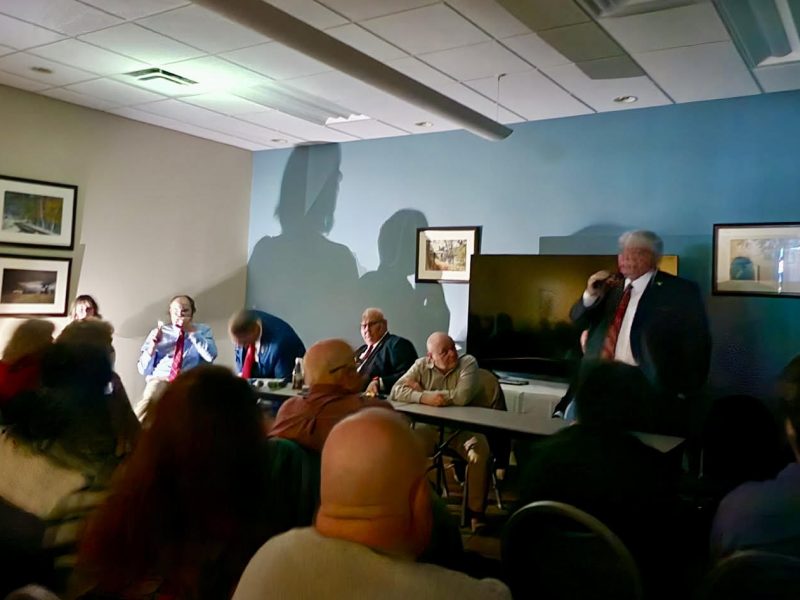
The Greenbrier County Republican Executive Committee, on Tuesday, hosted a Legislative Town Hall at the Greenbrier County Convention and Visitors Bureau. More than 70 residents gathered in the CVB’s conference room to hear from local Republican lawmakers, including State Senators Vince Deeds and Jack Woodrum, along with Delegates Jeff Campbell, Ray Canterbury, and Tom Clark.
Republican Executive Committee Chairman Ben Anderson served as moderator for the evening, reading questions submitted by audience members. For the first question, representatives were asked to highlight one of their favorite accomplishments of this legislative session.
Deeds stated that Lauren’s Law getting signed into state law was a notable achievement. The legislation, which increases penalties for drug trafficking offenses involving fentanyl and other deadly substances, was named in honor of Lauren Cole, a 26-year-old Morgantown resident who died after unknowingly ingesting drugs laced with fentanyl.
Campbell noted that the voter ID bill being signed into law was critical for having “safe, protected elections.” Del. Canterbury focused on the economic side of the session, stating that the controversial microgrid bill was a significant piece of legislation for the state, explaining that the potential tax revenue relating to this bill could be “hundreds of millions of dollars.” Del. Clark focused on Senate Bill 199, which gives teachers the authority to remove violent or disruptive students from the classroom.
“The only thing is, we’ve got to make sure that we have enough alternative schools and facilities to put those kids in, because they deserve an education too,” Clark noted.
Sen. Woodrum reiterated that a “number of bills” dealing with election integrity were critical to protecting future elections in the state, explaining that lots of work went into coordinating the legalities of updating those laws. He also noted the microgrid bill could be “transformative” for the state’s economic future.
The second question related to federal funding, stating, “40 to 45% of the budget for the state of West Virginia comes from federal funding. What is your plan to replace lost revenue and support food programs and medical clinics, especially those in rural areas?”
“Ultimately, I think there will be some adjustments to the federal funding,” answered Sen. Deeds, “The state is prepared to fill those gaps. Of course, there will have to be supplemental spending, because we cannot predict where those shortcomings are going to be.”
He encouraged everyone to pay attention to the Special Sessions, stating that they “always have supplemental spending in them.” Mentioning food pantries, he said you’d be surprised at how quickly the Blessing Boxes in the area are emptied, saying there is a lot of untalked about need with food insecurity.
Clark, who represents all of Webster County, and as he describes it, “the poor part of Nicholas, and the very poor part, in my opinion, of Greenbrier County, the western part,” said that, as of now, the food banks in his region “have not been affected yet” by the federal funding cuts. He added that they do have the ability to act under law to replace some of that money, but he encourages the public to contact their U.S. Senators and Congressional representatives to “let them know how important that is.”
“We did send a letter asking the federal government to revisit some of those cuts,” explained Canterbury, “and the President’s comments suggest that they may very well do that, may very well take a second look at some of those.” He explained that the budget is structured to start with “base budget” and certain discretionary items, but they also have a surplus at the end of each year “around $60-80 million dollars, and that’s to cover shortfalls and things that come up like this later.”
Woodrum explained that a special session is called by the governor, and “we don’t get to add to” the agenda for those special sessions. He encouraged phone calls to the governor’s office to state what you’d like to see addressed at the special sessions, because “we’re really not allowed to add to that, under the constitution.”
Another question touched on the vaccine exemption bill: “The legislature, in its closing hours, voted against certain vaccination exemptions. The Governor defiantly issued an executive order to allow for religious or philosophical exemptions, he then doubled down saying that he has no intentions of rescinding this order. What will each of you do to address the Governor’s actions relating to vaccination exemptions?”
In the middle of the question, a county-wide power outage occurred. However, with the help of several flashlights and cellphones, the town hall was able to continue..
“I don’t think the legislation that was brought forward was the way to address it,” stated Sen. Woodrum. “I think it needs to happen with having a medical exemption process in place that actually works, and reporting that works. Currently what we have in place does not work, and has never worked.” He said he believes that the focus should be on “true medical exemptions,” and said that polls show that “68-70% of the people want the current vaccine policies in place.”
Sen. Deeds said that in his tenure, they have discussed vaccines every year. When it
comes to medical exemptions, he expressed his belief that an effective medical exemption should be easy to obtain, but “unfortunately, it always gets lost in the conversation with religious exemptions, which, whether you are for them or against them, there is a constitutional issue with religious exemption.” He explained that the constitution states that the government cannot set up any kind of religious test “for anything.”
“All five of us up here voted ‘no’ on the vaccine bill,” explained Del. Campbell. “I think if it had just been a medical exemption, I agree with Vince, I think it would have passed easily.”
Campbell voiced concern for measles outbreaks elsewhere in the country, and said that he received feedback from constituents in Greenbrier County “overwhelmingly” in favor of keeping the current vaccination policies.
Another question asked how economic growth could be facilitated by collaboration between the legislature, businesses, educational institutions to provide high-paying jobs in the district. Deeds said that in the last few days of the session, they passed a microgrid bill. Microgrids, which are independent energy systems and electrical networks that can be used to help power data centers and other tech systems, will now be permitted to operate in the state. Deeds said that with the way the bill is set up, we will start seeing the effects in 2027.
“If you have a microgrid data center in your county, the county itself gets 30% of the tax revenue off of that, and 10% from that center goes across all 55 counties in the state.” He stated that a potential $100 billion dollars could be generated from these microgrids. He encourages the public to read House Bill 2014 to learn more, and to call his office with any questions.
Del. Clark said that they did “nothing” for economic growth in the state, aside from the microgrid bill.
“This session was absolutely terrible for economic development in the state,” Clark said. “We didn’t do anything for coal, very little for gas, we didn’t do anything for the private businessman on the streets of Lewisburg or Rupert or Webster Springs, we didn’t do anything.”
He said that legislators need to spend more time out talking to business owners to see what would benefit them the most, a point upon which Woodrum agreed.
The next question focused on the Hope Scholarship program and its impact on public school funding. The questioner stated that each student who uses the scholarship to leave the public school system takes state funding with them, and asked how lawmakers plan to maintain adequate support for the students who remain at public schools, especially with a projected increase in scholarship usage.
“It is a concern, I know, in education committees in both the Senate and the House,” answered Sen. Deeds, who sits on the Senate Education Committee. “The Hope Scholarship now will not have any guardrails on it.”
Deeds said in the future, lessened Hope Scholarship guidelines mean that students will not have to attend public school for six weeks before being eligible recipients.
“There is concern because it’s going to be very expensive very quickly,” Deeds stated. adding that anyone, including high-income families, will be allowed to apply for the roughly $5,000 scholarship. “I think public education, especially in Greenbrier County, you have a wonderful opportunity to get a good education in public schools. We need to balance that out, and we know it’s out of balance. The solution is going to be difficult, but we have to make sure that if we’re going to have public education, we need to fund public education.”
Del. Campbell cited projections claiming that by 2026-2027 the Hope Scholarship could go up to $300 million each year. “I don’t know if that’s something we can continue to afford.” He floated the idea of capping it, similar to the Promise Scholarship. “I believe in public schools, but the Hope Scholarship is here to stay.”
Sen. Woodrum noted that the minimum operating expenses of a school do not change based on the number of students in attendance, and this is a “top three issue” for the state.
The next question asked, “Are there any plans to increase funding and support for the foster care system?”
Canterbury said the House passed a bill allowing foster children to become permanent in a home after 15 months, rather than the current 18 months. However, the Senate didn’t take it up. He agreed that funding needs addressed, saying it’s “one part of a bigger problem” with the rising instances of grandfamilies, or grandparents raising their grandchildren, and states that “collapsing families” are a major issue.
A second part of the question added, “How do you plan to address the shortage of foster families in West Virginia?”
Sen. Deeds said that “a whole generation of parents” was lost to the drug epidemic in the state, and that there are almost 6,000 kids in foster care. He said that it’s “very difficult” to become a foster parent, and that one of his goals is to make it easier for “good West Virginians with the best values in the country” to be able to foster.
The discussion then turned to PEIA, with a question about rising health insurance premiums for teachers and public employees. The question noted that these increases often offset any salary raises and asked lawmakers for their thoughts on how to address the issue.
“We had a 60-day session, and PEIA wasn’t mentioned one time,” said Del. Campbell, who agreed that rising insurance costs need to be addressed. “We’re just going to have to wait and see what the Governor’s going to propose at the special session coming up this summer.”
Sen. Deeds echoed, “We could not believe that we were not dealing with PEIA early on in the session,” adding “it should’ve been a top priority” and “we have to get this right.”
Deeds explained that they asked several times in leadership for PEIA to be addressed, but “it just wasn’t a priority with leadership and the Governor’s office, but it should’ve been.”
A more generalized question followed, asking how the general public can help a bill pass through committee. Overwhelmingly, the answer was to contact leadership, including the chairman of the committees the bill is in, the Speaker of the House, and your local representatives to encourage bills to be placed on the agenda. Showing up in person in Charleston was also recommended, with legislators saying that a face-to-face conversation with one or two people goes a long way.
Next up was a question on the state’s finances, “Why is it reported that the state of West Virginia’s finances are worse now that we have a different Governor? Who is fudging the truth, and why?”
“The Governor presented to the legislature that he inherited a structural deficit,” Canterbury explained. He said the Governor included every funding request within the base of the budget. However, Canterbury noted that the House divided the budget into three parts: the base budget, the back of the budget, and the surplus.
“We produced a budget that was smaller than the Governor’s, and had about a $60-80 million dollar surplus.”
As far as “who’s right” in the situation, “The governor’s wrong, I’ll just be blunt,” Canterbury said.
“The Governor was just completely wrong about this,” Canterbury added, however noting that “there are long term issues that do need to be addressed.”
The next question asked how much progress West Virginia has made in reducing the state income tax or personal property tax, with Sen. Woodrum answering that personal income tax has been reduced 22 percent “in the last few years.” He noted that there is a cushion built in so that the state won’t be in default.
Another question asked, “What will impact the future outcomes for programs for the deaf and hard of hearing, and other disabilities?” Del. Campbell referred to a bill he supported, House Bill 3013, which would have required movie theatres with more than 6 screens to offer closed-caption subtitles on two showings per week, at minimum. It did pass the House, but wasn’t taken up by the Senate. Sen. Deeds said he “wasn’t satisfied at all” with where the legislature left those with special needs.
The second-to-last question asked how the legislature will ensure accountability and oversight within the WV DHHR. “Human Services knows they have a lot of room for improvement,” said Sen. Deeds, and voiced support for the new director of Human Services, Alex Mayer. He added that they are putting a lot of pressure on the Governor’s office, as well, when it relates to DHHR. Del. Canterbury said that there have been complaints from the legislature to DHHR with how they use their funding. “I will tell you this, there has been some informal discussion about, if necessary, putting full-time legislative auditors on-site to keep track of them every single day.”
“It’s very easy for someone to come to the legislature and ask for money for something that everyone is sympathetic to, and as soon as they get their money then they reallocate it to somewhere else in the agency to some project they know we wouldn’t fund,” claims Sen. Woodrum. Seeing where funding is being allocated “is an ongoing project,” on his radar.
As for everyone’s final thoughts on the 2025 legislative session, the answers were overwhelmingly negative. “I wasn’t happy with it, to be quite honest with it,” said Sen. Woodrum. Del. Clark echoed, “compared to last year’s session, it was not good.” He said there was a lot of pressure on certain bills, including the vaccine bill, and overall, “education is in trouble in this state,” and “I personally believe that the Hope Scholarship may break this state if we are not careful with it.” Del. Canterbury describes it as “the single most chaotic session I’ve ever seen,” saying it “went off the rails” with priorities of what was addressed. He stated that while he believes Gov. Morrisey was a great Attorney General, he criticized his availability and accessibility as Governor. “I saw Governor Morrisey one time during the session,” said Canterbury. Del. Campbell said more of the same, “In my five sessions, this was my most disappointing session.” Sen. Deeds agreed, adding, “I think where we came up short was in leadership,” and due to that, “we never got in the groove at all.”