Morrisey signs new well-plugging bill into law
By Autumn Shelton, RealWV
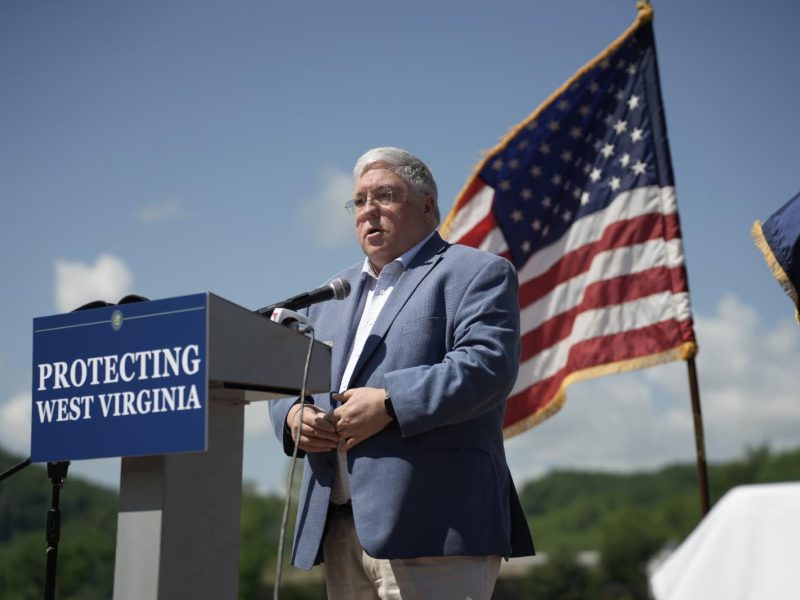
WHEELING, W.Va. – On May 15, Gov. Patrick Morrisey was in Wheeling to hold another ceremonial bill signing – this time for House Bill 3336, which updates state law regarding the plugging of orphaned and abandoned oil and gas wells.
“As the people of Wheeling, and surrounding areas know very well, abandoned and orphaned wells can pose a significant threat and safety risk, and can potentially impact surface and groundwater, drinking water sources, land and air quality,” Morrisey stated. “So plugging these wells safely and effectively is critical to protecting these resources.”
Morrisey continued that West Virginia has about 21,000 documented orphaned and abandoned wells.
“Previously, state code in West Virginia required operators to remove most of the well’s infrastructure before plugging it with cement and other materials, even when the casing was damaged or it would be more difficult to the environment to remove,” Morrisey explained, adding that this new law will allow for “a practical and field-proven method for plugging abandoned and orphaned wells.”
Additionally, Morrisey said this updated law will give well operators more flexibility when managing older wells that may be in poor condition and will lead to an increase in the amount of wells that are plugged.
“This new method, where operators pierce the casing and fill the well with cement, without having to remove the central casing, has been successfully tested in the field, and meets all environmental and safety standards,” Morrisey said.
“Here, today, we can say we are cutting red tape and we’re moving the state forward,” Morrisey noted.
West Virginia Secretary for the Department of Environmental Protection (WVDEP), Harold Ward, added that this new method for well plugging is “not a controversial process.”
“This is the right thing to do, and the right way to do it,” Ward said. “Historically, West Virginia has only been able to plug one to two wells a year because of lack of funding.
During a March 17 House Energy and Public Works Committee hearing on HB 3336, Jason Wandling, general counsel and director of the office of legal services for the WVDEP, stated that one well was plugged in West Virginia using state funds prior to 2022, 14 wells were plugged in 2022, 18 wells were plugged in 2023, and 42 wells were plugged in 2024.
Through the recent influx of federal infrastructure money, Wandling added that 202 wells were able to be plugged in 2023 and 2024.
An additional 200 wells may be plugged this year, but that is dependent upon continued federal funding, he noted.
In 2021, in collaboration with Diversified Energy, an independent energy company founded in West Virginia, the WVDEP began a pilot program to study the method of piercing the casing of abandoned and orphaned wells and filling them with cement in lieu of removing the central casing, Wandling explained.
“We gave them 10 wells to plug using this method to see if it would work, and it did,” Wandling told committee members. “There was trouble with one of the wells, but Diversified was required to go in, correct it, plug it properly again, and it’s now fine. So that pilot project proved to us at least that it’s a success.”
Additionally, Wandling stated that there are about 15,000 abandoned wells and about 6,000 orphaned wells throughout the state as well as 60,000 active wells. There are 15-19 oil and gas inspectors.
The average cost to plug a well ranges from $30,000 – $60,000, Wandling continued, noting that problematic wells can cost considerably more.
During the ceremonial bill signing on May 15, Ward also spoke about the high cost of well plugging and said the state still has “a lot of work to get done” when it comes to plugging abandoned and orphaned wells.
The bill’s lead sponsor, Delegate Mark Zatezalo, R-Hancock, said that it was “heartening” for him to see industry and the WVDEP come together to create an efficient method to protect groundwater.
“I think that’s what we want in this state. I think it is a product of rational thought and moving the state forward,” Zatezalo said.
Related Articles

How 22-year-old entrepreneur Alex DeGraff has built a vibrant life in Appalachia
This story is part of RealWV’s year-long focus on youth and belonging in West Virginia, exploring the difficult decisions young people face when deciding whether to stay or leave.
Real West Virginian of the Week: From India to Appalachia, Madhur Bedre finds home and opportunity in West Virginia
This story is part of RealWV’s year-long focus on youth and belonging in West Virginia, exploring the difficult decisions young people face when deciding whether to stay or leave.