WVSOM hosts successful ‘Bio’ forum, discusses $35 million expansion project
By Dakota Baker, RealWV
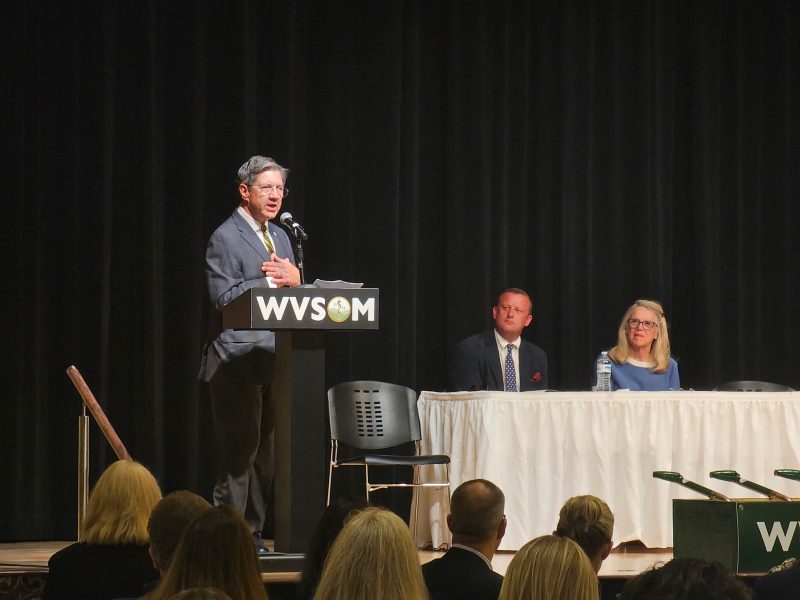
LEWISBURG, W.Va. – The West Virginia School of Osteopathic Medicine (WVSOM) held an economic development forum on Thursday, to discuss the future expansion plans for their Bio Hub. The Bio forum was the first one it has held at the school, and it began with a video message from Senator Shelley Moore Capito, who was unable to attend in person.
Capito stated that the expansion is “really great news,” and that it would benefit researchers, faculty, staff, students, WVSOM, and West Virginia directly. Capito also discussed how the expansion will promote research collaborations, specifically in the area of obesity, diabetes, cancer, and cardiovascular diseases—supporting a healthier West Virginia. Capito used her role in the Senate Appropriations Committee to help secure $6 million in a congressionally directed spending award. She expressed enthusiasm about how the expansion would foster private and public partnerships over the next two years of construction and promote quality care in the area.
Following Capito’s video message, James Nemitz, Ph.D., president of WVSOM, explained why WVSOM was hosting a bioscience economic development event.
Nemitz explained that WVSOM is an “excellent medical school,” and they are very proud of what they have accomplished in more than 50 years in the state, including being the largest medical school, the leading producer of physicians, and the largest provider of rural medical care in the state. According to Nemitz, WVSOM provides quality medical education and quality research, but the WVSOM Bio is not about what they are doing; it is about what others can do at WVSOM, in the Greenbrier Valley, and in West Virginia to improve the bioscience ecosystem in this state.
On Wednesday, WVSOM ceremonially “broke ground” on a $35 million expansion of its Fredrick W. Smith science building to primarily meet the research needs of students, faculty, and staff. WVSOM held this Bio Forum because it sees an opportunity, and they hope others do as well. WVSOM is open to collaboration and partnerships in all areas of interest. Dr. Nemitz stated, “One of the things about WVSOM is we’re a good partner. We say what we do, and we enter into partnerships only wanting the best for this state and our students.” Dr. Nemitz continued by thanking all the legislators who have supported WVSOM and their efforts, and discussing his recent trip to Bio Boston, where he was immersed in the amazing world of bioscience. Dr. Nemitz detailed at Bio Boston that out of 20,000 attendees, WVSOM was the only organization from West Virginia. WVSOM aims to expand bioscience research in our region by doubling the size of its research enterprise and fostering public and private partnerships that will benefit its students and residents of West Virginia by establishing another bioscience point of entry in West Virginia, further developing our current bioscience ecosystem to attract more bioscience companies to invest in West Virginia.
Dr. Nemitz added, “WVSOM plans to establish relationships that evolve into larger opportunities for our region, the state’s division of economic development, Marshall University, WVU, and other institutions that want to work with us. My key takeaway is this. You know, if we work together, the bioscience ecosystem in West Virginia could grow and get stronger. We are better when we work together. Hosting WVSOM Bio with the incredible panelists that we have today, and all of you, are part of that growth. Thank you for being here.”
Dovenia Ponnoth, Ph.D., Associate Dean of Research, spoke next, expressing her eagerness to see how the day unfolded. She stated, “My hope is that each person here leaves with something meaningful, whether it’s a new conversation, valuable information, or the spark of a future collaboration.” She then goes on to say, “You may be wondering why West Virginia? I ask why not? Our state offers affordability for businesses and an environment full of freedom. The low cost of living, housing, family life, and energy, along with the endless, often free adventures in our beautiful mountains, make it a place where dreams can be realized at the pace of your choosing.” Dr. Ponnoth emphasized the vital connection between energy, education, and the future of biosciences in West Virginia. “West Virginia is an energy state, and energy is essential to the future of biosciences,” she said, calling for forward-looking partnerships to drive progress. A proud West Virginia University graduate, Dr. Ponnoth credited the state and her alma mater for recognizing her potential and providing her with a world-class education, prestigious fellowships, and mentorship that shaped her career. “I stand here proudly before you as a testament to that investment made many years ago,” she said. “We asked ourselves, can we do more? Some see opportunities, some see obstacles—and then there are those who see opportunity despite the obstacles. We at WVSOM are firmly in that third camp.” She added, “We said, yes, we can do more. We can do more. We will do more. We look to the future together.”
A video was then shared about the planned expansion and what it offers. In the video, Dr. Ponnoth highlights a new building designed to support advanced research with state-of-the-art labs, shared core facilities (like microscopy, cell culture, and computational sciences), and modern collaborative spaces for students, researchers, and staff. The facility brings together a range of clinical science experts—including pharmacologists, virologists, and microbiologists—as well as researchers studying patient outcomes related to obesity, diabetes, and metabolic syndrome. Current research projects, such as vaccine development and natural product discovery using West Virginia resources, offer strong potential for partnerships with biotech and pharmaceutical companies. The video emphasizes WVSOM’s openness to collaboration and the unique opportunity to build and grow alongside a flexible, forward-thinking institution.
On the panel of speakers, Patrick Plues, Senior Vice President of State Government Affairs and Affiliate Relations at Bio International, was the first to speak. Plues discussed the growth and competitiveness of the bioscience industry in the U.S., highlighting its economic impact and potential for regional investment. He notes that the industry directly employs about 2.3 million people and explains the broader effect on the job market: “For every one person employed directly by the industry, there’s another five ancillary people that are employed doing various things and supporting roles for the industry.” Altogether, the bioscience sector contributes approximately “$3.2 trillion to the U.S. economy.” He also emphasized the importance of location when considering clinical trial investment and spoke personally about his strong ties to West Virginia: “I’m a WV grad, I’m very proud to be a WV grad.” He shares that he worked with a congressional advisor who later became governor, as well as with Mike Fulton and Ryan McGinn, saying, “I have a lot of connections to West Virginia.” These personal and professional ties underscore his interest in seeing growth and innovation in the state’s bioscience landscape as the bioscience industry continues to grow.
The second speaker of the day was Mark Bates, M.D., a CAMC Cardiologist and nationally recognized clinician, innovator, and entrepreneur. Dr. Bates said this project is “very near and dear” to him. He shared an experience from medical school that shaped his journey as an innovator, and he also talked about compassion and how it drives us. Dr. Bates further shared his journey as an entrepreneur in West Virginia, attempting to start his own company, mentioning that the main challenge was finding the engineering talent they needed. “The worst thing than not having the right talent is partnering with the wrong people,” Dr. Bates added. Emphasizing the importance of partnerships and how, if you envision what your future looks like and surround yourself with the right people, you will make it happen. “Innovation is not a science but rather an art that is based on science and fueled by compassion”.
Bryan Brown, Executive Director of the Bioscience Association of West Virginia, spoke next. Expressing excitement, stating, “I applaud President Nemitz, Dr. Ponnoth, Don Smith, faculty, and researchers here at WVSOM for embarking on this initiative to enhance opportunities not only for the students and researchers, but for the benefit of Lewisburg, Greenbrier County, and the state as a whole”. WVSOM is creating the opportunity for life science industry growth here in the region by building this new state-of-the-art facility, according to Brown. Additionally, Brown asked the legislators in attendance to consider passing an extension of the programs that help to fund these vital programs.