Lawmakers hear how the One Big Beautiful Bill will affect Medicaid financing in West Virginia
By Autumn Shelton, RealWV
CHARLESTON, WV – On Monday, West Virginia Bureau for Medical Services (BMS) Commissioner Cynthia Beane told state lawmakers that between 20,000 to 40,000 residents may be affected by new Medicaid work requirements as part of the One Big Beautiful Bill (OBBB).
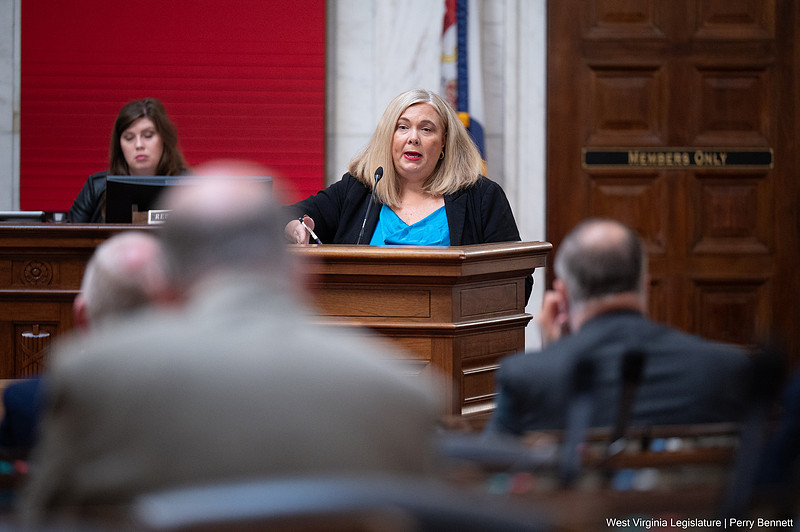
During the second day of legislative interim meetings, currently being held in Charleston, members of the interim Joint Standing Committee on Finance heard from Beane, who discussed provisions in the OBBB, including the new work requirements, that will have the greatest impact on Medicaid in the Mountain State.
According to Beane, there are over 20 provisions in the OBBB that impact Medicaid, but the state already meets some of the requirements, like preventing dual enrollment in Medicaid and CHIP. As a result, the state will not see much of an impact in these areas.
Other OBBB provisions, however, will change the way the state must manage Medicaid, including ensuring enrollees meet work requirements.
All persons between the ages of 18-64, unless they have special circumstances, will be required to work or participate in other qualifying activities, such as volunteerism, for at least 80 hours per month to be eligible for Medicaid, according to the OBBB, which was passed in July 2025.
The new requirements will take effect in January 2027, Beane said.
“Even though the bill does say there is a possibility for CMS (Centers for Medicare and Medicaid Services) to waive the timeline if you’re not ready, CMS has made it very clear . . . there is no good faith waiver. They will be anticipating that you will be ready next January.”
West Virginia Medicaid has started to work on this, and has partnered with WVU Health Affairs for project management and to make sure that systems and technology are ready, Beane explained.
“We are going to follow the model of the SNAP ABAWD (Able-Bodied Adults Without Dependents) program with regards to notices, timelines and making sure that individuals understand what they are trying to report with regards to their work requirements,” Beane said.
“We have approximately 160,000 members on our [Medicaid] expansion rolls,” Beane continued. “We are trying to really, kind of, tweeze out those numbers. We know around 60% of those individuals already have earned income.”
However, Beane said that about 20,000 to 40,000 members will be affected by Medicaid work requirements in West Virginia, and those numbers are currently being looked at.
Another provision that has received a lot of attention concerns state directed payments, Beane said, noting that the state passed legislation regarding directed payments last year.
Answering a question from Del. Matthew Rohrbaugh, R-Cabell, about state directed payments, Beane responded that this is the first year all hospitals have joined the directed payment program.
“That directed payment program went up from $335 million to $1.3 billion that will be given to the West Virginia hospitals this year based on the legislation,” Beane explained, adding that $1.3 billion will start decreasing in 2028 as part of the OBBB.
Beane said that the state will see losses of $35.6 million in 2028, $71 million in 2029, $107 million in 2030, $142 million in 2031 and $178 million in 2032, although funding from the Rural Health Transformation program may help to offset some of those losses, especially for rural hospitals.
“The other thing is that the bill made it clear that we had to have a uniform tax,” Beane said. “We will be running legislation in January around our MCO tax to make it uniform as that tax is currently tiered.”
Only one MCO in the state will have to pay more tax as a result of the OBBB, Beane said. But, discussions with that provider have already taken place.
The good faith waiver for Payment Reduction Related to Certain Erroneous Medicaid Payments is another provision in the OBBB that will impact the state, Beane noted.
According to Beane, PERM (Payment Error Rate Measurement) rates involve errors, such as entering a birthdate wrong or failure to find documentation that a patient received care. The PERM rate in West Virginia has been as high as 15%, but is now down to 3.43%. The OBBB requires that the PERM threshold be under 3%.
“I feel like this is a particular part of the bill that the state needs to pay a lot of attention to,” Beane said. “Because, like I said, it could just be one county worker, stressed, and entering something wrong or something like that could really affect your PERM error.”
“In the past, Medicaid agencies have never had to pay back money because of PERM, there’s always been an opportunity for the secretary of CMS to waive . . . but, starting in 2029, they will no longer have the ability to waive,” Beane explained. “So, if you have a PERM error and we have a high PERM error rate, that could cost the state of West Virginia, potentially, millions of dollars.”
This new provision may require the state to hire additional employees to ensure PERM error rates stay low, Beane added.
Other Medicaid impacts to the state as part of OBBB include:
- Possible system changes and member education to comply with Medicaid recertification reduction from once a year to every six months
- The loss of support for family planning
- A change in retroactive payments for eligible Medicaid members being reduced from 90 days to 30 days
- Cost-sharing caps of $35
Beane also explained the changes in the OBBB regarding Federal Medical Assistance Percentage (FMAP) for emergency Medicaid for undocumented immigrants.
Currently, undocumented immigrants are not eligible for federally-funded Medicaid coverage, but emergency Medicaid will reimburse hospitals for emergency care provided to immigrants in certain circumstances, Beane said.
“Right now, we put them in, if it’s an adult, they would be an expansion adult and they would be at the 90% FMAP,” Beane said. “This will now go down to our regular FMAP, which is around that 75%.”