
SUNDAY SERMON: A little fight with a big implication
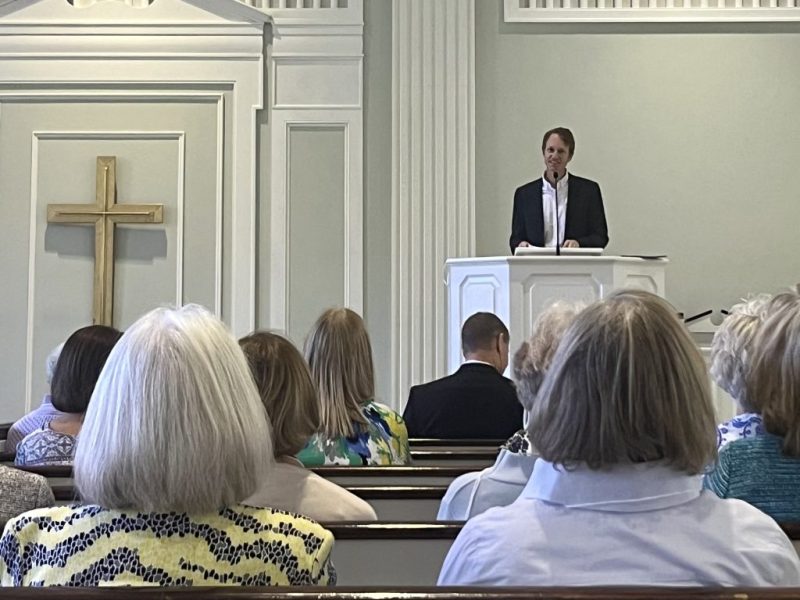
By Rev. Stephen Baldwin
OT: Psalm 98
NT: Luke 20.27-38
Today’s scripture is about a little fight with a big implication. Have you ever gotten in a little fight with a big implication?
It’s like the time this ol’ farmer was sitting in his garage one afternoon, taking a break in his lawn chair. His wife brought him a bowl of ice cream with strawberries on top.
He smiled, thanked her for the ice cream, and then said, “I don’t like strawberries.”
“Since when?” she said.
“Since ever!” he replied. “I haven’t liked strawberries any of the 50 years we’ve been married!”
And just like that, it blew up. Little fight. Big implication.
Today’s scripture follows that same pattern. So let’s dive into the conflict to understand what it’s all about.
Who were the Sadducees? Biblical historian Bart Ehrman says, “During Jesus’ day, the Sadducees were the real power players in Palestine. They appear to have been, by and large, members of the Jewish aristocracy in Jerusalem who were closely connected with the Jewish priesthood in charge of the Temple cult.”
Are the Sadducees and Pharisees the same? No. The Pharisees were religious leaders who used the temple. The Sadducees were the rich landlords that owned the temple. They worked together, often, but they were different and held different beliefs on things like resurrection and free will.
What did they believe about resurrection, since that’s what the fight was about this time? To put it briefly, they didn’t believe in resurrection. Pharisees did. Jesus did, of course. But the Sadducees believed that the dead would never rise again.
What about marriage? Since they believed the dead would never rise, they believed that marriage ended with death. And they wanted to know how Jesus would reconcile marriage and resurrection. If you were married multiple times on earth, who would you be married to in the resurrection? It’s a series of questions meant to make resurrection look ludicrous.
This is what their fight was about in Luke 20. Jesus turns the tables, though, and tells them it’s a ludicrous question to try and make sense of resurrection using earthly categories. He basically says you’re putting earthly categories on eternal matters.
Kind of like asking if the streets of heaven will be paved with gold. That’s not the point. Those things won’t matter in the eternal realm. Because, for Jesus, resurrection changes everything. It ends the threat of final death, which fundamentally changes the way you live.
That was the huge implication of the little fight. It wasn’t really about what happens when we die; it was about what happens when we don’t live. How often do we get stuck in little squabbles that don’t really matter? Jesus’s teaching is meant to free the Sadducees from going through the motions of living. Instead, he invites them to be children of the resurrection. He invites them to be reborn, never subject to death’s little limitations ever again.
Of course, it didn’t go over well. The Sadducees despised Jesus for it. According to the Gospels, Jesus had at least two encounters with them. The one we are reading about today, and the time he turned over their tables. That’s right–when Jesus flipped over the tables, he did it to the Sadducees in protest of them monetizing religion. Then they turned him into Rome, who arrested him. People often blame the Pharisees, but it was the Sadducees who did that.
This was the little fight that had the biggest implication of all, because it led to Jesus’ death on the cross. And the implication of his death, of course, is that death could not hold him. His death was not the end. It was the proof of resurrection.
Leave the little squabbles and disagreements that occupy so much of your time behind. They’re just not worth it. God has a resurrected, hope-filled life in store for you. The implications of that promise are simply astounding. If God intends that kind of life for you, what can hold you back?
Mary Oliver says it so well in her poem, “When Death Comes”:
When it’s over, I don’t want to wonder
if I have made of my life something particular, and real.
I don’t want to find myself sighing and frightened,
or full of argument.
I don’t want to end up simply having visited this world.
You are a child of the resurrection. You cannot die anymore, not in any final sense. You are not here simply to visit. You are here to live for God, full of hope and full of promise. Amen.
Related Articles

Irons & Porter open ‘The Fancy Pheasant’ in Lewisburg
The store is a men’s and children’s clothing and home goods store.

‘Like a dagger’ – Lewis County reacts to Vandalia’s closure of labor & delivery
This is the second labor & delivery unit being closed by Vandalia Health in West Virginia.