Front Porch Conversations: The Campbell’s debacle, a brief history of the USDA, and a good pivot to Chef Boyardee
After the Campbell’s soup 3D chicken printing issue, I’m curious, are we eating lab-grown meat?
Welcome to our Front Porch!
Former Campbell’s Soup Information Technology Vice President Martin Bally stuck his foot all the way in his mouth, allegedly, when audio was released in November of him saying the food was s**t for poor people. In that same rant, recorded by Robert Garza, a former employee who has filed a wrongful termination suit against the company, Bally makes racist remarks toward the company’s Indian workers and suggested the company’s chicken is 3-D printed. Mmm Mmm! Not Good.
When the lawsuit was filed, and the audio was released, Campbell’s quickly went to work to stop the damage to their company’s reputation, and to end any possible boycotting of the company’s products.
Campbell’s issued a statement on November 25 that the remarks made by Bally were “vulgar, offensive and false.” As a result, Bally is “no longer employed by the company.”
They also released a FAQ on where the chicken in their products comes from.
“The chicken meat in our soups comes from long-trusted, USDA approved U.S. suppliers and meets our high quality standards. All our soups are made with No Antibiotics Ever chicken meat. Any claims to the contrary are completely false,” a statement from the company reads.
Well, that’s a start. But, can we trust the USDA if a company says its food isn’t 3D printed?
The United States Department of Agriculture, “The People’s Department,” was founded in 1862 by Congress and signed into law by President Abraham Lincoln. This later led to the first Morrill Act of 1862, which saw the federal government donate public land for the establishment of land-grant universities and “the benefit of agriculture and the Mechanic arts.”
This led to the founding of the Agricultural College of West Virginia, now West Virginia University, and ultimately West Virginia State University through the Second Morrill Act of 1890, which required states to establish separate land-grant institutions for Black students during segregation.
Today, the USDA is made up of 29 agencies, including the Food Safety and Inspection Service (FSIS), the branch that is responsible for ensuring poultry meets guidelines for safety and proper labeling – including Campbell’s soup ingredients.
Campbell’s largest poultry supplier is USDA approved Amick Farms LLC, founded in 1941 in South Carolina.
Ben C. Harrison, President and CEO of Amick Farms LLC, issued a statement shortly after Campbell’s came under scrutiny:
“Founded in 1941, Amick Farms has always been dedicated to supplying quality chicken products to our customers. As the main supplier of chicken to The Campbell’s Company (“Campbell’s”), we are committed to producing wholesome chicken products in accordance with all food safety and regulatory guidelines set forth by the US Department of Agriculture. The chicken meat we supply to Campbell’s is derived from real, antibiotic-free (NAE) birds grown on family farms with whom we contract. This chicken meat is not genetically modified nor is it created via a 3D printer. Quality, integrity and service are the core values of Amick Farms.”
Now, we would be remiss to say that large-scale poultry farms don’t experience their fair share of public outcry over animal welfare and safety practices, and often warrant USDA investigations. But, as far as 3D chicken printing goes, the USDA, as well as the Food and Drug Administration, has approved the sale of lab-grown meat, although cell-cultured meat must be properly labeled. So, it is unlikely that we are consuming lab-grown meat without knowing it.
Additionally, in 2024, in West Virginia, the “Truth in Food Labeling Act,” was passed, setting forth labeling guidelines on “analogue” food products, including “cell-cultured products,” which may provide additional confidence that we aren’t eating lab-grown meat. However, in 2025, Senate Bill 751, which would have banned lab-grown meat from sale, stalled.
We don’t know what the future holds regarding lab-grown meat, but we sincerely hope that “The People’s Department,” remains a steadfast source of trusted agriculture guidelines and keeps us safe and informed.
And now, for our pivot.
We couldn’t talk about canned foods in West Virginia without mentioning the famous Chef Boyardee, aka Hector Boiardi.
As the story goes, Chef Boiardi immigrated to the United States from Italy in 1914. His cooking skills took him all the way to New York’s Plaza Hotel, and he even served for a time at The Greenbrier in White Sulphur Springs.
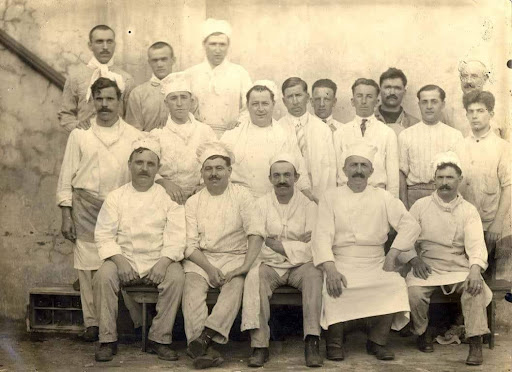
An August 13, 2024 post about Chef Boiardi from The Greenbrier’s Facebook page featured the following image of the famous chef seated second from left, as submitted by Bob Conte.
Who would have thought that The Greenbrier’s Chef Boiardi would eventually move to Cleveland, become Chef Boyardee, and found one of the most iconic brands of our generation?
###
Do you have a question or a topic of conversation? Reach out to us at https://therealwv.com/front-porch-conversations/. Discussions take place over on our Facebook page @TheRealWV.