Utility rates 101: An expert discussion on utility services, utility rates, and who is in charge of them
By Autumn Shelton, RealWV
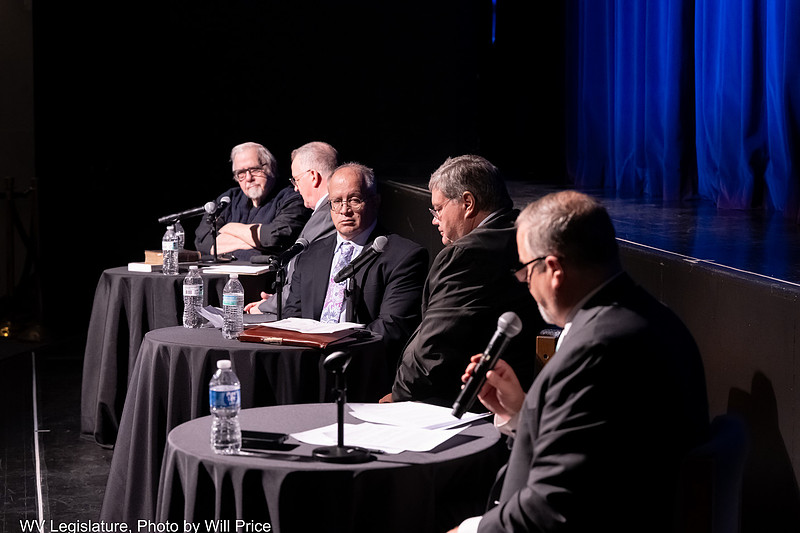
CHARLESTON, W.Va. – On Monday, West Virginia Delegate Clay Riley, R-Harrison, moderated a panel discussion at the Culture Center, which focused on utility services, utility rates, and who is in charge of them.
The expert panel included Michael Griffith, a certified public accountant; John Scalzo, vice president of regulatory affairs and finance for Appalachian Power; James Kelsh, head of Bowles Rice’s Infrastructure and Public Utilities practice areas; and Dave Ellis, a long-time employee of the Public Service Commission of West Virginia (PSC) and expert in regulatory issues.
This discussion ranged from the history of utility rates and how they are determined, to legislative policy impacts.
Ellis began the discussion by providing a brief history of utility regulation.
According to Ellis, public utilities best function as monopolies.
“Many years ago, it was decided that because of the capital intensity of utility companies, and because of the limited geographic nature of their customer base, that competition in utility service was not economical,” Ellis said, adding that this decision to allow public utilities to operate as monopolies also created the need for their regulation.
“The regulation has to consider the [operational] cost of providing the service,” Ellis continued. “As a matter of fact, the statute requires the West Virginia Public Service Commission to set rates that are both reasonable and based primarily on cost. Therefore the commission can’t just make up any set of numbers to set rates. It reviews the cost of the utilities and then it sets rates based on those costs.”
Kelsh added that the Public Service Commission of West Virginia was created in 1914 after the need for regulation, especially in the railroad industry, became apparent.
He also explained that no one wants a public utility, such as a water company, to go out-of-business due to their importance as a public service – and this involves ensuring the companies have the ability to attract capital, obtain revenue, and continue to invest in the state.
“The commission needs to adequately reward that investment of capital, and utilities have a duty to serve,” Kelsh said. “The local car dealer, if you’ve got low income or bad credit, they can say, ‘Get lost,’ but a local utility has to take on every customer, serve every customer, who applies for service and pays a security deposit. They can’t run a credit check on them, and that’s the duty to serve.”
It is because of this regulation that a “base rate” increase requested by a utility company must be considered by the PSC before it takes effect, Griffith added, noting that a base rate change is, in the simplest explanation, the cost for the company to maintain its infrastructure (power lines, treatment plants or water pipes) and the cost of operation (through administration or depreciation of assets).
“A public entity . . . all the costs . . . for them to operate to keep people in water, those are all part of their base rate where you need revenue to cover those,” Griffith continued. “And, in almost every case, you have bond covenants and borrowing requirements that they have to also meet, which include principal interest and administrative fees. They have to, most of them, have a coverage requirement that, even beyond that, they have to cover at least 15% more than their net operating cost. You also have requirements for reserves, you have cash working capital reserves, which is a statutory requirement, which has been very helpful.”
Griffith said it’s important for utility companies to find revenue sources to meet these financial requirements in addition to finding revenue for the maintenance of their infrastructure.
“We’re always trying to project, to the extent we can, what those costs are going to be in the future, at least in the near term future, . . . to come up with a budget for that entity,” Griffith said. “It’s a fine line of trying to meet the customer impacts plus having enough to operate and meet all their obligations.”
Scalzo added that, from a utility perspective, a company will file a base rate case in certain circumstances.
“There’s two types of costs, there’s [operational] costs that you recover dollar for dollar from your customers, and then there’s capital – that’s building for us transmission lines, distribution lines, power plants,” Scalzo explained. “Then, on that piece, the capital piece, if I invest $100 we get to earn a return on that.”
Scalzo said that return is calculated by a combination of debt and equity, with half of it coming from shareholders and the other half coming from the market. He said that base rate increases are needed when a company spends more money on infrastructure (capital) to improve service to its customers.
“So, when the commission sets their rates, they give us an opportunity to earn a return,” Scalzo said. “So, in our last base case, they said we could earn 9.25%. It’s an opportunity because they set your rates to give you that opportunity. But, by the time your rates go into place, you’re making additional investments. So, you may earn your return. Historically, we’ve never earned near authorized return.”
Scalzo added that his business is ‘very capital intensive.”
“We get our money from two different sources – shareholders and debt markets,” Scalzo said. “So, just like everyone here, when you go get a car loan, you get a FICO score. Appalachian Power has credit agencies that rate our bonds, or rate us, and that’s like our FICO score. The better our score, the cheaper the interest rate.”
From a legal perspective, Kelsh noted that standards for utility rate adjustments are broad, but detailed.
“That’s because ratemaking is ultimately a legislative function that the commission exercises,” Kelsh explained, adding that each rate change application is heavily scrutinized.
“The commission is aware of some of the basic features of life in West Virginia . . . that we are a low income state and, also, that we would like to see more good paying jobs,” Scalzo added. “And, West Virginia has historically had a lot of industry, particularly along the Ohio River. A lot of that was because of low fuel expense, low utility expense, and I think the commission is mindful of trying to support industries and good paying jobs. They have to be mindful of not creating subsidies, you know, where residential rate payers are subsidizing commercial or industrial. But, they are sensitive to the need to support industry, to make sure the West Virginia economy is as robust as possible.”
Ellis noted that the average residential customer in West Virginia is represented by those with the PSC Consumer Advocate Division (CAD), which is “functionally separate from the PSC.”
The CAD has a duty to “intervene” in rate change cases and “represent the interests of the residential customers,” Ellis said.
As each rate case is being considered by the PSC, with all due process considerations, residential customers have the right to provide testimony based on how the rate change will affect them, or whether or not they agree with the rate change and why, Ellis said. Each case, including orders and other documents, is available for public viewing on the PSC website.
Griffith then explained a “hot button topic” in West Virginia regarding public utility acquisitions by another company, which can result in higher customer utility bills.
Usually, in these cases, a municipality has not been willing or able to make a much needed capital investment, Griffith said. So, the acquiring utility will need to make that investment, often resulting in the need for a rate increase.
“The ratepayers, in the end, will pay for the investment that the acquiring utility is making,” Griffith said.
State-by-state policy decisions may also affect the amount a state’s customer pays for utility services, Ellis said. This was evidenced recently by policies, like the Virginia Clean Economy Act, made in bordering states that receive a benefit from West Virginia’s coal-fired energy generation facilities.
“When Virginia said, ‘We’re not going to pick up the cost,’ the commission had to take another look at it, and decide ‘Is it worth it to us, the value of those plants, to keep them running?’ Ellis explained. “And, in the case of the ELG investment . . . we said absolutely. The capacity of those plants – to try to replace that capacity – would be prohibitively cost expensive. And, even though it costs more to build a new coal plant than perhaps a new gas plant, we’re talking about plants that are 50% or 60% depreciated, but still have a lot of useful life in them. So, the cost of those plants compared to replacement capacity is relatively very small. So, the commission said, ‘Of course we are going to make that investment. And, we will assign the entire cost to West Virginia customers.’”
However, Virginia (and Kentucky) will still receive the benefits of West Virginia’s coal-fired energy generation plants, Ellis continued. This prompted the PSC to say that by 2028, when a coal-fired plant would have had to have been shut down, West Virginia will take all the capacity as a credit in lieu of a deficit to PJM, an area-wide system that tells the state how much energy generation capacity it must have.
“When PJM tells ApCo that it needs 6,000 megawatts of capacity, we’re not going to let it include the capacity at John Amos or the capacity at Mitchell in that capacity,” Ellis said. “So, to meet that requirement that would normally be allocated to Virginia, the West Virginia commission said they’ll have to go out and buy that, and Virginia customers will have to pay for that. We said the same thing in Kentucky.”
Ellis added that there has been a “huge shift” in the cost of acquiring capacity in the PJM system in the last two years, which is another noteworthy conversation that should be held at a later date.
At the end of the panel discussion, experts provided their thoughts on what legislators could do to enact policies that would help both utilities and customers when it comes to rate increases.
Scalzo concluded that legislators may need to “think out of the box” when it comes to policy, and consider things that are much more advanced than what is included in a state code that was written in the early 1900s.
Related Articles
THE FRONT PORCH: Why is harm reduction important?
Oftentimes, the topic of harm reduction can become controversial. So, let’s talk about it.