Hancock County Schools in dire straits, may not make February payroll
By Autumn Shelton, RealWV
NEW CUMBERLAND, W.Va. – Hancock County Schools may not be able to make payroll in February due to an apparent mismanagement of funds at the county level, according to Pat McGeehan, R-Hancock, Majority Leader of the House of Delegates.
On Jan. 3, McGeehan took to social media to discuss the financial crisis that started to come to light back in September 2025.
According to McGeehan, Hancock County Schools is facing a $5.3 million deficit for the current fiscal year, ending on June 30. This adds to a $2 million deficit from the prior year’s fiscal budget, which had been initially reported by county administrators as a $1.6 million surplus.
“We’re looking at about a combined deficit between the two years of roughly $7.3 million,” McGeehan stated, adding the annual county budget is about $50 million.
“This problem didn’t happen overnight,” McGeehan noted. “It’s also clear that it’s not a revenue problem. It’s not like a shortfall of tax dollars. In fact, tax collections going into Hancock County Schools look pretty strong on everything I’ve been shown, and stronger than they have historically been in a while, actually, more or less, mainly because of the excise tax levies. But really, this dilemma, this situation, is the result of, at the very least, unfortunately severe budgeting errors.”
Examples cited by McGeehan of Hancock County Schools budgeting errors include yearly estimated costs for child nutrition of $350,000, when the actual cost per year was about $1.2 million. Additionally, Hancock County Schools has an annual debt service fee of $500,000 for a $3 million loan for lighting and turf at Oak Glen High School, which was never included in the county’s budget.
In addition to these budgeting oversights, McGeehan said that the school district is 143 personnel positions over the state school aid formula, which costs the county an additional $10 million annually in payroll. Yet, local revenue only amounts to $3.5 million to $4 million per year.
Further adding to the financial crisis in Hancock County Schools, the $10 million in federal subsidies that were distributed through the Elementary and Secondary School Emergency Relief Fund (ESSER) to assist with educational impacts following the COVID-19 pandemic have run out, McGeehan said. In fiscal year 2024, this funding provided for 43 teaching positions in Hancock County.
“Another point worth mentioning, this fiscal year Hancock County Schools also held one of the highest ratios in the state of central office administrators per student population,” McGeehan said. “So, in other words, relative to the rest of the county school districts in West Virginia, Hancock County Schools is top-heavy – too many administrators in the central office for the number of students in our local school system.”
In September, Hancock County Schools reached out to Uriah Cummings, school financial aid officer for the West Virginia Department of Education, to ask for an advance on their state school aid funding monies to meet payroll, McGeehan said. However, the county was denied that funding.
At that time, Hancock County Schools was able to meet payroll through another means not disclosed by McGeehan. But, this request created an awareness by state officials that something wasn’t right.
“This sounded the alarm to the officials with the state school board that there was a bigger problem in Hancock County than what they had previously known about,” McGeehan said.
After the county reached out to Cummings, Education Consulting Team LLC, led by Jeff Davis, was hired to look into the county’s finances. Also, during a regular meeting of the Hancock County Board of Education on Nov. 17, the county’s school finance director was fired.
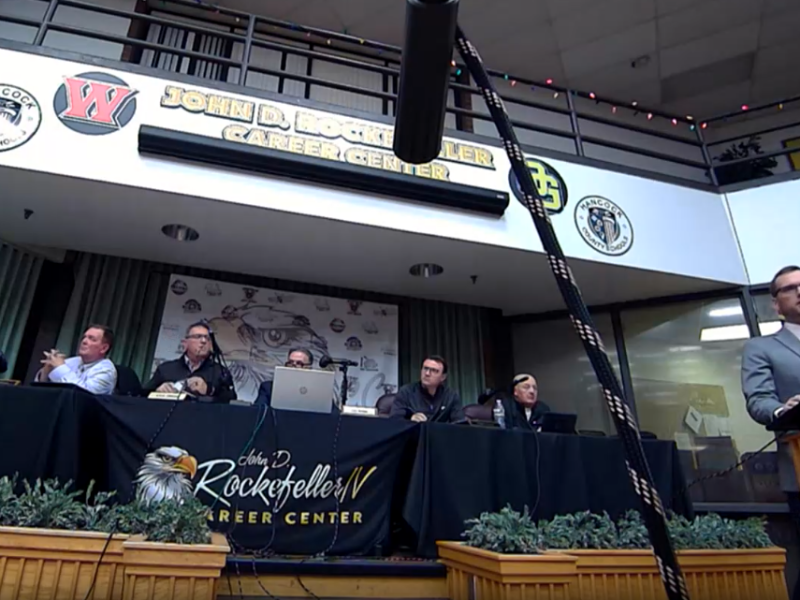
On Dec. 1, Cummings attended a meeting of the Hancock County Board of Education, where he discussed his understanding of the county’s financial status.
According to Cummings, about 85% of a county’s school budget is “taken up by personnel costs,” leaving 15% for other costs, such as transportation or facilities.
The state aid funding formula (the Public School Support Plan) as well as county taxes are the two major funding sources for a county’s school system, Cummings continued.
As for the Public School Support Plan, Cummings said that certified student enrollment data, which is collected on Oct. 1 of each year, plays an important role in the amount of funding each county receives from the state. Unfortunately in Hancock County, there has been an enrollment decline of about 450 students in the past six years.
“As enrollment in your county declines, ultimately, the county is receiving less money,” Cummings explained. “Just like every single county in this state, aside from a very select few, Hancock County has experienced a pretty steep decline in enrollment over the past five to ten years.”
There are three major factors, according to Cummings, that lead to student enrollment decline in West Virginia. Those include: school choice, a less competitive economic advantage compared to surrounding states, and a decline in birth rates.
Based on the state funding formula, for every 1,000 public-school enrolled students, the state will fund 72 personnel positions, Cummings explained.
“Hancock County Schools has a little over 3,000 students right now, so you can multiply that 72 by about 3.2, 3.3, and that will give you the number of personnel that the county is receiving funding for,” Cummings stated, noting that funding is based on the prior year’s enrollment numbers.
The funding formula is also complex, especially when county taxpayer supplements for teacher pay is factored into the equation, Cummings noted, adding that the state only funds the minimum amount set forth in personnel salary tables despite higher pay classifications for years taught and education level.
“That’s a really big deal in Hancock County because, and I don’t want to misspeak, but I believe that Hancock County Schools has one of the highest county supplements in the entire state,” Cummings said. “It kind of dates back to when times were really good here in the county in the steel industry and so forth that’s not necessarily here now.”
The school funding formula also only pays for personnel who are directly involved with student instruction, and does not fund positions such as director of transportation, director of technology, or director of finance, which must be funded through local sources.
Other factors that a county must consider regarding the state funding formula, Cummings noted, are service positions and student support positions, which can cause some administrative confusion when crafting a county school budget.
McGeehan noted that despite state, local and federal resources, and other ideas that have been presented – such as the closure of New Manchester Elementary School or the West Virginia Department of Education taking over the Hancock County school system – there is not a way to provide the funding needed to meet February’s payroll.
“As a matter of practicality, children need to go to school, and I don’t know about you, but I’m fairly certain that we couldn’t really expect people to show up and teach or keep schools running without honoring their pay,” McGeehan said.
As a result, McGeehan stated that he has drafted a piece of legislation that he will introduce on the first day of the legislative session – Jan. 14 – that may help fix the crisis.
According to McGeehan, the legislation will create an emergency school loan fund that will be a tool that may be used in “extreme situations,” but is not intended to be used as a “blank check” for county officials involved in the “maladministration” of funds, an impeachable offense.
The legislation would require a change in local administration before the loan funds would be distributed, McGeehan said.
“So, the people who presided over something like this, in Hancock County for instance of this magnitude anyway, these same folks who presided over it, they simply cannot remain in positions of authority,” McGeehan said. “Emergency funds just cannot be put into the hands of those who were captains of the ship while this very serious situation unfolded.”
McGeehan said that “confidence must be restored in the local school system,” and stated that the draft legislation would soon be in its final form.
“There’s a lot more work to do, though,” McGeehan said. “And, listen, there could be changes with local finances, perhaps something comes about that alters the financial picture, something the state overlooked or something the independent auditor overlooked, but based on everything that I’ve gathered and the probably two to three dozen different meetings and conference calls that I’ve had across a whole range of people and officials who know education very well and are working on this project with me, that would seem to be unlikely.”