Hardesty says lawmakers should fix the school aid formula, they may already be working on it
By Autumn Shelton, RealWV
CHARLESTON, W.Va. – The president of the West Virginia Board of Education had a message for the state’s lawmakers on Wednesday – do something to help public schools by amending the school aid formula.
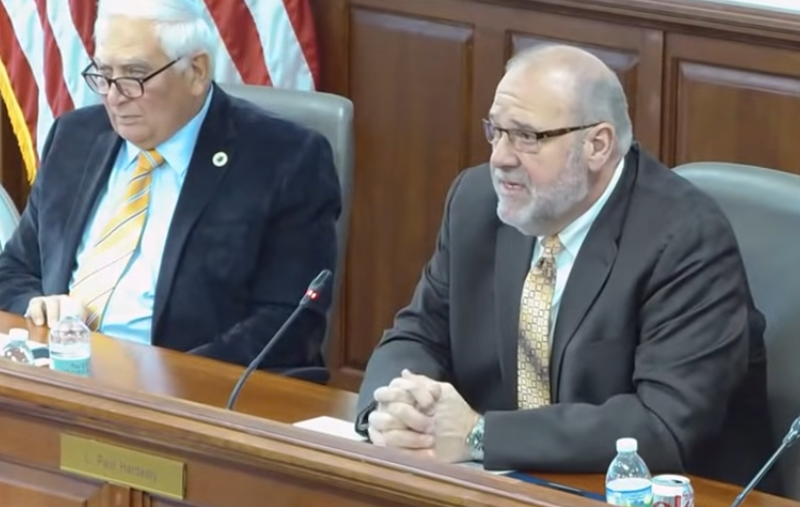
During the January meeting of the West Virginia Board of Education (BOE), which occurred on the same day as the start of the legislature’s 60-day session, President L. Paul Hardesty didn’t mince words when he said that the current school aid formula creates county financial winners and losers, and does so due to factors beyond a county’s control such as student population numbers and county land mass.
“Many years ago the legislature tweaked the school aid formula to what they call the 1,400 model,” Hardesty explained. “The 1,400 model says, basically, if you have less than 1,400 students, you’re going to get additional dollars. So, the floor for your funding is going to be based on 1,400. And they also put a provision in called the 940 rule – any county that has 940 square miles got extra dollars because they had a very large land mass county, which means longer bus rides as you well know.”
Hardesty continued that certain counties experiencing financial hardships, like Roane which is currently under a state of emergency due to budget challenges, end up being financial losers when it comes to school aid formula calculations.
Using Pocahontas County, a county with a student enrollment of 833, as an example, Hardesty said that because of the school aid formula Pocahontas County receives funding for an additional 500 students that “they don’t have.”
“That’s over $3 million [in additional funding],” Hardesty stated. “And, again, I’m not picking on them, but I want the legislature to understand here’s how you tweak the formula, and we’ve got to find a way to do this. Roane County has 1,545 [students]. You’re only 145 students from qualifying for this 1,400 provision. So, you’re on the penalty side of the equation.”
Hardesty said that counties, 12 in total, with lower student populations, shouldn’t continue getting paid for extra students while other counties, who do not qualify for additional funding, suffer.
“We’ve gotta find a way to do something to blend this system, whether it be a sliding scale or something, and they can factor in personal property values in these counties as well, because some of those in the Marcellus Shale region are so cash flush, you know, we’ve got the haves and the have-nots,” Hardesty stated.
Hardesty added that Roane County is his “case-study” for a potential change in the school aid formula, and he expressed his wish for the state’s legislature to look into the county’s situation.
“It’s asinine to keep funding people at 1,400 level when they’ve got 800-900 kids,” Hardesty said. “There’s just no rhyme or reason we oughta keep doing that.”
Meanwhile, in the legislature . . .
On day one of the West Virginia Legislative Session, also on Wednesday, members of the House Education Committee heard a presentation on the school aid formula from Benjamin Master, senior policy researcher at the RAND Corporation, and Brian Phillips, policy researcher with the RAND Corporation.
According to Master, RAND completed an analysis of the state’s school aid funding formula, sponsored by the West Virginia House of Delegates.
Master noted that the analysis comprises four key areas including the adequacy of current funding levels, distribution of resources for individual districts, incentives created by the funding formula and opportunities to maximize benefits of the HOPE Scholarship program.
Highlights from RAND’s analysis on the adequacy of current funding levels include:
- West Virginia spends slightly above the national average per student, when counting local, state and federal dollars
- Funding has been increasing, including for teacher pay, but federal pandemic funding is coming to an end
- Challenges facing West Virginia’s students are significant compared to other states
- The state ranks 8th in the nation in student poverty, 5th in the nation for students with disabilities, 47th in the nation in terms of students whose parents have at least a bachelor’s degree, and near the bottom when it comes to math and reading.
Highlights from RAND’s analysis on the distribution of resources for individual districts include:
- West Virginia’s school aid formula has not been accounting for the extra expenses districts face when it comes to the education of those with special needs, those that are economically disadvantaged, or English language learners
- West Virginia is “well-below average among states in terms of compensating school districts for the additional costs they face”
- Districts with higher numbers of special education students are getting less on average per student than other districts.
Highlights from RAND’s analysis on incentives created by the school aid formula include:
- West Virginia’s school aid formula is complex and, unlike most states, it allocates resources based on buildings and staff rather than a per student basis. Funding rises or falls with student enrollment numbers
- Resources for staffing includes rules that allocates more funding for professionals with advanced degrees or years served, which may reduce natural incentives for salary costs when making personnel decisions
- Funding is allocated based on the prior’s years transportation spending, which can reduce incentives for cost-cutting when possible
- Research shows that a “last-hired, first-fired” policy when determining reductions in force can increase district costs and create missed opportunities for student achievement
Highlights from RAND’s analysis to maximize benefits of the HOPE Scholarship program include:
- While not a part of the school aid formula, the HOPE Scholarship program is a part of the state’s overall plan for education funding
- Research shows that scholarships must encourage change in parents’ behavior surrounding their child’s education in order to be effective
- The program is expected to expand eligibility to those who already attend a private school without HOPE Scholarship funding. If half of newly eligible students take scholarships, it would cost the state about $105 million annually
- Research shows that sudden and broad growth may cause private schools to increase their tuition costs.
As of the end of the day on Jan. 14, a total of 63 education bills had already been introduced by the West Virginia Legislature, some related to changing the school aid funding formula.
RealWV will provide updates on these bills and more as the session continues.
Related Articles

THE FRONT PORCH: Why is harm reduction important?
Oftentimes, the topic of harm reduction can become controversial. So, let’s talk about it.