10% personal income tax reduction? Maybe, but it’s up to West Virginia’s legislature
By Autumn Shelton, RealWV
CHARLESTON, W.Va. – Governor Patrick Morrisey’s fiscal year 2027 executive budget was released on Wednesday, and despite his State of the State address comment that he would like to “kickstart economic growth” by seeing a 10% personal income tax reduction, his budget bill only includes a built-in 5% personal income tax reduction. The rest is up to the state’s legislature.
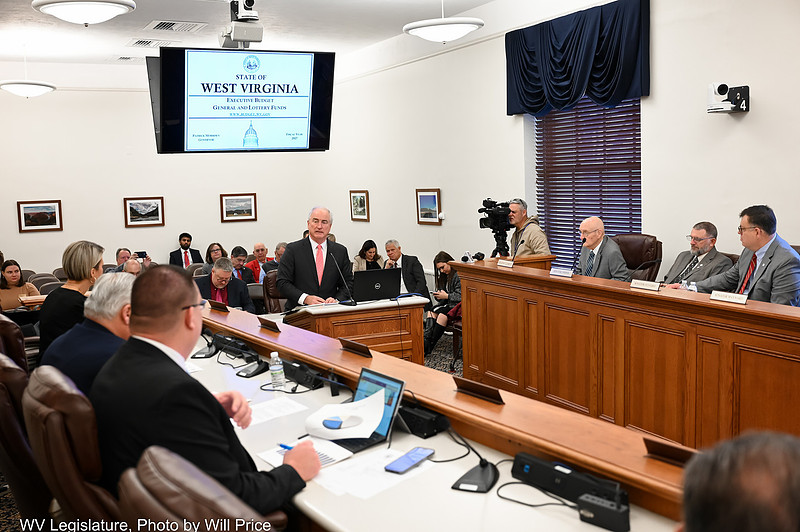
On Thursday, members of the Senate Finance Committee heard from West Virginia Department of Revenue Cabinet Secretary Eric Nelson, who said that the governor is “very committed to getting to that 10% personal income tax cut,” and is looking forward to working with the legislature to craft a budget that allows for the 10% cut.
Additionally, Nelson said that the six-year plan has been the “driver” of the governor’s budget process, which is an ever-changing tool that can show “gaps” in the state’s budget.
“The baseline budget this year is $6.26 billion – a growth of roughly $253 million over the prior year,” Nelson explained, adding that Public Employees Insurance Agency (PEIA) employer cost increases, a 3% proposed pay raise for state employees and the growth of the HOPE Scholarship are the primary expense drivers behind the budget. “The budget fully funds public education (a roughly $2 billion estimate), corrections, Medicaid, and two items that are near and dear to all members – LEDA (Legislative Economic Development Assistance) is fully funded, and fairs and festivals are fully funded at last year’s levels – so, no change.”
“General Revenue estimates for this year are $5.493 billion,” Nelson added. “That’s roughly a 3.2% increase off last year’s budget.”
Nelson also said that the state’s cash reserves are “stable and strong,” with $460 million in the personal income tax fund and no plan to tap into rainy day funds.
Additionally, for the first time in a decade, the state received a positive upgrade to its bond rating.
“We’re an AA rated state by both Moody’s and S&P, and we’re on a positive outlook right now, so we’re very excited about that,” Nelson said, adding that the rating shows financial stability.
Mike McKown, director of the West Virginia Budget Office, explained Nelson’s statements in a bit more detail.
According to McKown, West Virginia is heavily reliant upon appropriated federal funding, and the budget doesn’t include an intent to replace any lost federal funding.
“There is no way we could supplement or replace lost federal dollars if events ever happen,” McKown said, speaking about federal rule changes placing more of a burden on states. “There’s some questions about how certain programs are going to be affected in the future. It’s way too early to determine some of those, but we do have some answers on some of that. The intent is to not replace lost federal funds. Again, that’s, you know, $10 billion totally. So, it dwarfs our general revenue.”
Moving on to some of the major items included in the budget bill, McKown discussed the Public Employees Retirement System (PERS) and the Teachers Retirement System (TRS).
McKown said that PERS is a little over 100% funded, and has been that way for a little over two years.
“That’s right where we want to be,” McKown said.
However, the TRS is funded at 85%, McKown said, but that should be funded at 100% by 2034 if funds continue to be invested in the stock market appropriately.
“It’s still about $2 billion of unfunded liability,” McKown said. “But, it’s much, much better, much healthier – our retirement systems are some of the best in the country.”
The state’s rainy day fund is also one of the healthiest in the country, totaling just over $1.4 billion, which is about 26% of the state’s general revenue fund, McKown stated, though he did add some caution.
“If something catastrophic should happen, $1.4 billion would replace about 90 days of general revenue,” McKown said. “So, while it’s a lot of money, it’s all relative.”
As for the personal income tax reserve fund, McKown said the fund was small until 2024, when the legislature voted to place $400 million into the fund to act as a buffer for tax cuts.
“We have not touched it,” McKown said. “There’s $33 million in the ‘26 budget, currently. That $33 million shouldn’t be a problem to transfer that late in the fiscal year. So, that fund will be almost half a billion dollars at June 30,” McKown said. “Another good reserve.”
Fiscal year 2026 general revenue collections are projected to be $128 million over estimate, McKown continued.
Back in December, when Morrisey first announced his personal income tax reduction plan, this $128 million over estimate, driven by personal income tax strength and consumer sales tax collections, is one of the reasons why he said the state could afford another personal income tax reduction.
It is also that estimate, and, what Morrisey called a “dedication to fiscal responsibility” in his State of the State address, that will fully fund the HOPE Scholarship under his plan.
“We have built it into our baseline so that HOPE funding is not dependent upon surpluses,” Morrisey said during the State of the State. “We are pre-paying all of next year’s HOPE Scholarship as a commitment to this policy.
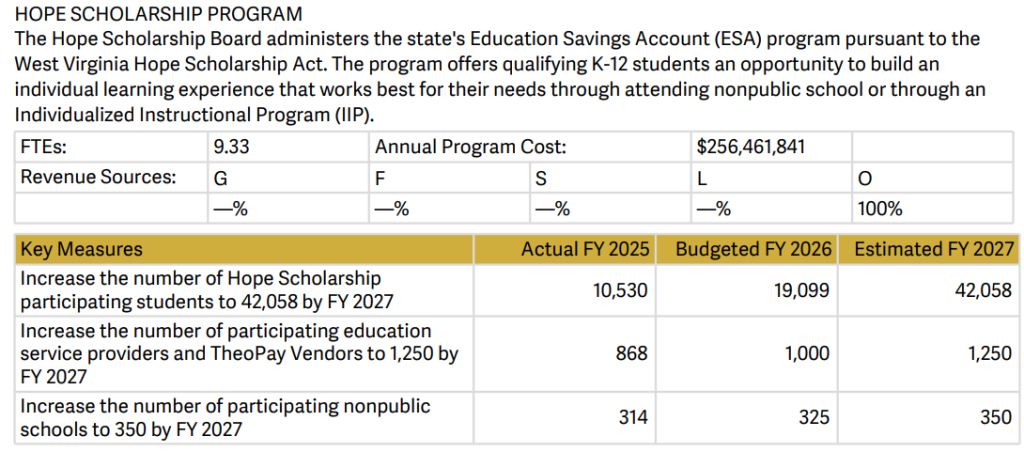
According to McKown, a base increase in fiscal year 2027 of $124.3 million, with a total base increase of $230.1 million, will fully fund the HOPE Scholarship program for one year. Last year’s base budget was $108 million.
Another major budget driver, first mentioned by Morrisey in December, is the 3% pay raise for certain state personnel, who are funded through general revenue.
McKown said that pay raise will amount to $78.4 million, but is just an average of 3%.
“The average state employee makes about $60,000, so for state employees, the average raise [would be about] $1,794,” McKown said, adding that teachers would get “$1,560 additional in the governor’s proposal and service personnel will get $870 a year.”
Other major baseline budget drivers, mentioned by McKown, include:
- $100 million from the general revenue fund to the road fund
- A PEIA employer share cost increase of $35.1 million, a three percent increase despite a total cost increase of 9%
- Funding the state’s remaining three state health facilities (Welch, Bateman and Sharpe) at about $21.9 million
- $9 million increase in base funding for the IDD waiver in order to take care of at least half of the waitlist
- $10 million for higher education funding
- $11 million for foster care funding
- Increased funding for SNAP administrative costs, due to federal government funding changes, at $13.5 million.
The six year plan for fiscal year 2027 shows state revenue in the amount of $6.1 million, while estimated expenditures total $6 million, McKown said, noting that the governor’s six year financial plan shows only general revenue, lottery and excess lottery funds.
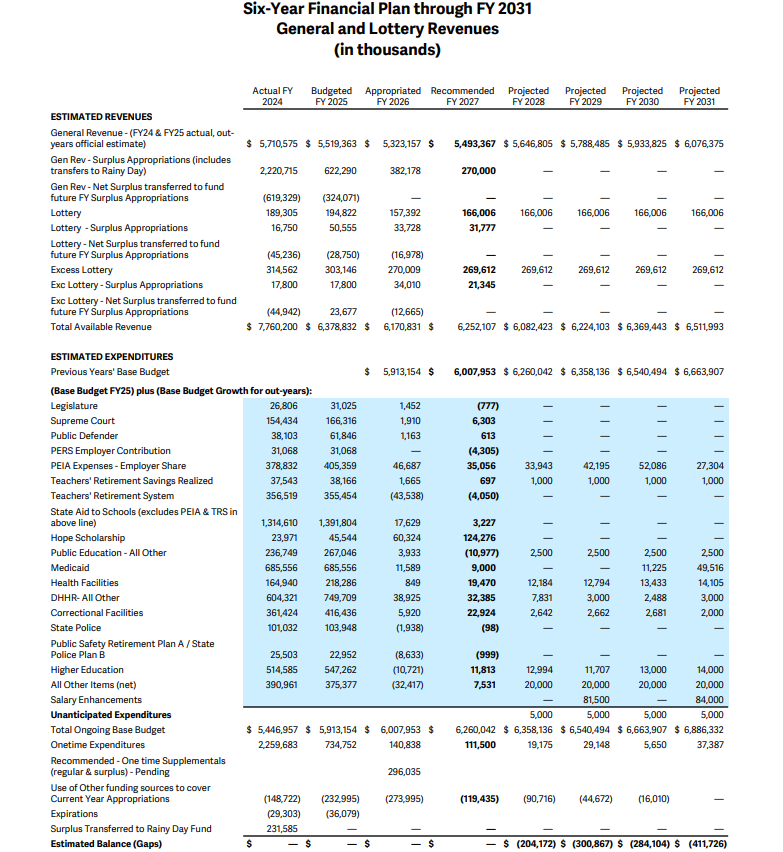
Responding to lawmaker questions regarding the governor’s six year plan, McKown noted that there is no budgetary projection beyond fiscal year 2027 for the HOPE Scholarship program.
“You know, the $230 million is probably a conservative number,” McKown explained. “That includes about 40,000 students. Those are homeschooled (about 12,980 private and 27,239 are homeschooled) . . . so it’s an unknown, and we want to take advantage of that. That’s the treasurer’s office estimate. We got those numbers from them. They handle that program and we rely on them for that.”
To view the complete governor’s budget bill, visit https://budget.wv.gov/executivebudget/Pages/recommendedbudget.aspx.