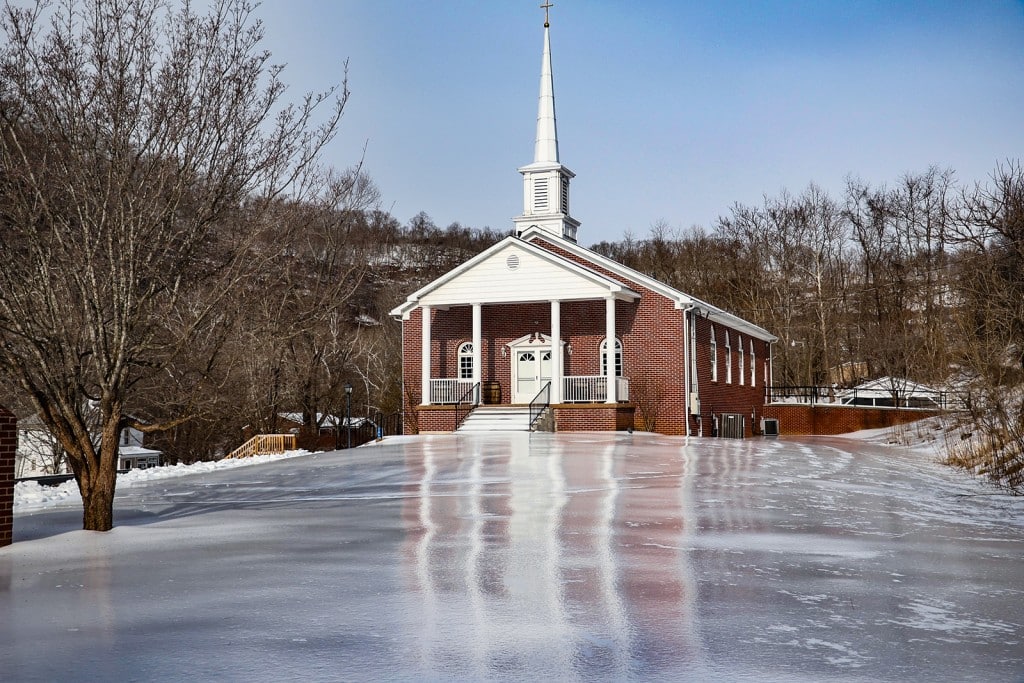
SUNDAY SERMON: Risking a fall to lift others up
By Rev. Stephen Baldwin,
NT: Matthew 4.12-23
When John the Baptist is arrested, verse 12 says Jesus “withdrew” to Galilee. On first read, that makes it sound as if Jesus runs away. Flees. Retreats. It’s what we all wanted to do this week, right? Withdraw into our warm homes, out of the ice and cold, never to come outside again. Flee somewhere far, far away where it’s 80 degrees and sunny, preferably with a beach and those little umbrella drinks, right? Don’t tell me the thought didn’t cross your mind as you checked on the livestock or busted ice or slipped in the parking lot. We all thought about withdrawing, fleeing, or running away this week. Yet that isn’t at all what this passage means for Jesus. That’s what it sounds like, but that couldn’t be further from the truth.
The verb used in Greek is a form of “choreo,” which means “to pass through” or “to go.” It includes the prefix “ana” which often means “back to.” So the literal translation of this verse is that Jesus went back to Galilee.
This word is used 14 times in the New Testament, and in all those circumstances Jesus goes somewhere by himself with purpose.
So when John the Baptist is arrested in Matthew 4, Jesus goes back to Galilee by himself with purpose. This is a major moment, upon which he is wholly focused.
John was not only his cousin but also his colleague. John was not only the one who baptized Jesus, but he was his example in ministry. His mentor, his dear friend, and his brother in faith. When he’s arrested, Jesus drops everything and goes.
The person who ordered the arrest of John the Baptist was Herod—the Roman king who would later arrest Jesus. Why did he arrest John? Two reasons.
One, the Gospels say that John was openly critical of Herod for marrying a woman who was his relative, as this was illegal under Jewish law. Two, John was a popular public figure whom many people followed, and Herod feared rebellion by the people against him when John began preaching against Herod’s behavior.
Where did all of this happen? On the banks of the Jordan River in Galilee. That’s where John not only preached and taught and baptized people (including Jesus), but Galilee is also Herod’s prime territory.
So when Jesus hears that Herod arrests John, he goes to Galilee. He doesn’t withdraw. He doesn’t flee. He doesn’t retreat. He doesn’t run to a faraway land. He runs into the lion’s den, in defense of his relative and friend, despite the personal risk, defying Herod’s power, going straight to Galilee.
This is the perfect example as to why the Bible must be studied rather than simply read. A quick reading would lead you to think Jesus retreated on John’s arrest, fearful for his life, when in fact the opposite is true. Jesus moved into the heart of the storm. This was not a moment of weakness; it was a crowning moment of strength. He followed his heart to even the darkest corner of the world.
This passage is a story of discipleship. It’s about when the rubber hits the road in your journey of faith. Because you can sort out your beliefs and get your values in order in your mind and heart, but at some point those values and beliefs will be tested in real life. The rubber will hit the road. Or this week for us, it’s when the rubber in your soles will hit the ice on the ground. That’s when it gets real. You’re not looking out the window. You are outside in the thick of it. We all come to that moment.
For Jesus, that’s when John is arrested. For you, that might be when tragedy strikes. You lose your job. You lose a loved one. How many times have you fallen this week when your rubber hit the ice? Most people who have spent some time outside this week have fallen. It’s not a matter of if but when. For the disciples, the moment is when Jesus walks by and invites them to join him. The rubber hits the road. And they go. They’re going to fall more times than they can count in the years to come, but what matters is that when it’s time to follow they go. They go!
This is a story about discipleship. About following Jesus. Being a disciple isn’t just about saying you follow Jesus. Being a disciple means doing the work of following Jesus. Saying you are a Christian does not require you to act anything like Christ. Being a disciple means you have to act like Christ, and if you are focused on that, you don’t have to take time to tell people you are a person of faith…that much is evident.
The hardest part of discipleship lies in following Jesus together. It is one thing for you to follow him as an individual, but can we follow him together? When his friend and relative was in peril, Jesus ran into the lion’s den. No retreat. No surrender. He acted boldly. He stood up for those close to him. He risked offending those who could, and would eventually, kill him. He stood firm for justice. For whom are we willing to stand? For what are we willing to fight? How far will we follow Jesus?
The point is that Christianity began as a faith of average, ordinary people without any sort of power or influence. The town where Jesus went to live, Capernaum, was a humble town of 1,000 people who were mostly fishermen and farmers. Early Christians were a decided minority who quickly began an oppressed minority. Today, we are anything but.
We are the unquestioned majority. We have the power of Herod. That’s why to claim to be a Christian is not enough for discipleship. To be a disciple we must “withdraw” in the same sense Jesus did. We don’t retreat to the comfort of our inner circle. We don’t hide inside our houses. We go out into the shadows of the world in defense of justice and righteousness, just as he went out in defense of John and the good news. We follow. We take risks. We risk falling so that we can lift others up. For whom are we willing to stand? For what are we willing to fight? How far will we follow? Amen.