Senate Education committee begins discussions on funding for public schools
By Autumn Shelton, RealWV
CHARLESTON, W.Va. – Members of the Senate Education committee began discussions on Tuesday regarding bills that would amend the current state school aid formula and provide additional resources for county boards of education.
Proposed Senate Bill 801 would increase the number of professional educator and service personnel ratios by 3 positions per 1,000 students beginning July 1, 2026. Statewide, the bill would add 720.82 professional educators and 715.88 service personnel.
According to a fiscal note provided by the West Virginia Department of Education, the estimated cost, under the Public School Support Plan, for these additional positions would cost $86,634,763 per year. The estimated cost includes salary, retirement and Public Employee Insurance Agency costs, among others.
The proposed financial break-down is as follows:
- Allowance for Professional Educators – $38,741,731
- Allowance for Service Personnel – $21,520,088
- Allowance for Fixed Charges – $4,959,548
- Allowance for Substitutes – $1,506,545
- Retirement – $4,585,92
- PEIA – $15,320,927
If made into law, the bill would provide each county with funding required to pay the state minimum salaries and change the allowance for state aid eligible professional educator positions from 72 and three tenths professional educators per 1,000 students in net enrollment to 75 and three tenths professional educators per 1,000 students in net enrollment.
Service personnel positions would increase as follows:
- High density counties: From 53.79 positions per 1,000 students to 56.79 positions per 1,000 students
- Medium density counties: From 54.35 positions per 1,000 students to 57.35 positions per 1,000 students
- Low density counties: From 54.92 positions per 1,000 students to 57.92 positions per 1,000 students
- Sparse density counties: From 55.50 positions per 1,000 students to 58.80 positions per 1,000 students.
The bill also provides that a county board of education shall not be “penalized for failing to meet the minimum ratio of professional instructional personnel per state aid funded professional educators” for the 2026-2027 school year.
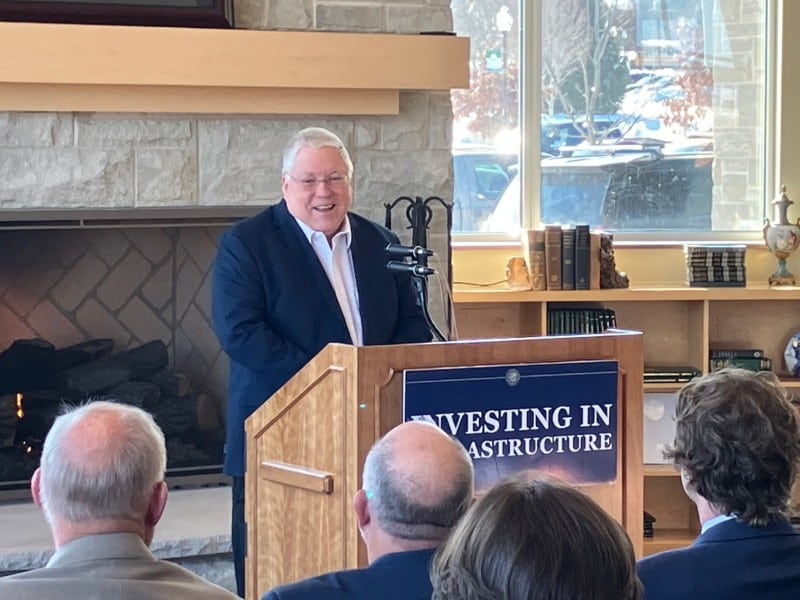
Cabell County School Superintendent Tim Hardesty spoke before the committee regarding the bill.
“This was an item that really came about as a way to try to increase the funding formula to help counties with personnel, because the personnel costs is the bulk of what we spend the money on,” Hardesty said. “If you look across the state it is a common concern in counties.”
Hardesty explained that special education costs are not accounted for in the regular state aid formula, and are often “astronomical.”
“One of the things we looked at was adding the state aid formula,” Hardesty said. “In its simplicity, it already takes into account the population density across the state, and adding the three professional and three service would increase what goes to the counties as far as paying for the employees that they have.”
Specifically, in Cabell County, Hardesty said the county is “going into the hole more and more every year,” and the funding would not be used to add 66 additional staff members, per Cabell County’s enrollment numbers, but to help pay for those they already have.
After discussion, the committee voted to advance Senate Bill 801 to the Senate Finance Committee for additional consideration.
Fair State Aid Formula Act of 2026
Additionally, the Senate Education Committee discussed Senate Bill 437 – the Fair State Aid Formula Act of 2026.
Although this bill didn’t pass the committee on Tuesday, it will return at a later time in order to create a committee substitute/amendment that ensures funding will go toward special education students, according to Senate Education Chair Amy Grady, R-Mason.
As explained during the committee meeting, a committee substitute of the bill would add extra weighting in a tiered system for special education students in each county’s foundation allowance per 1,000 students. Level one special education students would be counted as 1.1 students, level two special education students would be counted as 1.2 students and level three special education students would be counted as 1.3 students.
The bill would also exclude additional weighting from being included if a county’s net student enrollment is below 1,400.
A fiscal note from the West Virginia Department of Education (WVDE) estimates the cost of this bill to be $45,925,235, which would take place July 1, 2026.
Drew McClanahan, legislative and policy officer for the WVDE, and Uriah Cummings, school financial operations officer for the WVDE, were on-hand to answer questions.
According to McClanahan, special education students are provided a needs level at their school, with the county special education director providing input as needed through the Individualized Education Program (IEP). The level is not written into state code.
“The definition of a level one student, students require adaptation to connect to methodology, not extremely high need compared to maybe level two or level three,” McClanahan said. “Level two students are going to require intensive and explicit support. Our level three students are gonna be the ones that need significant adult supervision.”
In response to a question from Sen. Vince Deeds, R-Greenbrier, about the number of special education students in the state, Cummings said that there are 45,771 level one students in the state, 3,613 level two students and 724 level three students.
Over the past five to ten years, Cummings said that the number of students in the state who require special education has been increasing.
After additional discussions, Sen. Eric Tarr, R-Putnam, expressed concern that funding through this bill may not go directly toward special education students. He requested a conceptual amendment that would provide directive language to ensure the money goes where it is intended.
Grady suggested that due to the complex nature of the amendment, which would require drafting by counsel and support of the WVDE, that it be worked into a new committee substitute for discussion at a future meeting.
RealWV will provide updates on this bill as they become available.