Aerial acrobats shoot for the moon at Seneca Rocks
By Vanta Coda III, RealWV
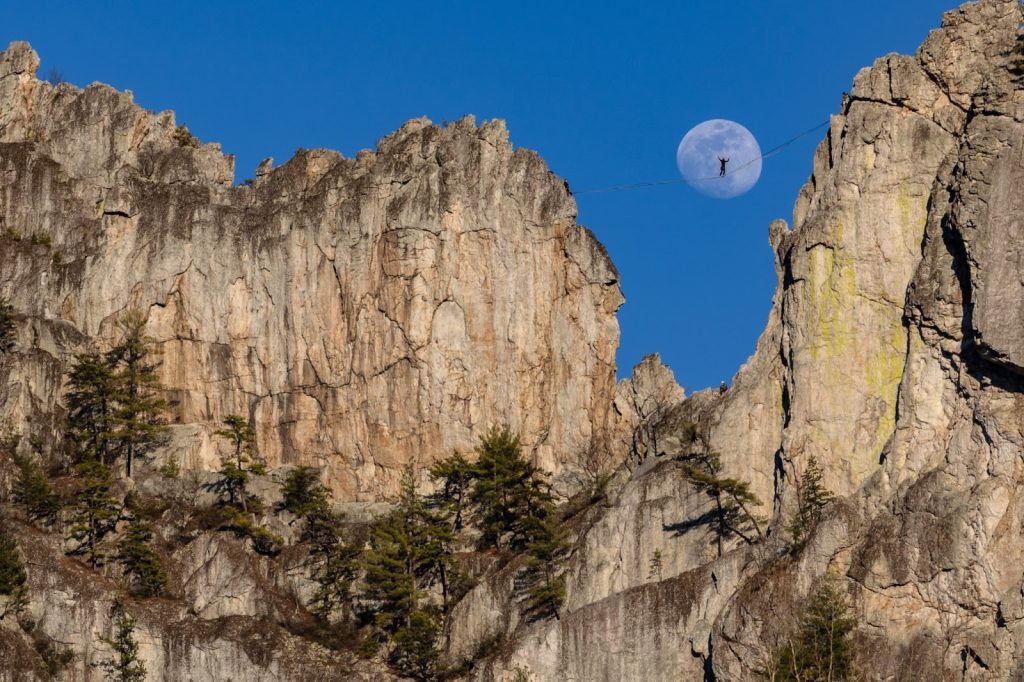
A Fourth Moon Camp highliner balances on the highline in profile with the rising moon in between the Seneca Rocks Gunsight Notch. Photo by Vanta Coda III for RealWV.
From the top of Seneca Rocks, the wind whips through the jagged, sawtooth-like blades of Tuscarora Sandstone that make up the picturesque crag. Within the blades of Seneca Rocks, a team of highliners from Fourth Moon Camp, led by Wade Desai, set up a highline between a gap in the sawtooth formation called the Gunsight Notch. On Feb. 28 and Mar. 1, the moon rose between the notch where some of the team walked across the highline in profile against the moon, visible from the Seneca Rocks Visitor Center hundreds of feet below, where a photo workshop led by Jesse Thornton and Dave Johnston set up to capture the shot.
“Finding out the moonrise can be caught behind Seneca Rocks, I conferred with Dave Johnston on the potential for pulling a photo workshop off because he is very good at pulling off these events that require a high level of precision,” said Jesse Thornton, landscape photographer and Seneca Rocks Moonwalk organizer. “One thing led to another and after a couple failed attempts, we were able to successfully pull off our first moonwalk with Wade and his highliner group in late 2021, but since 2020 Dave and myself have led at least a dozen workshops at Seneca Rocks where we capture the moonrise through the Gunsight Notch in the rocks. We began working with Wade and Fourth Moon Camp in 2025 and have run a couple of these Moon Walk workshops. This was our third event on Feb. 28 – Mar. 1.”
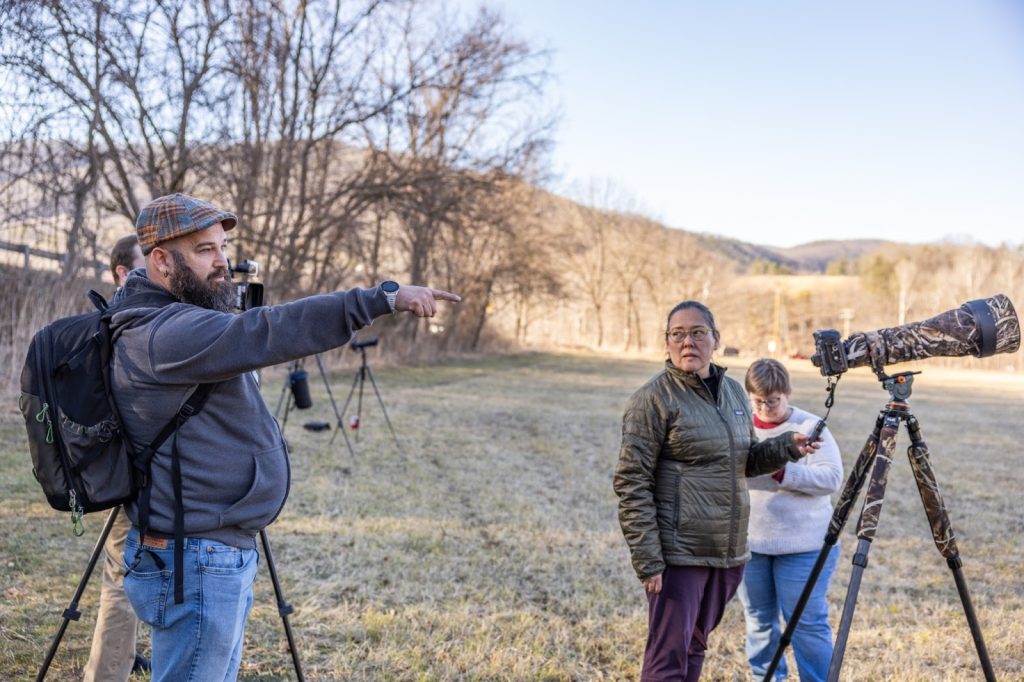
Jesse Thornton guides photographers to where they should set up to capture the event. Photo by Vanta Coda III for RealWV.
Dave Johnston, the technical brains behind the workshop, mapped out the location and timing of the Moon’s trajectory through the Gunsight Notch, lining up with highliners making their walk across the notch. Johnston uses a software called The Photographers Ephemeris, which uses astronomical calculations to determine when celestial bodies will be aligned with things on earth, providing highly accurate predictions of the positions of the sun, moon, eclipses, and the Milky Way in relation to earthly landmarks. To provide the most accurate predictions, the program needs precise information on the geographic location and elevation of topographic features. Due to the narrow blades of Seneca Rocks, which rise abruptly from their surroundings, the program couldn’t account for the steep contours of the rocks, which posed a problem for Johnston.
“To solve this I went out to Seneca Rocks for several nights and photographed the stars around Seneca Rocks and within the notch,” said Dave Johnston, local photographer and Seneca Rocks Moonwalk organizer. “I was then able to use astronomy software to determine the angle of specific stars adjacent to different parts of the rocks from my shooting position at that time. Dusting off my high school trigonometry I was able to use the star positions to calculate the geographic location and elevation of the key edges of the rocks. After I fed that data to the geodetic software, I was able to predict the dates, time and viewing location for moonrise into and through the Gunsight Notch with very good accuracy.”
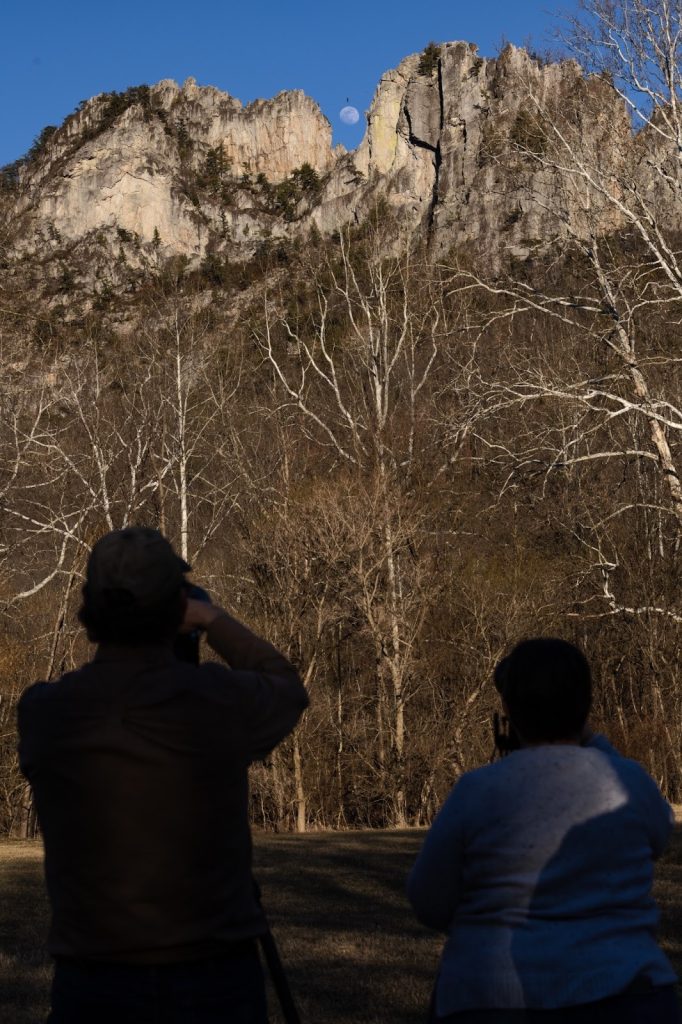
Photographers take photos of highliners balancing as the moon rises in the Gunsight Notch. Photo by Vanta Coda III for RealWV.
Due to the rotation of the earth, the moon moves about half its diameter every minute. Johnston and Thornton use this information to determine how long it will take for the moon to rise all the way through the Gunsight Notch. The timeframe for this is 4 to 5 minutes from the starting point of the shoot and closer towards the end of the shoot it takes about 6 to 8 minutes. Knowing these time parameters in relation to photography movements with the moon, Johnston and Thornton calculate a detailed path on the ground along where the moon can continue to be viewed in the notch, directing photographers to follow a route allowing extended time to photograph the moon in the notch.
Up on the rocks, Wade Desai, land manager of Fourth Moon Camp, and his team of highliners set on the Seneca Rocks trail at 11:00 a.m, with equipment in hand. Within all aspects of these events, safety is at the forefront of Desai’s mind.
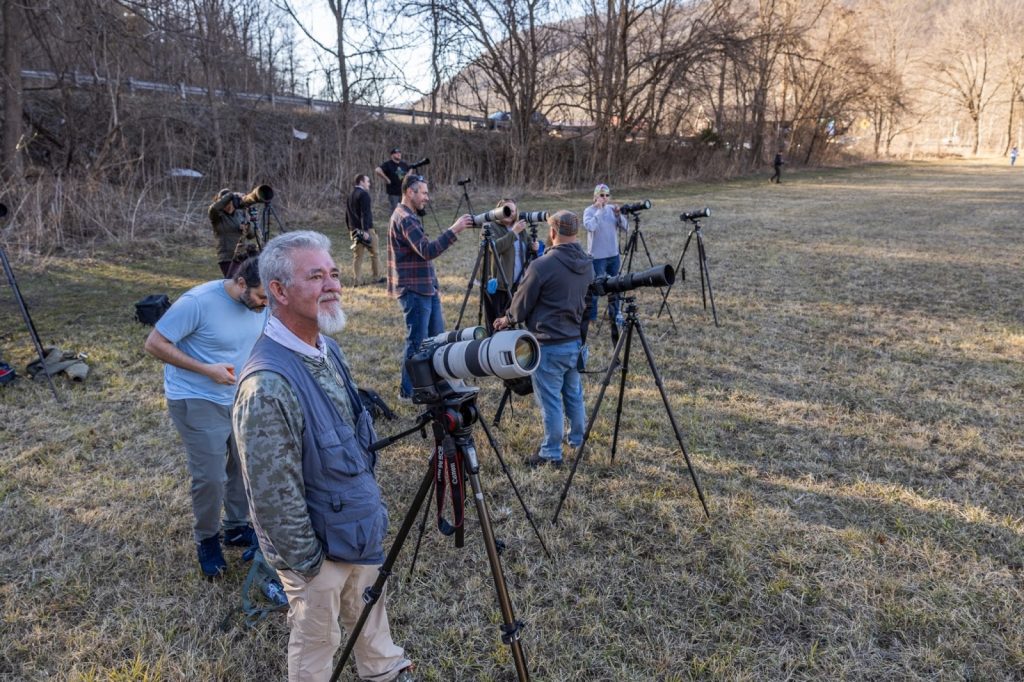
Photographers set up at the first location to capture the Moon rising through the Gunsight Notch. Photo by Vanta Coda III for RealWV.
“Before we even leave the camp to head up for the line, we have probably around 6-8 hours of planning conversations and safety checks,” said Wade Desai, land manager of Fourth Moon Camp and Seneca Rocks Moonwalk organizer. “It feels very similar to medical or flight checklist systems, which use statistical data to help drive decision making in a mathematically proven way that supports minimal risk. In addition, we have deep personal relationships with our rigging/slacklining crews. We care deeply about the safety and wellbeing of our team, and are constantly on the lookout for preventative measures to avoid adverse events. There’s a Scout motto we sometimes bring up, which is “no one left behind.” This applies when we’re hiking, but also in a greater sense of personal responsibility.”
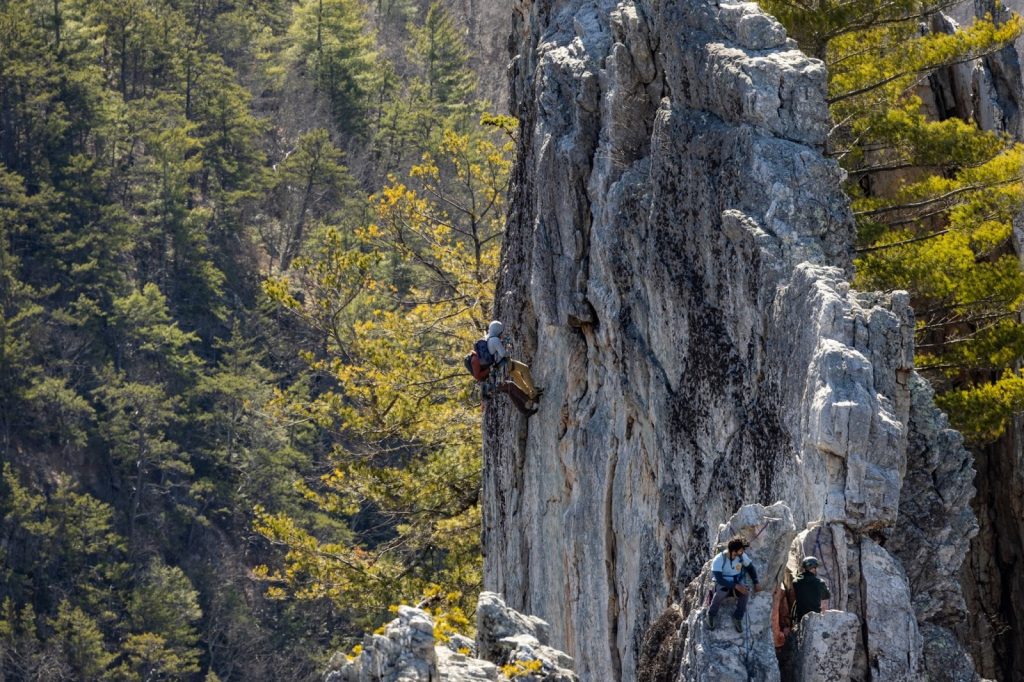
Climbers rappel down as the Fourth Moon Camp rigging team takes a moment to sit on the blade-like rocks that make up Seneca Rocks. Photo by Vanta Coda III for RealWV.
Desai and his team set up anchors on both sides of the rock, then establish a tagline across the gap using thin cordage and a throw bag. They then pass increasing diameters of cord to create wide highline webbing parameters. They then affix two separate systems of webbing to two separate anchor systems, adjusting the tension of the two lines to ensure that the equipment is in the proper place, all while climbing and repelling Seneca Rocks.
Fourth Moon Camp started in January 2021, led by Desai, with a desire to offer more wilderness campsites as well as events, festivals, slackline/highline and aerial workshops to promote Appalachian conservation through recreation. Fourth Moon Camp’s grounds is an undeveloped 175-acre private property located east of Seneca Rocks, a haven for highliners, slackliners, and aerial acrobats alike.
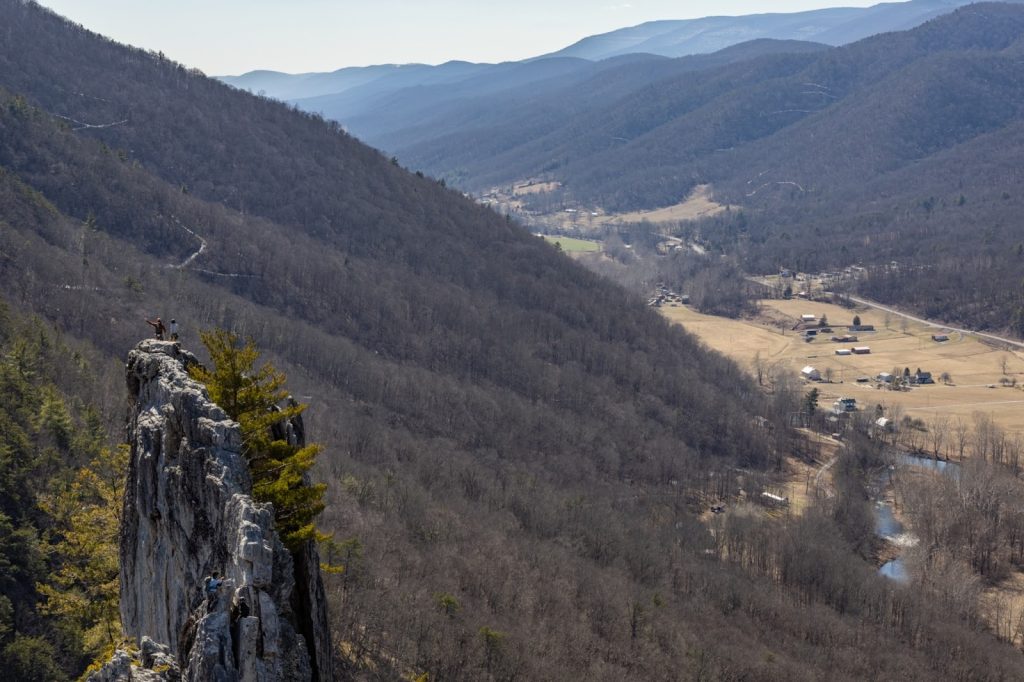
Climbers stand on the top of the outcrops of Seneca Rocks, overlooking the North Fork Valley below. Photo by Vanta Coda III for RealWV.
“I think many people see us as attention-seeking adrenaline junkies, looking for a thrill. But that could not be further from the truth,” said Desai. “We practice this sport 99% in private, and make public only a snapshot of our most cherished projects in places that we cherish. Whereas most people might think we seek being up there to feel a rush, the reality is we need to practice extreme levels of calm at those times in order to maintain any semblance of success, much less safety. In those moments of pure calm, you feel an incredible type of gratitude that I can’t really describe. It just makes me really thankful to be present.”