Green Bank telescope supports Artemis moon mission
By RealWV Staff,
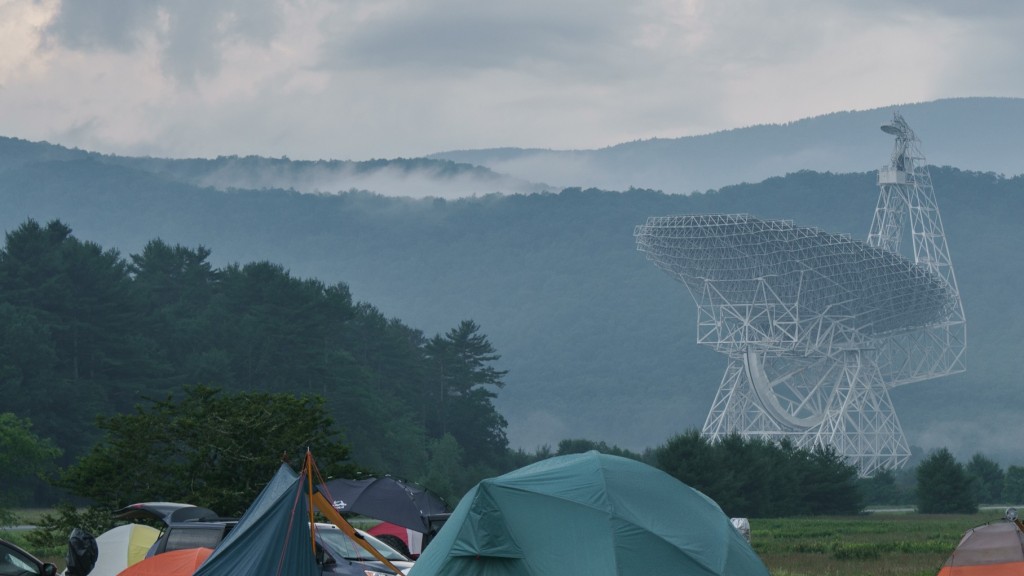
GREEN BANK, WV – As the world watched NASA’s Artemis II mission lift off from Cape Canaveral, Florida, on Wednesday evening, a group of scientists in West Virginia worked quietly behind the scenes to support the mission.
Located in rural Pocahontas County, the National Science Foundation’s Green Bank Telescope is the world’s largest steerable, single dish telescope.
“Scientists come from around the world to use the Green Bank Telescope, because it is the most accurate, versatile, large dish radio telescope in the world,” according to the National Radio Astronomy Observatory. “Its suite of receivers covers 100 MHz to 100 GHz in frequencies, its processors can spot nanosecond timing differences in data, and it observes under radio-quiet skies. The Green Bank Telescope can be used to do chemistry, physics, radar receiving, and astronomy and has no equal in the world.
Now, the Green Bank Telescope will turn its attention to the moon, using radar to monitor the Artemis crew on part of their 10-day flight.
“The GBT will provide support for the Artemis II mission for five days of the roughly 10-day test flight, observing Orion for six hours each day while the crew is closest to the Moon,” the NSF reported on Wednesday evening.
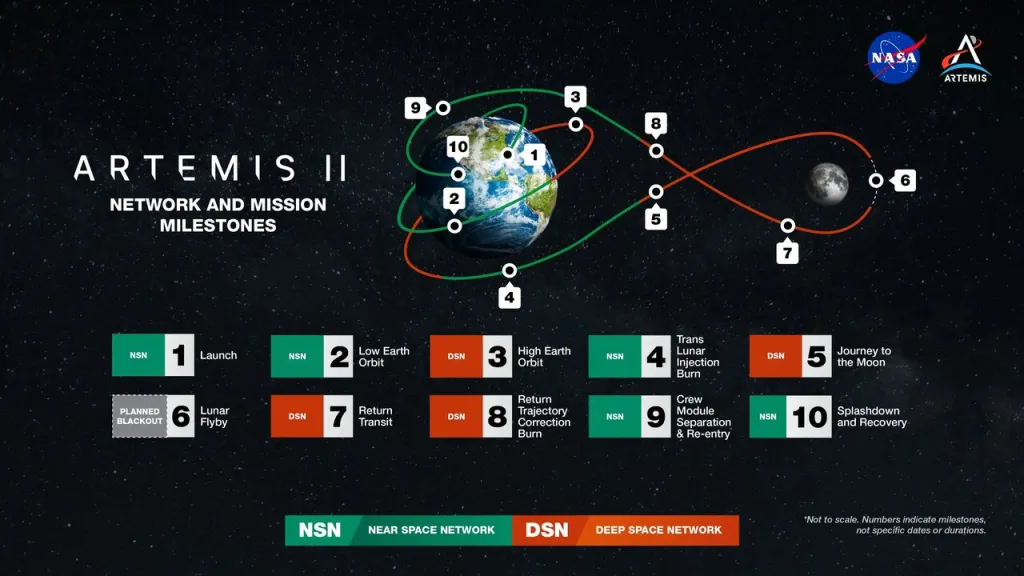
The Artemis II mission will use SCaN’s networks to send vital data back to mission controllers on Earth. This includes astronaut communications, mission health and safety information, images, video, and more. Credit: NASA / Dave Ryan.
“Radar lets us pinpoint the trajectory of the spacecraft without relying on its on-board communication antennas,” said Will Armentrout, a scientist at Green Bank. “Performing radar observations at the distance of the Moon requires powerful transmitters and really, really big radio telescopes, like the GBT, so this partnership lets us spotlight some of the very best space support capabilities that the U.S. has to offer. We’re honored to work with NASA on the first crewed Moon mission in decades and look forward to even more collaboration as launch cadence increases!”
Author