Vandalia seeks ‘critical access hospital’ status for GVMC
By Stephen Baldwin, RealWV
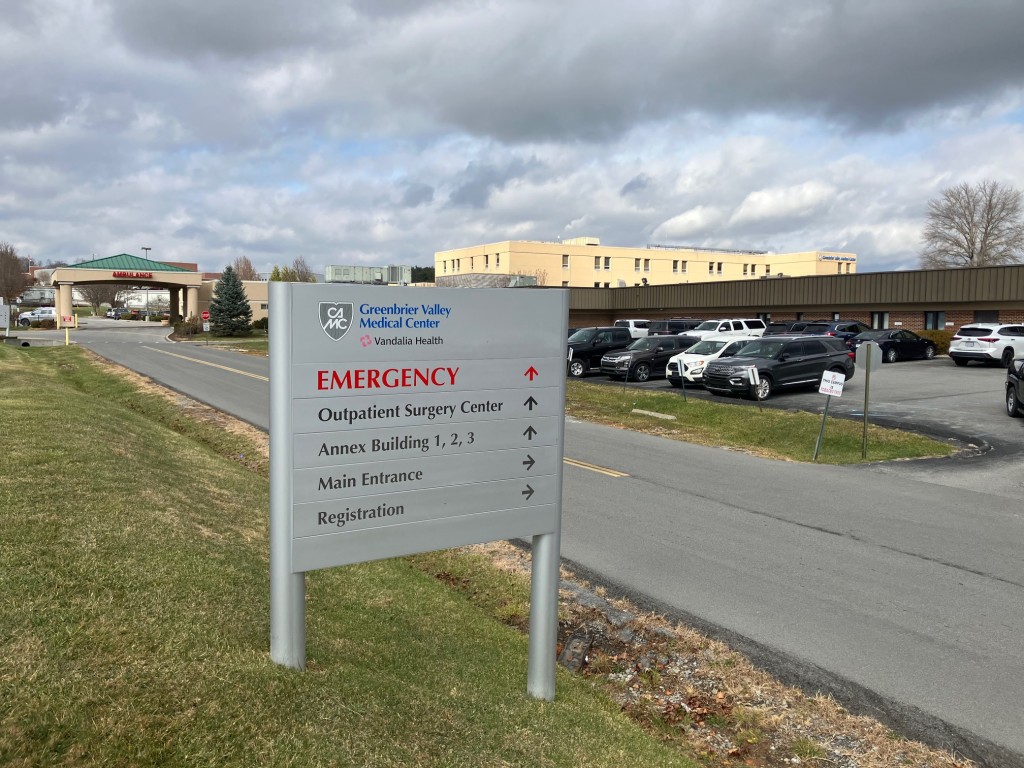
FAIRLEA, WV – Vandalia has applied to transition Greenbrier Valley Medical Center from its current status as a “community access hospital” to a “critical access hospital.” The move is being made for financial reasons, intended to shore up the fiscal health of the hospital by accessing higher reimbursement rates for services provided to patients covered by government health care. But it will also mean practical changes for local patients.
“They (critical access hospitals) were created to preserve rural health care,” said Jeff Goode, Executive Vice President of Vandalia. “They do have limitations of 25 inpatient beds and nine observation beds.”
Additionally, critical access hospitals (CAH) must have an average patient stay of 96 hours, be 35 miles from the next closest hospital (or 15 miles in mountainous areas), and maintain an emergency room that’s open 24 hours a day and seven days a week.
How long do patients stay now? And how many are in the hospital on average?
Hospital leadership says their current numbers are close to the established CAH thresholds now, with an average inpatient census of 31 people in January and an average stay of just over four days last year.
“We’re close,” Goode said. “The length of stay does have the historical OB (obstetrics) numbers in them. When you remove the OB numbers, we’re right about that number.”
GVMC is closing the OB unit this month, ending labor & delivery at the hospital for the first time in generations.
Goode believes that the length of time patients stay in the hospital following a surgery, for example, will continue to decrease in the future as it has in the past.
“With technology, things like robotic surgery, more and more of the patients that are traditional can be done as same-day surgeries,” he said.
After receiving state approval for CAH status, the final approval comes from the federal government via the Centers for Medicare and Medicaid Services (CMS).
“There’s a chance it could all be completed this year,” added Goode. “We would like to have this completed by the end of 2026.”
GVMC will be the state’s 22nd critical access hospital if the application is approved.
Improved financial stability?

Dr. Arvin Singh, Secretary of Health for the Morrisey administration, said in an interview last month that he thinks the status change makes sense.
“A lot of these systems who move to critical access hospitals (CAH)–and I know this from my hospital in northern Maryland–a lot of them are already operating like a CAH. Switching allows them to become more sustainable. It’s more outpatient-focused. But it doesn’t mean emergency rooms close or doctors leave or services disappear. What the community will see is their local hospital will have improved financial stability and lower risk of the full hospital closing.”
GVMC is seeing a reduction in services via the closure of labor & delivery, while simultaneously expanding in other areas.
“Probably, they’ll be able to start having more capital investment in the facility,” Singh said. “But fewer inpatient beds. They’ll coordinate with complex care hospitals. That requires a strong transportation system, which we’re hoping to address with the Rural Health Transportation Program (RHTP).”
Preparing for the change
Dr. Adam Crawford works as Chair of Emergency Medicine for Vandalia, coordinating emergency room care across the health care nonprofit’s various facilities.
In an interview with RealWV, he said of the impending status change, “There’s been a ton of work that’s gone into it.”
Gaining efficiencies in terms of post-surgical stays will be key to the change, he says.
“Most people don’t want to stay in the hospital,” Crawford said. “It makes them happy to go home sooner and then we can get more people in.”
That speaks to one fear patients have about the change, which is that they’ll come to the local ER for service and be transferred out somewhere a distance away for care.
“It’s probably not going to mean everybody has to be transferred,” Crawford said. “But there will be a few more patients a day that we’ll have to transfer. We’ve worked out arrangements with the surrounding hospitals like Beckley, Roanoke, and Charleston.”
Crawford has been through this status change before at other hospitals in the Vandalia network. He points to Preston County, specifically.
“You get more efficient over time. Now (in Preston County) they’re not transferring many patients out like they had to.”.
Asked if the status change will lead to any staffing changes at GVMC, Crawford said he doesn’t think it will. He anticipates that all current medical providers will stay on board. He also hopes to provide additional coverage.
While GVMC will no longer provide pediatric inpatient care, Crawford said they will have pediatric care in the ER.
“We will be adding in some pediatric coverage to current staffing. It will help our staff feel more confident in managing kids.”
He’s proud of the job done by Vandalia in the ER at GVMC. “CAMC (Vandalia) has made a big investment in this emergency department. We started staffing this when it was purchased. Immediately, we made it our mission to improve the quality of care.”
“There had been a loss of trust in the community. If you look at the metrics, we’ve improved. We’ve improved the time it takes to be seen. Most everyone sees a provider quickly. Turnaround times in the lab have improved. The emergency department is the front door to the community.”
Because of the closure of labor and delivery combined with the emphasis placed on emergency medicine caused by the CAH status change, Crawford said his team is focusing on specific training for medical providers.
“We’ve gone back and rewritten protocols so we can deliver the same sort of care they delivered on the OB unit,” he shared. “We’re partnering with other agencies to have simulation equipment. It also means getting ready to transition those (pregnant) patients from here to Charleston–telemedicine, networking, NICU docs on standby there. We have transfer agreements with Beckley and Vandalia hospitals to get quicker access to those hospitals.”
And if a patient comes to the ER ready to deliver, will the doctors be trained to assist?
“The docs…are trained to do C-sections in accidents but not elective C-sections. We’ll get those patients to a hospital where they are trained. Only in very rare instances will an ER doc be the one doing that.”
“In residency training for emergency medicine, one of the competencies is vaginal deliveries,” Crawford explained. “They have to have a number to complete training. We’re doing a refresher. We have to be prepared.”
Stay tuned to RealWV for further reporting on critical access hospitals.