At Neyland Stadium, Luke Combs’ story still felt close to West Virginia
By Hannah Yost, RealWV
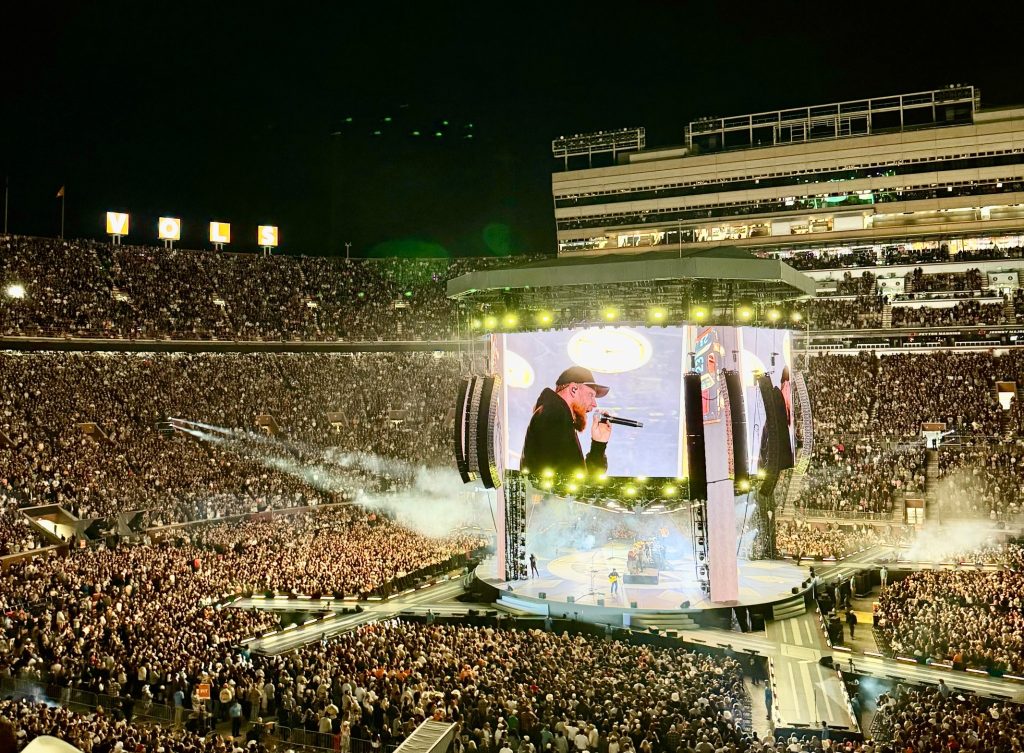
KNOXVILLE, Tenn. — On Saturday night, I stood in Neyland Stadium with about 80,000 other people and watched Luke Combs do what few artists ever get to do: turn a football stadium into something that felt personal.
Combs brought his “My Kinda Saturday Night Tour” to Knoxville on May 2, with openers Thelma & James, Jake Worthington, Ty Myers and Dierks Bentley before Combs took the stage around 9 p.m. The show drew an estimated crowd of about 80,000 people, filling Neyland Stadium with voices singing along to songs about love, heartbreak, work, growing up, missing home, making mistakes, and trying again.
But as big as Saturday night felt, it also felt familiar.
That is one of the things country music does best. It can fill a stadium and still feel like it belongs to small towns, county fairs, local stages, and the people who heard the songs before the rest of the world caught on.
For West Virginians, Combs’ rise is also a reminder that artists do not simply appear under stadium lights. They start somewhere. They open for someone else. They play the fairs. They stand on stages where the crowd may be smaller, but the connection is often just as real.
And that matters.
Live music is not just about the person on stage. It is about the people who show up. It is about the folks who buy the ticket, stand in the crowd, sing along, clap for the opener and give a new artist a chance before everyone else knows their name. It is about recognizing that music is built in real time, between artists and audiences, one show at a time.
Before Combs was selling out stadiums and breaking attendance records, he was playing in places like West Virginia.
Publicly documented concert listings show Combs has played in West Virginia several times. Those stops include Schmitt’s Saloon in Morgantown in November 2016; the Charleston Civic Center in February 2017, when he opened on Brantley Gilbert’s “The Devil Don’t Sleep Tour”; the Putnam County Fairgrounds in Eleanor in July 2017; the State Fair of West Virginia in Lewisburg as a free grandstand show in August 2017; a sold-out State Fair show in August 2018; and a show in Huntington in February 2019.
That list matters because it shows the distance between where an artist starts and where the road can lead. In 2017, Combs was one of the free grandstand shows at the State Fair of West Virginia. The next year, the fair announced his return as a sold-out concert. By 2026, his current tour had already produced the largest show of his career, with reports showing Combs drew 97,367 fans at Ohio Stadium in Columbus before heading to Knoxville.
That is a long way from a fairground stage. But in another way, it is not so far at all.
Our stories, accents, churches, coalfields, farms, hollers, fairs, and family gatherings all live inside the larger sound of country music. The genre may be marketed from Nashville, but so much of its emotional language belongs to Appalachia.
That is part of what made Saturday night in Knoxville feel bigger than a concert.
It was easy to look around Neyland Stadium and see the scale: tens of thousands of people, stadium lights, rows of boots, hats, jerseys, and friends standing shoulder to shoulder. But the heart of the night was still simple. People sang together. They remembered moments from their own lives. They connected to songs that, at their core, are about ordinary people and the things they carry.
Those themes are not new. They are the same kinds of stories that have been sung in the mountains for generations.
For West Virginia, there is something worth holding onto in Combs’ journey. When a young or lesser-known artist comes through a fair, a civic center, a small venue or a community stage, it can be easy to see it as just another show. But sometimes those are the places where the next chapter starts.
That is why it matters to show up.
Go to the local show. Listen to the opener. Support the artist playing the fair stage, the small theater, the community event, or the downtown venue. Not every musician will go on to fill a stadium, but every musician who keeps going needs people willing to listen. That is how music communities are built. That is how artists grow. And that is how audiences become part of the story, too.
Combs’ career is proof of that. He played in West Virginia when his name was still growing. Years later, he is standing in front of stadium crowds large enough to fill a small West Virginia town several times over.
Country music artists start somewhere. Sometimes that somewhere looks a lot like home.
And maybe that is why, even inside Neyland Stadium with about 80,000 people singing along, the night still felt connected to West Virginia. The stage was bigger. The crowd was louder. But the roots were familiar.