
Morrisey announces ‘comprehensive statewide energy policy’
By Autumn Shelton, RealWV
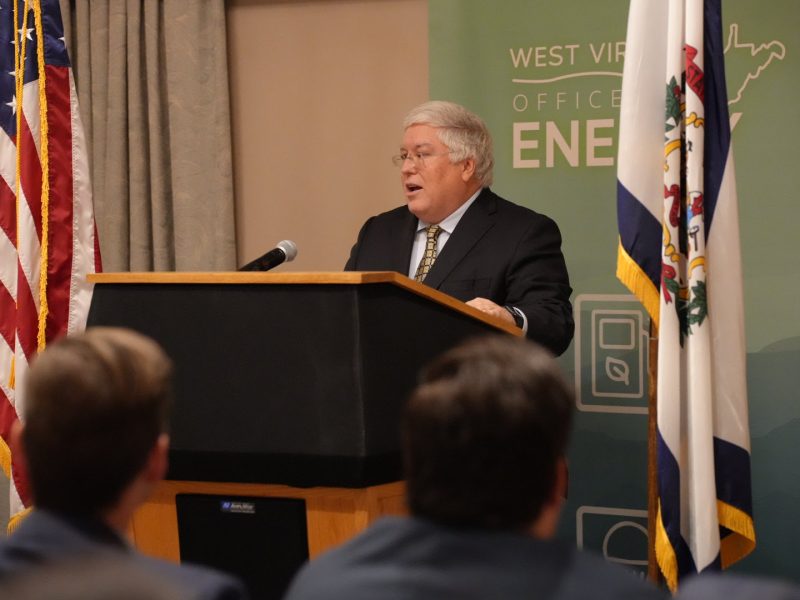
WHEELING, WV – Gov. Patrick Morrisey unveiled his plan for a comprehensive statewide energy policy at the West Virginia Energy Educational Forum in Wheeling on Wednesday.
According to Morrisey, in order for West Virginia to “lift itself up from economic challenges,” the state is going to need to use its natural resources for energy generation.
“We are so rich in energy in our state and we always should be America’s energy state,” Morrisey said. “And we should always be looking for ways to leverage our energy resources to drive that standard of living up and to make sure that we have generational wealth that gets passed on to the next set of West Virginians.”
Morrisey explained that this new energy policy, the first of its kind in West Virginia, includes four components: The “50 by 50” generation policy, a 25-year strategic development policy for each energy source in the state, an energy transmission policy, and an energy security policy.
Morrisey’s “50 by 50” plan, first discussed at the annual West Virginia Chamber Business Summit in August, looks to increase the state’s current baseload generation capacity from 16 gigawatts to 50 gigawatts by 2050 using base load energy sources including coal, natural gas and nuclear.
“A lot of people say it’s ambitious,” Morrisey said. “We have to be ambitious. We have to be aggressive because we have to grow in the rankings and not accept being at the bottom.”
Although Morrisey said the 50 by 50 policy focuses heavily on coal and natural gas, solar energy generation will be considered as well, but the state needs to be realistic about this type of energy generation.
The state ranks 48th out of 50 states for average annual sunlight hours, Morrisey said. Additionally, there is limited flat land that must be used for agriculture and other areas of economic development.
“Now, our policy contemplates all energy resources, and all means all, but it does place a priority on stable, baseload generation over renewables,” Morrisey said, adding that he hopes this energy policy will be used as a blueprint for other states to develop their own policies.
This baseload energy will be used to end the nation’s power shortage, Morrisey added.
“Our country, let’s face it, we’re running short on power. Without immediate action, it’s only gonna get worse,” Morrisey said. “By 2045 it is projected there will be a 70 gigawatt increase in peak load within the PJM territory. It is also projected that approximately 40 gigawatts of PJM generating capacity could be retired by 2030. Let that just sink in for a moment.”
According to Morrisey, PJM coordinates the generation and flow of energy in 13 states. It is the largest RTO (Regional Transmission Organization) in the world by both electricity market size and customer base. It serves about 67 million people from Chicago to New Jersey to North Carolina.
Another part of this plan, according to Morrisey, is to “monetize the incredible value” of the state’s energy resources and keep more of the wealth in West Virginia.
He cited the recent passage of the Power Generation and Consumption Act of 2025, which allows for the expansion of certified microgrid districts and, ultimately, the construction of high-impact data centers, as example legislation to keep wealth in the state.
Morrisey said that one gigawatt of energy can be worth $100 – $150 million in revenue for the state and counties, per the new legislation.
“Half of that money gets fed back in to eliminate the income tax,” Morrisey said. “I want all people in West Virginia to know this will be one of the biggest economic development boosts, because it’s not just about creating something that people will say won’t have as many jobs. It’s about feeding money back to the people.”
Morrisey also said that the state has partnered with Oak Ridge National Laboratory, a foundational leader in the development of the Manhattan Project, to assist with crafting the data center development strategy.
Morrisey also explained that the energy policy includes a long-term plan that will be sustainable through changes in state administration.
“I want to give utilities, businesses, consumers, and investors confidence to put the money into big projects that might take decades to pay off,” Morrisey stated. “West Virginia needs an energy policy that’s not only forward looking but that’s gonna look deep into the future and see West Virginia out in front, and that’s why a twenty-five year period really matters.”
Energy transmission is also a vital part of this policy, Morrisey said.
“A transmission plan anticipates risks and strengthens weak points, making the system more resilient,” according to Morrisy. “It helps against cyber or physical attacks by diversifying power flow routes, and it anticipates growth, avoiding crises where demand outstrips supply. PJM states need our new generation, and our plan will ensure we have the proper transmission system to get it to them.”
Lastly, Morrisey said an energy security policy will be part of the state’s plan.
“We also must implement the state’s first ever Energy Security Plan. This is critical because such a plan will help provide resilience against physical and cyber threats, provide economic stability by reducing disruptions, and ensure public safety and well-being,” Morrisey said.
Related Articles


THIS WEEK IN WV HISTORY: Sep 13–19
The following events happened on these dates in West Virginia history.