What does Greenbrier County want? A Comprehensive Plan. When do they want it? Well, there’s another public hearing on Sept. 30
By Autumn Shelton, RealWV
LEWISBURG, W.Va. – Every ten years, Greenbrier County must develop a new comprehensive plan. This plan is used to identify goals for unincorporated land use over the course of the next decade.
The last time Greenbrier County officials had to develop a comprehensive plan was in October 2014, and a lot has changed since that time.
So, for the past year, members of a planning advisory committee have been gathering data from public surveys, hosting public meetings and conducting open houses – all with the intention of getting as much information as possible about what may be in store for Greenbrier County’s future.
On September 3, the Greenbrier Planning Commission presented its recommended Comprehensive Plan to members of the Greenbrier County Commission, who approved it shortly thereafter.
Coming in at over 90 pages, including maps and other information, the Comprehensive Plan is a large document, but an important one. The plan is guided by the residents of Greenbrier County, and is designed to protect farmland, provide opportunities for business and job growth, figure out ways to ease the congestion on Route 219, prepare for economic and weather-related disasters, and much more.
Due to the size of the plan, RealWV has broken it down into bullet points for a summarized version. The complete Comprehensive Plan can be found at https://greenbriercounty.net/comp-plan/
The first chapter of the Comprehensive Plan focuses on current land use, and contains interesting facts about Greenbrier County:
- Based on 2020 Census data, the population of Greenbrier County is 32,977, with a landmass of 1,025 square miles, and a population density of 32 people per square mile.
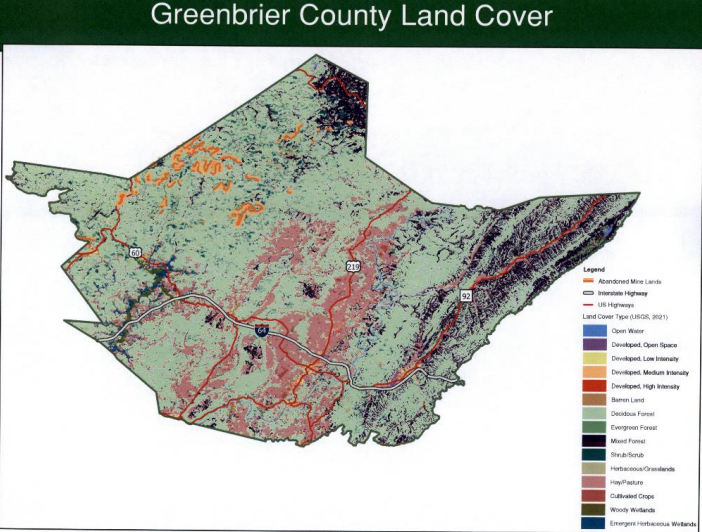
- In 2020, Greenbrier County had approximately 514,000 acres of natural forest, covering 79% of its land area.
- The county has 770 farms, occupying 175,026 acres. The average size of a farm is 227 acres, with 85% of farm sales from livestock and 15% from crops.
- Increasing demand for residential development and diminished economic viability of small-scale farming threatens small-scale agriculture as a land use in the county. Recent legislation hampers the use of planning measures to protect the rural landscape by preempting local authority.
- Geographical constraints such as steep slopes, floodplains and karst terrain pose challenges for development of available land.
- Approximately 21,615 acres are designated as floodplain areas, accounting for about 3.3% of the county’s total land mass area.
- The Monongahela National Forest accounts for eight percent of the county’s landmass, and is not available for development.
- County ordinances that impact land use include the county zoning ordinance, subdivision ordinance, building code, floodplain ordinance, sexually oriented business ordinance, telecommunications ordinance and the Farmland Protection Program.
- Sixteen farms, a total of 3,855 acres, have been protected through voluntary conservation easements under the Farmland Protection Program. Commitments to purchase an additional 2,032 acres were slated for 2025.
- The county’s demolition program removes dilapidated structures, which readies the lots for redevelopment. One example of this is the demolition of the former Exxon station in Crawley.
- Areas that have been identified for renewal and/or redevelopment include the area from Sam Black to Rainelle along Route 60 and Interstate 64 between White Sulphur Springs and Lewisburg, and Route 92 outside of White Sulphur Springs.
Community survey results for land use show that residents want to preserve the natural beauty and agricultural heritage of Greenbrier County, but there are also concerns about the lack of housing.
Some plans to address land use for the next 10 years include:
- The adoption of a nuisance property ordinance.
- Providing greater community outreach and technical support to developers, realtors and builders for compliance with the subdivision ordinance.
- Clarifying the Subdivision Ordinance regarding the approval process, providing development standards for commercial development, and providing incentives for connected development as well as the utilization of green infrastructure.
Chapter two of the Comprehensive Plan focuses on housing. Facts included in this section are:
- The median home value in the county is projected to rise from $158,598 in 2024 to $176,578 in 2029.
- “As of March 2025, the median price of homes listed for sale in Greenbrier County was approximately $315,000, reflecting a 5.7% year-over-year increase.”
- “The county’s housing market is characterized by limited inventory, with only 106 homes listed for sale as of March 31, 2025. This scarcity contributes to rising home prices and underscores the need for increased housing construction to meet demand.”
- “During the last ten or fifteen years, the housing market in Greenbrier County has begun to see the conversion of residential dwelling units to short-term vacation rentals (STRs).”
Plans to address housing issues include:
- Continuing the demolition program for dilapidated homes, included flood damaged homes
- The development of a “wall of shame” of dilapidated properties to incentivize owners to remove them
- Expansion of enforcement of the Property Maintenance Code
- Maintaining information on the number of STRs countywide
- Encouraging the development of housing, services, and facilities to address senior needs and increase the overall housing supply.
Chapter Three of the Comprehensive Plan focuses on economic development. Key statistics include:
- Greenbrier County has a population of 31,812 as of 2024, a decline of 8.1% in five years. The population loss is expected to continue with a loss of 1,881 residents over the next five years.
- The median household income in 2022 was $45,500, which is below the state average of $55,200.
- “From 2019 to 2024, jobs in Greenbrier County declined by 3.0% or 452, but are projected to grow by 370 over the next five years.”
Community survey responses illustrate that support for small businesses should be a top priority for the county. Goals to increase economic development include:
- Business retention and expansion, diversification through business attraction, tourism and outdoor recreation expansion, investing in renewable energy projects, educational partnerships, and increased remote work opportunities (such as the Ascend WV program).
- Providing consistent and easy procedures for development projects
- Streamlining the permitting process
- Continuing demolition practices for potential new investment
- Working with the Greenbrier Valley Economic Development Corporation to identify and develop strategies to further expand growing industries, identifying new sites for business recruitment, and leveraging new venture efforts such as the Bio Development Opportunity Zone, the WVSOM academic laboratory expansion and the Airport Collaboration with Marshall University to attract complementary businesses.
Chapter Four of the Comprehensive Plan focuses on transportation. Key takeaways are:
- Route 219 traffic congestion continues to be a problem. The WV Department of Highways (DOH) has proposed several bypass options over the last 20 or so years. Many residents and community leaders fear that an improperly designed bypass could strangle the economic vitality of their communities.
- “Public ground transportation is available through the Mountain Transit Authority (MTA), which operates fixed routes, including the Green and Purple Lines, connecting communities like Lewisburg, Ronceverte, and Alderson.”
- “Amtrak’s Cardinal Line offers service through White Sulphur Springs and Alderson, connecting to cities like Charleston and Washington, D.C. The train station passenger depots are located in the incorporated City of White Sulphur Springs and the Town of Alderson.”
- The Greenbrier Valley Airport (LWB), located north of Lewisburg, provides regional commercial flights and accommodates general aviation.
- “No roads in Greenbrier County offer bicycle lanes, which limits the availability of safe bicycle commuting. Nearly twenty percent of community survey respondents indicated a desire for better access to bicycle infrastructure.”
To address transportation issues, the plan suggests:
- Addressing citizen concerns about any future plan to establish a bypass near Lewisburg.
- Ensuring continued viability of the Greenbrier Valley Airport
- Developing an airport overlay zone to establish building height limitations and reduce or eliminate incompatible land uses which may encroach on the availability and expansion of air transportation at the Greenbrier Valley Airport
- Investigating the feasibility of establishing bicycle routes and community walkability.
Chapter five of the Comprehensive Plan focuses on utility and public infrastructure. Infrastructure includes:
- The Greenbrier County Landfill, which is permitted to accept up to 5,500 tons of waste per month, totaling 66,000 tons annually. The landfill has a life expectancy of at least 150 years.
- The Greenbrier County Solid Waste Authority operates a recycling center in Ronceverte. The facility has recycled approximately 14,174 tons of material between 2010 and 2019.
- Medical service infrastructure includes the Greenbrier County Health Department, CAMC Greenbrier Valley Medical Center, Greenbrier County VA clinic, Robert C. Byrd clinic, Rainelle Medical Center and the Greenbrier Clinic.
- The most significant driver of economic growth and housing supply in Greenbrier County is the supply of public water & sewer. Approximately 23,237 individuals have access to public drinking water in their homes.
- The county is served by Mountaineer Gas Company, which does not release information regarding its number of customers or areas served. However, much of the county does not have access to natural gas distribution lines and many residents instead rely on individual propane tank services or oil for residential heating purposes.
- The county iis served by two electrical utility companies, Mon Power (a FirstEnergy company) and Appalachian Power (part of American Electric Power). The power grid in Greenbrier County, like much of the State, faces challenges posed by aging infrastructure, severe weather events and mountainous terrain coupled with a diffuse customer base.
- Access to fiber broadband is very limited, estimated to be less than 30%, but the Greenbrier County Commission has made significant investments in programs designed to provide reliable high speed internet access to all residents in the County.
- “There are currently 13 public k-12 schools in Greenbrier County, 9 elementary schools, 2 middle schools and 2 high schools with a total enrollment of 4,609 students. Several private primary schools operate in the county, including the Greenbrier Community School, Seneca Trail Christian Academy, Lewisburg Baptist Academy, Greenbrier Valley Academy. A statistically significant number of school age children in Greenbrier County are homeschooled, however, concrete figures regarding the number of homeschooled children are not available due to a lack of reporting requirements.”
- Academic institutions include New River Community College and WVSOM.
Goals to address infrastructure concerns include:
- Continuing to increase reliable high speed fiber internet access
- Simplifying permitting requirements for telecommunications facilities by incorporating the telecommunication facility requirements in the county zoning ordinance
- Promoting, and maintaining and preserving historic facilities and resources.
Chapter five of the Comprehensive Plan also focuses on environmental hazards. Environmental hazards include:
- Threats to water quality, such as runoff from local mining operations, sedimentation from logging, non-point source discharge from agricultural operations, and stormwater runoff.
- Due to the lack of access to public sewer services, many of the county’s residents must utilize private septic systems. Although no data is available with regard to the failure rate of these systems, many such systems do not work properly due to improper maintenance such as cleanout services.
- Forest fires are the greatest contributor to air quality degradation in Greenbrier County, but most often the source of the smoke is “external to Greenbrier County.”
Goals included to address environmental hazards include:
- Reducing light pollution to protect dark skies.
- Protecting environmentally sensitive areas and features such as springs, sinkholes, caves, other karst features, floodplains, and wetlands.
Chapter six of the Comprehensive Plan concerns public safety. Responses to the community survey indicate that public safety is a top concern of residents.
Goals included in the plan to address public safety include:
- Evaluating existing public safety services in Greenbrier County and making recommendations for continuity and improvement of services
- Mitigating flooding hazards, such as stormwater runoff, by studying the feasibility and practicality of implementing a county-wide stormwater ordinance
- Preparing for future disasters by assessing community volunteer capacity, mapping assets and developing the framework for volunteer coordination and supply chain management to match needs with resources
- Participating in programs to mitigate costs of flood insurance, and supporting updates to the Greenbrier County Floodplain Ordinance as well as commitment of personnel time and training involved in meaningful floodplain management.
Chapter seven of the Comprehensive Plan concerns financing. Although the plan states that “a meaningful discussion of local government finance is largely beyond the scope of the Comprehensive Plan, . . . implementation of the goals expressed in the Plan must be financed.”
A brief overview of county financing includes:
- The Greenbrier County Commission entered an Order on December 23, 2004 creating a Tax Increment Financing (TIF) District to include the entirety of the White Sulphur District and the municipal corporation of the City of White Sulphur Springs. TIF funding has been used to upgrade various utilities in the area.
- “Greenbrier County has utilized various funding sources, including the American Rescue Plan Act funds, to provide significant funding for infrastructure projects (GigReady, PSD#2 Sam Black Water Extension; E911 Technology Upgrade).”
- “The Greenbrier County Commission is in the process of developing a plan for the distribution of Local Opioid Settlement Funds within the guidelines agreed to in a Memorandum of Understanding with the West Virginia Attorney General. The county will be studying a best practices model for this fund distribution to ensure funds are distributed for sustainable impact.”
On September 30, the Greenbrier County Commission will hold another public hearing on the Comprehensive Plan, which gives residents another opportunity to make their voices heard. The hearing will take place at 7 pm in the County Commission Courtroom located at 912 Court Street N in Lewisburg.