Greg Johnson’s latest idea, ‘Murder at The Greenbrier’, is a whodunit with a twist
By Stephen Baldwin, RealWV
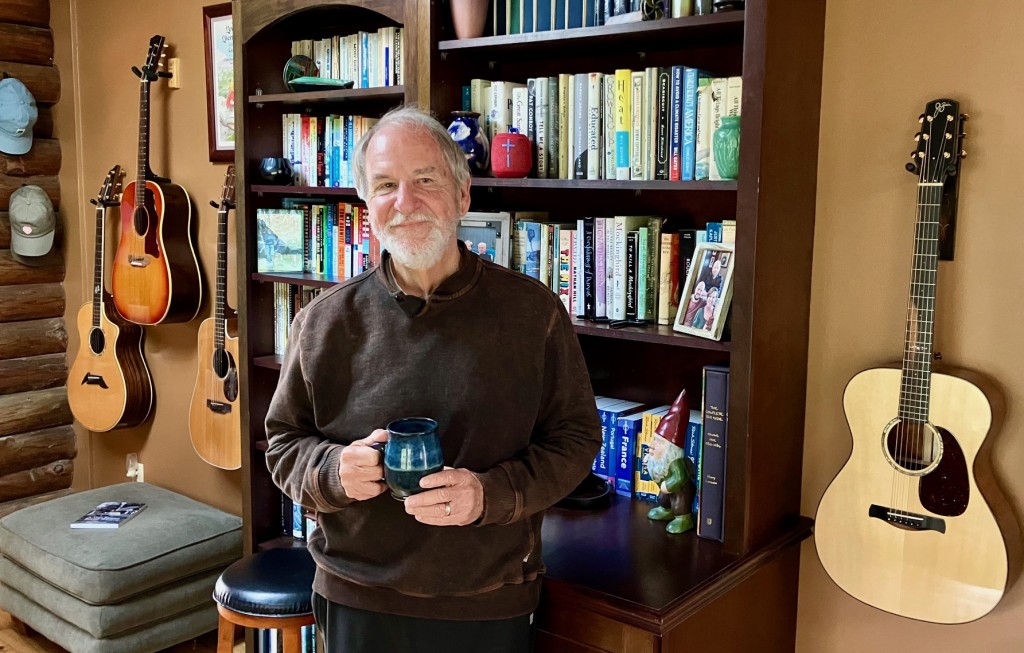
Greg Johnson is a fountain of ideas.
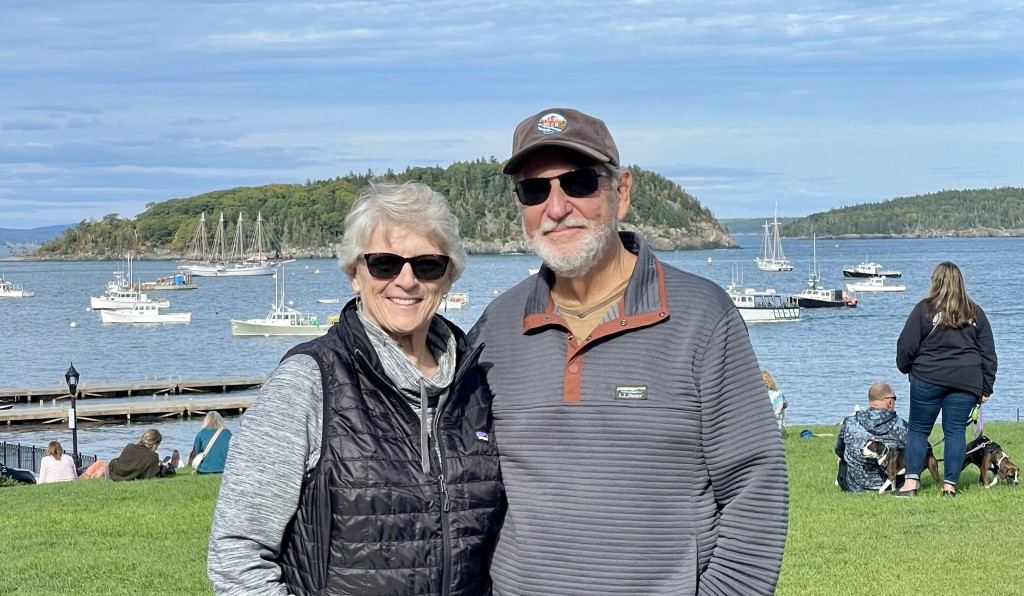
Just ask his wife, Libby. Now in their 47th year of marriage, she’s been known to pull the car over when she’s driving down the road and he announces that a new idea has dawned on him.
People ask him where he gets all of his ideas? After all, the retired social worker and financial advisor is also a prolific writer, having penned plays, magazine articles, books, and other “edited thoughts” (more on that term later) over the years.
“Coffee,” he says with a half smile.
Suspecting that the roots of his imagination run deeper, I ask him what the first thing he remembers writing was?
“In fourth grade,” he begins, “we had a little school paper. I wrote a story about how our dog got stuck under the coffee table one time. We didn’t know he was under there. And then he stood up and and started walking away. The coffee table was walking across the room. So my first piece was a humor piece when I was 10 or 11.”
His latest project, Murder at The Greenbrier, is a murder-mystery set at the world-famous Greenbrier Resort located just down the road from Greg’s home in Lewisburg.
When a Fox News commentator, who famously denies climate change, dies under mysterious circumstances while visiting the luxury resort, a local NY Times reporter begins an investigation that goes down unexpected paths. Readers will be guessing “whodunit” to the very last page.
In order to appreciate Greg’s latest idea, though, it’s important to get to know the man behind the novel.
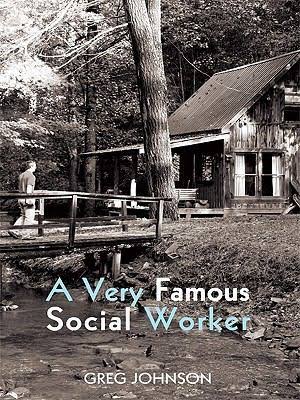
‘A Very Famous Social Worker’
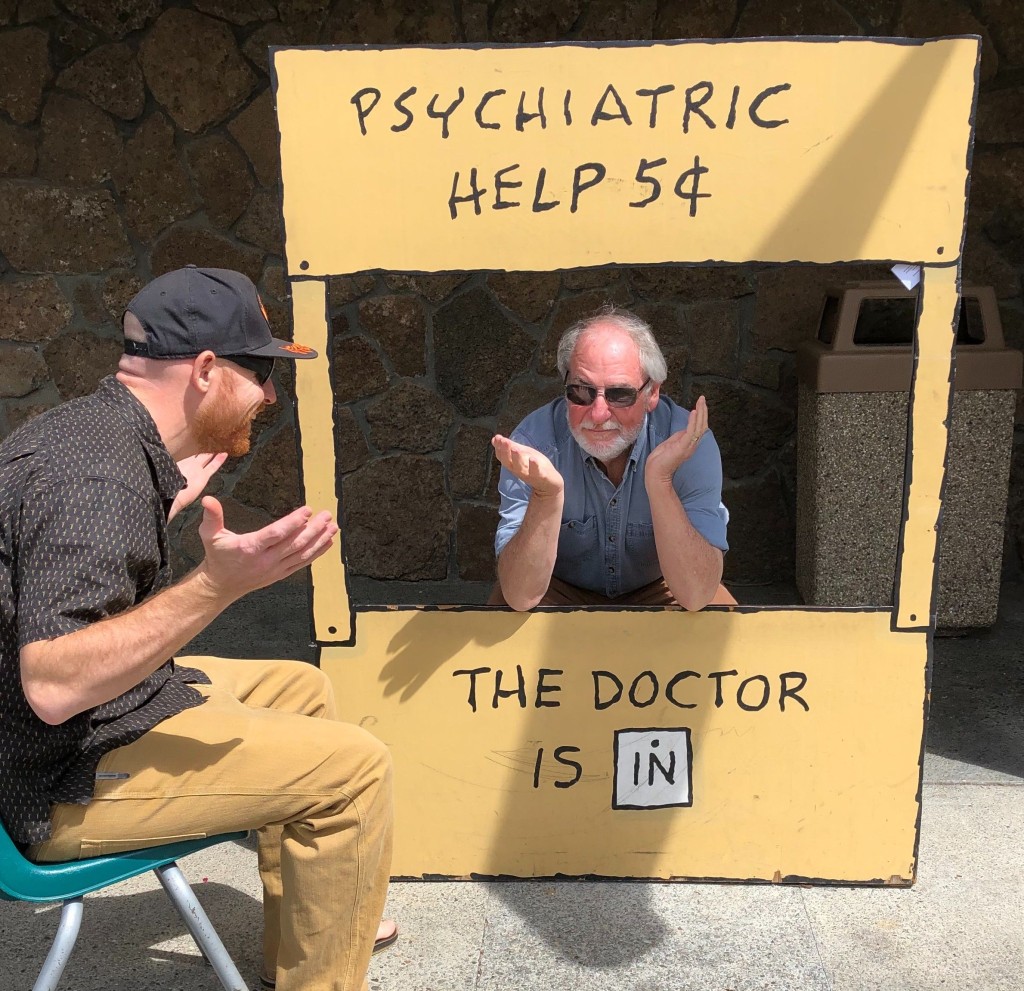
A native of Florida, Greg’s grandfather founded the city of Gulf Breeze, which is across the bay from Pensacola. He came north to West Virginia in support of his graduate degree in social work, which he attained in Morgantown at WVU.
Upon graduating, he was offered a job in Greenbrier County, where he met Libby and raised two children, Nick and Sarah. During that time, Greg’s career in social work spanned 30 years in several jobs doing crisis counseling, running group homes, and providing individual therapy.
In addition, he actively served the community through various boards and committees including Greenbrier Valley Theatre’s board, leading the scholarship program for Lewisburg Rotary, and co-founding the Lewisburg Literary Festival. As if that wasn’t enough, after retiring, Greg became a financial advisor.
I first met Greg in elementary school, as his son, Nick, was one of my dear friends. I spent many hours at the Johnsons’ log cabin, playing baseball, watching movies, and learning life lessons from Greg. He was the same man then that he is now–a fountain of ideas, with the energy, enthusiasm, and goodwill to act on those ideas.
So when he wasn’t doing social work, providing financial advice, or serving the community, he was writing. Ever since that first assignment for the school paper in fourth grade, Greg has been writing down his ideas.
And for his first play, he went back to his Florida roots.
The Playwright

“I was serving on the Greenbrier Valley Theatre (GVT) board when Cathey Sawyer, the artistic director, made a passing comment about the lack of plays with strong women characters,” Greg remembers. “I thought the late Florida writer Marjorie Kinnan Rawlings was an incredibly strong woman and would be a good subject.”
Rawlings won the Pulitzer Prize for Fiction in 1939. She lived in Cross Creek, Florida. In a home that is now a state park.
“I’d heard of her because of my upbringing in Florida,” Greg recalls.
“I went and I looked at her house and then I realized somebody told me that the woman who had been her maid, Idella Parker, was 83 years old and still living.”
And…he had an idea.
“Marjorie got sued by somebody that she had used as a character in a nonfiction book who didn’t like the way she’d been depicted,” Greg explains. “Although, everybody who knew the woman said, ‘This is exactly what the woman is like.’”
“And I thought, I wonder if Idella Parker would talk to me about Marjorie,” says Greg. “And so I got in touch with Idella, and we became friends, and she worked with me on the play.”
Mrs. Rawlings Mess would be Greg’s first play. Idella Parker came to the premier to see the final product at the Greenbrier Valley Theatre in Lewisburg, WV.
For his next play, Thursday’s Child, Greg decided to pick a subject closer to his new home in West Virginia, focusing on the painter P. Buckley Moss.
“I stopped by P. Buckley Moss’s art gallery in Waynesboro, VA, once,” Greg shares. “I realized that this woman, who had severe dyslexia and couldn’t read, had built a wildly successful art career from absolutely nothing. She was so successful she was able to donate $10 million to Virginia Tech, and they named their center for the creative arts after her.”
“I met Pat, we became friends, and she worked with me on a play about her unusual life. She and some of her family members traveled to Lewisburg for the premiere and stayed here several days. She painted a poster for the play that’s still sold in her galleries.”
Both plays, centering on strong women, were directed by Cathey Sawyer and included professional and local actors.
Breakfast at the Rosendales
In keeping with the theme of breaking barriers, another of Greg’s projects led to follow a man into a kitchen.
More specifically, he followed Chef Rich Rosendale of The Greenbrier Resort as he competed for the prized Bocuse d’Or, which is often referred to as “the Olympics of cooking.”
With the resort in Greg’s backyard, he pitched a story to The Washington Post.
“It turned out that the editor (of the Washington Post Magazine) and her husband were big foodies.” Greg recalls. “They knew what the Bocuse d’Or was and asked me to send them something else I’d written. “
“She called back like three hours later and said, ‘We want this.’”
In addition to following Chef Rosensale at the resort as he prepared alongside training from the world’s top chefs, Greg was invited to his house for breakfast one morning.
“I thought, ‘This is, this is gonna be great. Here I have a renowned chef who’s going to make me breakfast while he’s training to go off to France to compete for the United States.”
What did Chef Rosendale prepare for his biographer?”
“We had scrambled eggs, toast, and I think bacon,” Greg remembers with a laugh. “I thought, you know, these chefs don’t necessarily eat the way they cook.”
Rosendale went on to finish in the top third of the competition, backed by a successful profile Greg wrote the the Post Magazine. It was the largest paycheck he ever received for a writing assignment.
“I was able to take my family on a vacation,” Greg proudly shares. “And it worked out for him too. A producer for CBS read the piece and he ended up getting a TV show for a few seasons.”
A ‘whodunit’ about…climate change?
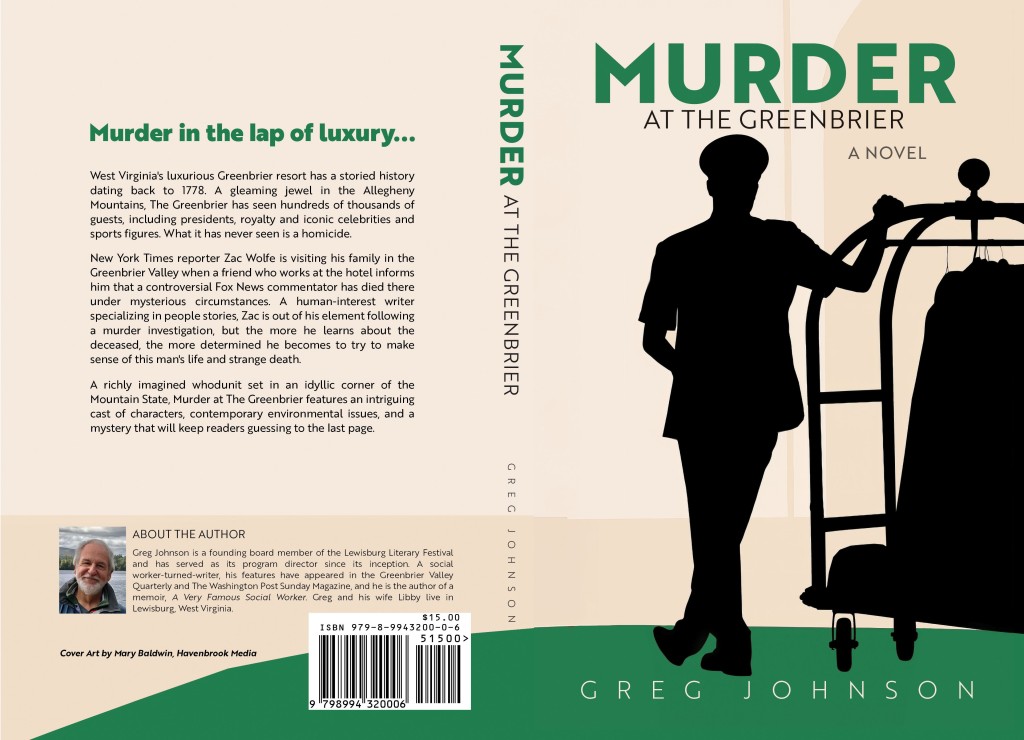
Greg’s latest work takes him back to the world-famous Greenbrier Resort, for his first murder-mystery novel. He admits he was “winging it” with a foray into a new genre.
“I wrote this book to entertain myself, and my hope is that other people find it entertaining,” Greg says. “And maybe a little bit thought-provoking when it comes to environmental issues.”
“I want this to be more than just a book about a murder,” he says. “I don’t want it to be an Agatha Christie kind of thing where that’s all there is to it. I want the book to have some sort of meaning.
“So I decided that the person who was going to be murdered was going to be a Fox News commentator, and he was going to be the voice of climate change denial for the network. And so,he dies in the first chapter and you don’t know until the last page who actually did it.”
I asked Greg why it was important for him to interweave climate change in a murder mystery? Was that always the issue or did he consider others which would have functioned similarly in the story’s development?
For Greg, it was always climate change.
“That seems to me to be the overriding issue of our time,” he says. “Wars come and go. Disputes come and go. Politicians and leaders come and go. Even nations come and go. But we only have one planet and it’s foolish not to worry about taking care of it.”
“So, it just seems to me that that’s such a large topic that it might be a reason somebody would kill somebody.”
Other pivotal characters in the book include Zac Wolfe, a New York Times reporter who grew up in Frankford, WV, and is back home visiting family when the murder occurs. “Homicide isn’t his normal beat,” Greg says, “But he decided to pursue the story with his editor’s blessing.”
Perhaps his favorite characters to write were the students of a high school environmental science teacher who is involved in the plot. “They’re funny, witty kids, and I loved writing scenes with him.”
‘Edited Thinking’
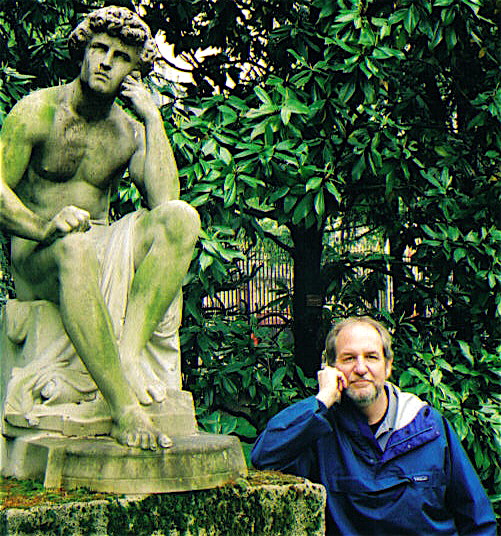
I ask Greg what’s next for him?
“I’m not sure yet, but I’m sure I’ll have an idea,” he replies.
Whatever is next, Greg will certainly continue to write. Because for him, writing is a way of making sense of the world.
“I call writing ‘edited thinking,’” he says. “Sometimes when we speak, the right words don’t come out. But when you write, you can keep working at it until you have the right words. And to me, that’s very rewarding.”
“Very few people are so articulate that every time they open their mouth, it pours out the right way. But writing gives you a chance to go back and fix that. And so you can say what you’d like to say. That’s why I say writing is edited thinking.”
It’s the kind of nuanced view of the written word you would expect from a man whose family devours books.
“I grew up in a family of readers,” Greg shares.
His favorite books are coming-of-age stories. “We’ve been fortunate to have authors of some of the great ones at the Lewisburg Literary Festival–Homer Hickam with Rocket Boys, Jeanette Walls with The Glass Castle, Tobias Wolff with This Boy’s Life, and Tara Westover with Educated.”
Having come of age around Greg, I appreciate his ability to continually hone his “edited thinking” skills by taking on new challenges. It allows him to blend wit and weight in complex characters that keep you on your toes as a reader.
I can’t wait to see what his next idea will be.
Murder at The Greenbrier is available via Amazon and in person at A New Chapter Bookstore in Lewisburg (along with other local stores across West Virginia). An audiobook version is currently being recorded by Eric Fritzius and will be available soon.