Riley Gaines Act signed into West Virginia law by Gov. Morrisey
By Autumn Shelton, RealWV
CHARLESTON, W.Va. – The first major piece of legislation to be signed into West Virginia law by Governor Patrick Morrisey became the “Riley Gaines Act,” which defines sex-based terms such as “male” and “female,” and provides private single-sex spaces for women in locker rooms, prisons, bathrooms and more.
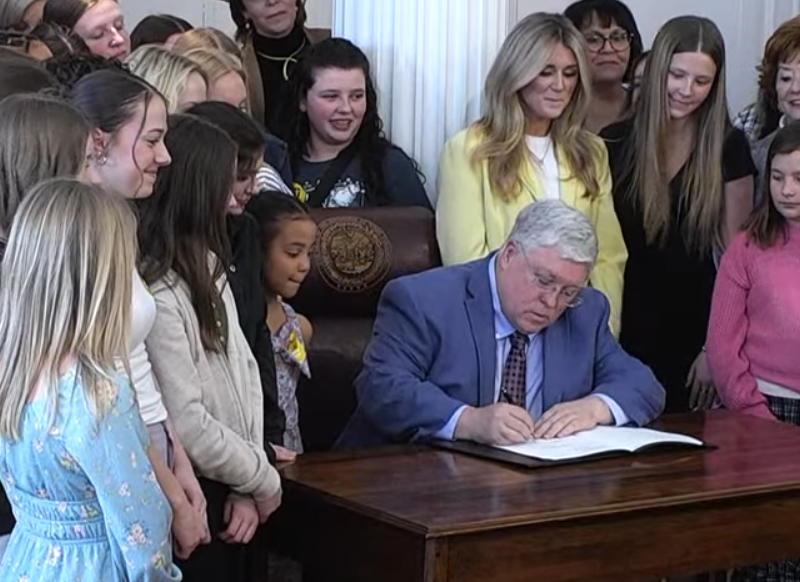
The Riley Gaines Act, SB 456, was signed by Gov. Morrisey on March 12 in front of an audience of women, legislators and other officials who championed its passage.
“This is something we have all been working on for a very long time,” Morrisey began, calling the signing a great day for West Virginia.
Morrisey continued by highlighting the stories of two West Virginia athletes, including Harrison County track and field athlete Emmy Salerno.
“Emmy and her teammates from Harrison County were forced to compete against a male in track and field,” Morrisey said. “Emmy bravely took a stand and refused to participate. We are grateful for Emmy’s courage.”
In a statement from Salerno, provided by the Governor’s office, she said, “Thanks to Governor Morrisey and the West Virginia legislature, I no longer have to worry about facing sex-discrimination. He stood by me as Attorney General, and now as Governor, he is fulfilling his promise to Stand with Women. I am grateful for Gov. Morrisey’s persistent leadership as a Stand with Women champion, fighting for the rights of women and girls across the state.”
Adaleia Cross, another athlete from Harrison County, was praised by Morrisey for her courage and her voice.
According to Morrisey, Cross had to share a locker room with a male, but after raising concerns with school officials with no success she eventually “took on the Biden administration’s unlawful changes to Title IV laws.”
“This is an issue that has nearly universal support,” Morrisey said of providing single-sex spaces to females. “Yet the woke left – they always dig in their heels and they try to force the rest of the country to adhere to the radical gender ideology. Well, that’s not going to happen here. That’s not going to happen in West Virginia.”
The bill’s namesake, former collegiate athlete Riley Gaines, was in attendance to discuss her experience and her advocacy.
“By now, many of you are probably familiar with my story,” Gaines said. “I was a member of the University of Kentucky women’s swim team where I very proudly finished my career as a 12-time NCAA All-American, a five-time SEC Champion, actually the SEC record holder in the 200 butterfly, making me one of the fastest American’s of all time, two-time Olympic trial qualifier, SEC Scholar Athlete of the Year, SEC Community Service Leader of the Year, the list goes on.”
According to Gaines, during a national championship, she was standing on the block “looking over at the lane next to [her] and seeing a man standing eight, nine inches taller than me, visible Adam’s apple from his side profile, his feet, size 15, taking up the entire diving block.”
Gaines said that she also had feelings of “utter violation, betrayal and humiliation,” in the women’s locker room when a “fully intact” man who identified as female was exposing himself. However, she was met with “emotional blackmail” when she tried to discuss her concerns with officials.
Although Gaines said that she could go on about her experience, the day was about celebrating a win for West Virginia’s females and women’s rights.
“Thanks to Governor Morrisey and the West Virginia prioritization of a bill that defines sex and preserves women’s spaces, nearly a million West Virginian women and girls will not be subject to embarrassing and, oftentimes, even dangerous experiences in their private spaces,” Gaines said. “And, equally as important, his signature defines common sense sex-based words like woman and man. Now, when these words are used in West Virginia, in the state statue, they mean something.”
Related Articles
How 22-year-old entrepreneur Alex DeGraff has built a vibrant life in Appalachia
This story is part of RealWV’s year-long focus on youth and belonging in West Virginia, exploring the difficult decisions young people face when deciding whether to stay or leave.
Real West Virginian of the Week: From India to Appalachia, Madhur Bedre finds home and opportunity in West Virginia
This story is part of RealWV’s year-long focus on youth and belonging in West Virginia, exploring the difficult decisions young people face when deciding whether to stay or leave.