WV House passes bill requiring that municipal elections occur on same day as statewide elections
By Autumn Shelton, RealWV
CHARLESTON, W.Va. – Members of the West Virginia House of Delegates passed Senate Bill 50 on Monday, which would require that municipal elections be held on the same day as statewide primary or general elections.
As explained by Del. JB Akers II, R-Kanawha, Chair of the House Judiciary Committee, the bill was recently amended by the House to allow for the new law to take effect in 2028, instead of 2030 and 2032 as was written in other versions of the bill.
This new House amendment requires that the Senate be in agreement before the governor may sign the bill into law. It previously passed the Senate on March 3 with a unanimous vote – only one senator being absent.
Del. Larry Kump, R-Berkeley, said this bill would end the ‘good ol’ boy’ network of voting throughout the state.
“Senate Bill 50 will eliminate the tax bill burden of holding these special elections, but, importantly, will also increase voter awareness and election turnout,” Kump stated.
Kump explained that in Berkeley County, two municipalities hold elections – Martinsburg and Hedgesville. However, Martinsburg, with a population of about 20,000, only has a municipal election voter turnout of about 200-300. Hedgesville, with a population of about 300, only has a municipal election voter turnout of about 20.
“The history of these flat-out goofy and obscure election dates goes back with me to 1991 when I moved to West Virginia as a refugee of the People’s Republic of Maryland,” Kump said, adding that when he asked about the “weird election dates” he was told “It simply is the West Virginia good ol’ boy system of government, where these elections help entrench government officials, ensure that their supporters got out and voted for them while keeping most of the rest of us voters in the dark.”
In 2022, Kump said that previous House Bill 2592 “prohibited the practice of routinely scheduling special elections, such as school levies on obscure dates – usually on a Saturday,” but did not address municipal election dates.
After Del. Kump spoke, Del. Mike Pushkin, D-Kanawha, questioned if the bill requires nonpartisan municipal elections to be held during a primary or general election.
Del. Akers stated that the bill “is silent on that.”
“I would have to imagine from practical application that a nonpartisan race would be handled in the same way as judicial races are now, which is nonpartisan, so I think that would be in the primary,” Akers said. “I would think that the municipalities can schedule that way. I don’t know of a legal challenge you would have to that, but I can’t promise you someone wouldn’t try.”
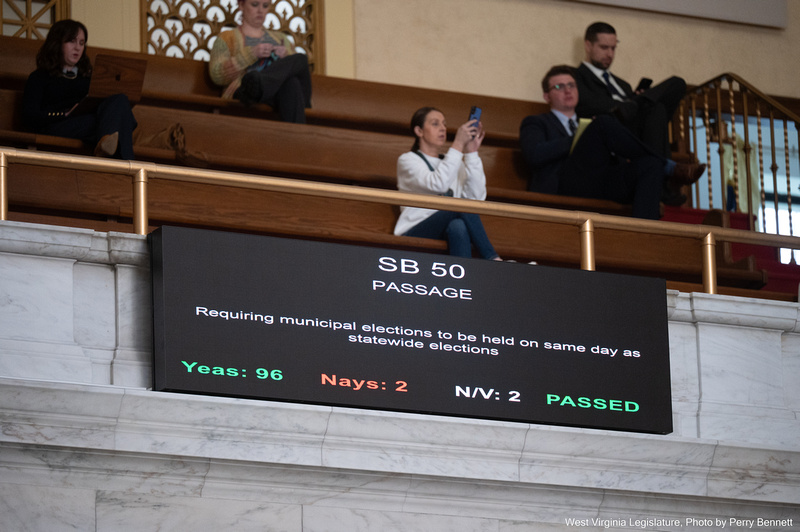
The bill passed the House with 96 yes votes, 2 no votes, and 2 members absent.