
Senate approves Morrisey’s plan to reorganize governmental departments
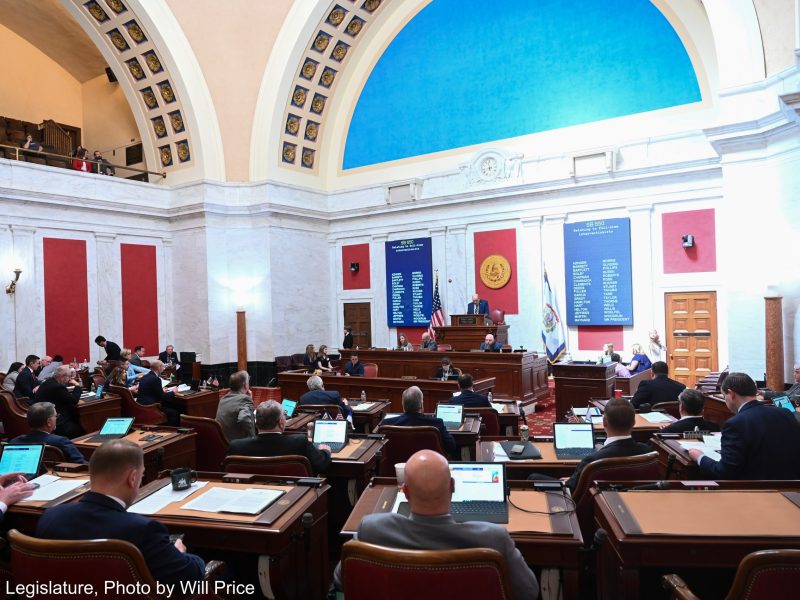
By Autumn Shelton, RealWV
CHARLESTON, W.Va. – The West Virginia Senate passed Gov. Morrisey’s government reorganization bills on Tuesday. Those bills are intended to bring the Department of Economic Development into the Department of Commerce and reconstitute it as the Division of Economic Development, to bring the Department of Arts, Culture and History into the Department of Tourism, and to exempt new hires and employees who leave their positions within the Bureau of Senior Services, Department of Administration, Department of Environmental Protection, Department of Revenue, and Department of Veterans’ Assistance from the classified civil service system and state grievance procedures beginning on July 1, 2025.
Merging the Department of Economic Development into the Department of Commerce and reconstituting it as the Division of Economic Development
House Bill 2008, was introduced in the House of Delegates at the request of the governor on February 18. The House passed the bill on March 11 by a vote of 61 to 37, with two delegates being absent.
As explained by Sen. Patricia Rucker, R-Jefferson, chair of the Senate Government Organization Committee, on Tuesday, this bill places the Department of Economic Development into the Department of Commerce as it was prior to 2020.
“The bill also makes employees hired after July 1, 2025 within the Department of Commerce, the Division of Economic Development and all included agencies, classified exempt,” Rucker explained. “Current employees, however, will maintain classified status for as long as they remain in their current position.”
A strike and insert amendment for the bill was adopted on Tuesday, which makes technical changes and eliminates two of the bill’s sections – one that transfers the Department of Natural Resources (DNR) to the Department of Homeland Security and one that makes DNR police an exception to the transfer of employees classified exempt status, according to Rucker.
An amendment by Sen. Robbie Morris, R-Randolph, was also adopted which would move the WV Broadband Enhancement Council to an agency within the Department of Commerce.
Amendments proposed by Sen. Eric Tarr, R-Putnam, to keep the Secretary of Economic Development and the Department of Economic Development separate from the Department of Commerce, and Senate Minority Leader Mike Woelfel, D-Cabell, to allow civil service protections and grievance procedures remain for employees were rejected.
The bill passed by a vote of 25 to 9, and will now go before the House of Delegates for concurrence on the new amendment before it heads to the desk of the governor. If approved, it will take effect on July 1, 2025.
Bringing the Department of Arts, Culture and History into the Department of Tourism
House Bill 2009 was introduced into the House of Delegates on February 28 and was requested by the governor.
Rucker explained that this bill, like SB 2008, would make employees hired after July 1, 2025 classified exempt. Current employees will maintain classified status as long as they remain in their current position.
A strike and insert amendment was approved for this bill which made technical corrections and added clarifying language regarding the transfer of employees from classified to classified exempt status.
An amendment proposed by Sen. Joey Garcia, D-Marion, to allow employees to retain their civil service protections and grievance procedures was rejected.
Speaking against the amendment was Senator Scott Fuller, R-Wayne, who said that civil service protections “doesn’t promote the best out of most individuals.”
“Most individuals on that would prefer using the merit system,” Fuller said. “What is really does is protect those who aren’t your top employees and top workers. Most of those people would prefer to not be on the civil service because they are only protecting those who aren’t doing their job.”
He said that employees are well-protected under current law, and that this bill gives employees a better chance to advance their career.
“It’s the best way to reward your employees, and it’s the best way to get productive work out of your employees,” Fuller said.
Garcia responded that his amendment is meant to “prevent some of the abuses that have happened in the past in state government . . . where cronyism is what happens.”
“These protections are there to make sure that it doesn’t happen because we have changes in government potentially every four years, and so while many of these civil servants, many who have served a long period of time, continue to do their work and will continue to be hired, and this doesn’t go backwards, but it does go forwards in eliminating that protection when they get a new administrator, when they get a new director, when they get somebody in there who may just want to bring in people that they like – not necessarily the people who do the job.”
Another amendment proposed by Garcia to amend educational requirements for the library section director was also rejected.
Prior to the bill’s ultimate passage, Sen. Bill Hamilton, R-Upshur, referred to it as “a bad bill.”
“I think, last count I heard this morning, I had 300 plus emails that are against this bill,” Hamilton said. “People are worried about their jobs.”
He continued that the bill “is moving us back 50 plus years.”
“This is just the forebode of what’s coming. They’re gonna come back next year and they’re gonna do the rest of the employees. I guarantee it,” Hamilton concluded.
Rucker responded “we are not ending the grievance process, and that the bill “is a very good bill.”
“I also had discussions with many of the folks around the state who emailed or called. Most times that there are problems or issues it gets resolved at the HR level. It does not get exacerbated,” Rucker said. “When you have a system that is based on merit, you have a system that rewards good, hard-working individuals. When you have a system that is not based on merit, there is no incentive or very low incentive. Fortunately, we have mostly great, hard-working individuals and those individuals are the ones not worried about this because they know that they show up on time, they know that they work the full hours, they know that they are responding to phone calls and issues with constituents. They are not concerned about this legislation.”
She said that people being fired for no reason is “inhumane.”
House Bill 2009 was passed by a vote of 24 to 10, and is now headed before the Senate for concurrence. It would be made effective July 1, 2025.
Exempting new hires and employees who leave their positions within the Bureau of Senior Services, Department of Administration, Department of Environmental Protection, Department of Revenue, and Department of Veterans’ Assistance from the classified civil service system
House Bill 2013 was introduced in the legislature on March 17 at the request of the governor. It passed the House on March 31 by a vote of 69 to 30, with one absent vote.
According to Rucker, beginning on July 1, 2025, all new hires and employees who leave their position at the Bureau of Senior Services, Department of Administration, Department of Environmental Protection, Department of Revenue, and Department of Veterans’ Assistance will be exempt from classified civil service and the state’s grievance procedures.
“It does not affect anyone who remains in their current position,” Rucker explained. “This change is essentially the same as the bills we just passed – 2008 and 2009. The bill further provides that the chief administrative officer of these governmental units shall have the authority to designate certain employee status under the classified civil service system and grievance procedures which may be deemed necessary to comply with federal law, federal regulation or the requirements of federal receipt of federal funding or assistance.”
Lastly, Rucker stated that the bill clarifies that “nothing in the bill removes protection from nepotism, favoritism, discrimination or unethical practices.”
House Bill 2013 passed by a vote of 24 to 10. It is now heading back to the House for concurrence.
In a press release from the governor’s office following the passage of these bills, Gov. Morrisey provided the following statement:
“I pledged to make state government more efficient and accountable to the people we serve, and these bills will help us do just that.”