
‘It was never just a headache, it was a monster’ – June proclaimed ‘Headache and Migraine Awareness Month’ in WV
By Matthew Young, RealWV
“For most of my life, the only normalcy I knew involved chronic pain. Migraine disease has been present in my life since I was a toddler.”
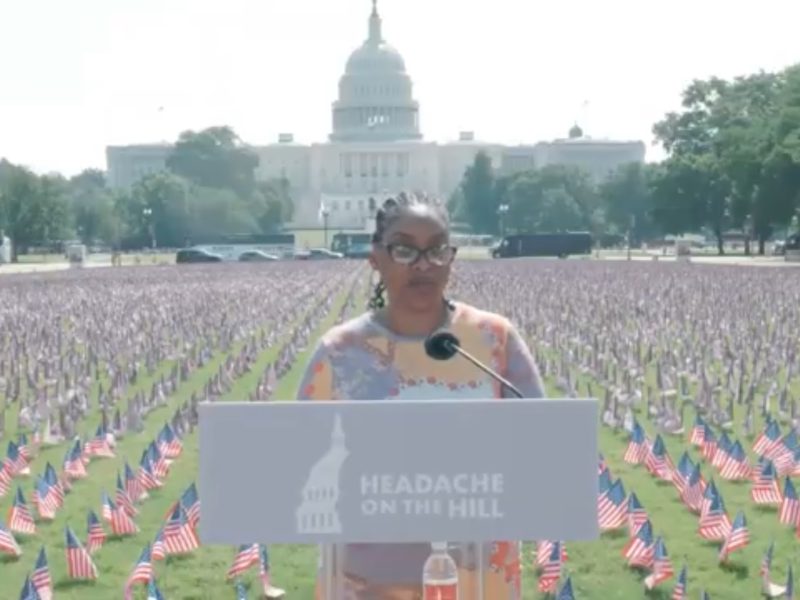
That’s what Virginia-native Jaime Sanders shared with those gathered on the National Mall in Washington D.C. last week, during the “Headache on the Hill – Flags for Headache” advocacy event. As the only nationally-recognized event exclusively dedicated to advocating on behalf of the approximately 40 million Americans living with headache disorders, Headache on the Hill brings together both headache sufferers and medical professionals from around the country, in support of legislation designed to positively impact those affected.
“I had my first migraine attack at eight-years-old, and was diagnosed by both my pediatrician and a neurologist,” Jaime continued. “My mother’s side of the family had a history of migraine, but I was told I’d outgrow them by the time I turned 18.”
Despite the early prognosis, Jaime’s migraines persisted well into her twenties, sometimes striking as often as eight times per month. By 27-years-old, Jaime’s migraines had become chronic, and by 28, persistent headaches were an everyday occurrence.
“Pain was a daily constant in my life,” Jaime said. “Living with chronic migraine is like navigating a minefield, never knowing when the next exposure to pain will come. As a child, the searing headaches were misunderstood and dismissed by those around me. ‘It’s just a headache,’ they’d say.”
“But it was never ‘just a headache,’” Jaime added. “It was a monster that consumed me, leaving me in a dark room isolated from the world.”
According to the American Migraine Foundation, “At least 39 million Americans live with migraine.” However, the foundation adds that as many who suffer receive neither the proper diagnosis nor the treatment they require, “the actual number is probably higher.”
In West Virginia, it is estimated that more than 200,000 residents – or 12% of the state’s population – suffer from migraine disease. A 2019 report by Cassie Thomas with the West Virginia University (WVU) School of Medicine indicated that of those more than 200,000 sufferers, approximately 20,000 endure chronic migraine – a situation which is exacerbated by the state’s shortage of neurologists. According to research conducted by WVU Headache Center Director David Watson, along with WVU’s Headache Center’s Umer Najib and former neurology resident Melissa Moore – research which Thomas based her reporting on – West Virginia has “just half the neurologists it needs.”
“There’s no way that 20,000 people can all be seen by a neurologist, much less the few certified headache specialists in the state,” Watson told Thomas at the time of her report.
A database maintained by U.S. News & World Report shows there are 24 doctors in West Virginia who treat headache disorder, or one doctor for every 833 migraine sufferers. And as the state’s only three doctors who are board-certified by the United Council of Neurologic Subspecialties (UCNS) are located at the WVU Headache Center in Morgantown, rural or impoverished residents have severely limited access to proper care, with the average patient traveling 70 miles or more one-way.
The concern, however, stretches beyond the boundaries of the Mountain State. During his research, Watson learned that for every specialist certified in headache medicine, some 8,000 Americans suffer from migraine. It is precisely these inequities in access, as well as shortfalls in research funding, which the Headache on the Hill event sought to bring attention to.
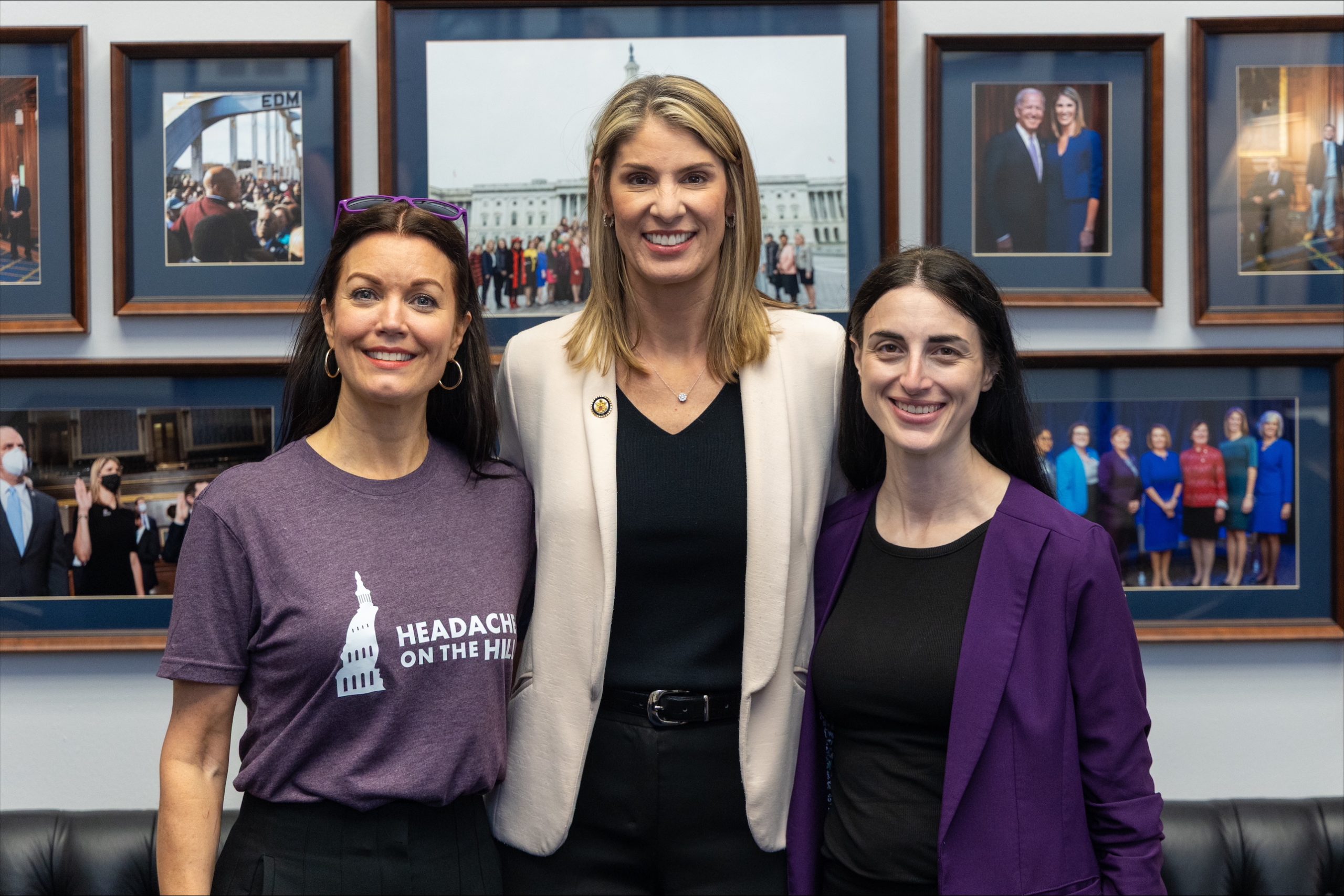
Organized by the Headache Alliance and the Alliance for Headache Disorders Advocacy, the Headache on the Hill installation project saw the National Mall transformed into a sea of purple as both recognition of those Americans plagued by the debilitating ailment, as well as a “call to action” in support of the proposed national HEADACHE (Headache Education, Access, Diagnosis and Care Equity) Act. Sponsored by Congress Member Lori Trahan, D-MA., the HEADACHE Act “would expand research, improve access to care, and address systemic inequities affecting people living with headache disorders.”
“Headache disorders affect nearly 45 million people in the U.S., including more than 117,000 people in the district I represent,” Trahan said. “Behind each of those numbers is a student falling behind in school, a parent fighting to stay employed, or a veteran enduring chronic, debilitating pain.”
And in West Virginia, due in large part to the advocacy of WVU Medicine’s Pediatric Craniofacial Center Coordinator Michele Vidulich, as well as Keyser-resident Andrea Kraft, an unexpected ally to those suffering has emerged in the form of Gov. Patrick Morrisey. Already gaining notoriety with his “Mountaineer Mile” physical fitness initiative, Morrisey proclaimed the month of June as “Headache and Migraine Awareness Month” in West Virginia.
“As a migraine sufferer since my mid-twenties, a concussion many years later caused a severe escalation to chronic status migraine which made life challenging for me,” Vidulich told RealWV. “Thanks to expert care from Umer Najib, MD at the WVU Headache Center I have been able to get back in control,”
“Many people in West Virginia and the US lack the ability to receive the expert care of migraine specialists and suffer from inadequate treatment,” Vidulich added. “Migraine is understudied and underfunded. With more research, awareness and understanding we can move forward to reduce the heavy burden of migraine sufferers. Migraine affects over a billion people in the world! I am very fortunate to be able to have excellent care but with more awareness and funding all migraine patients should be having headache free days also!”
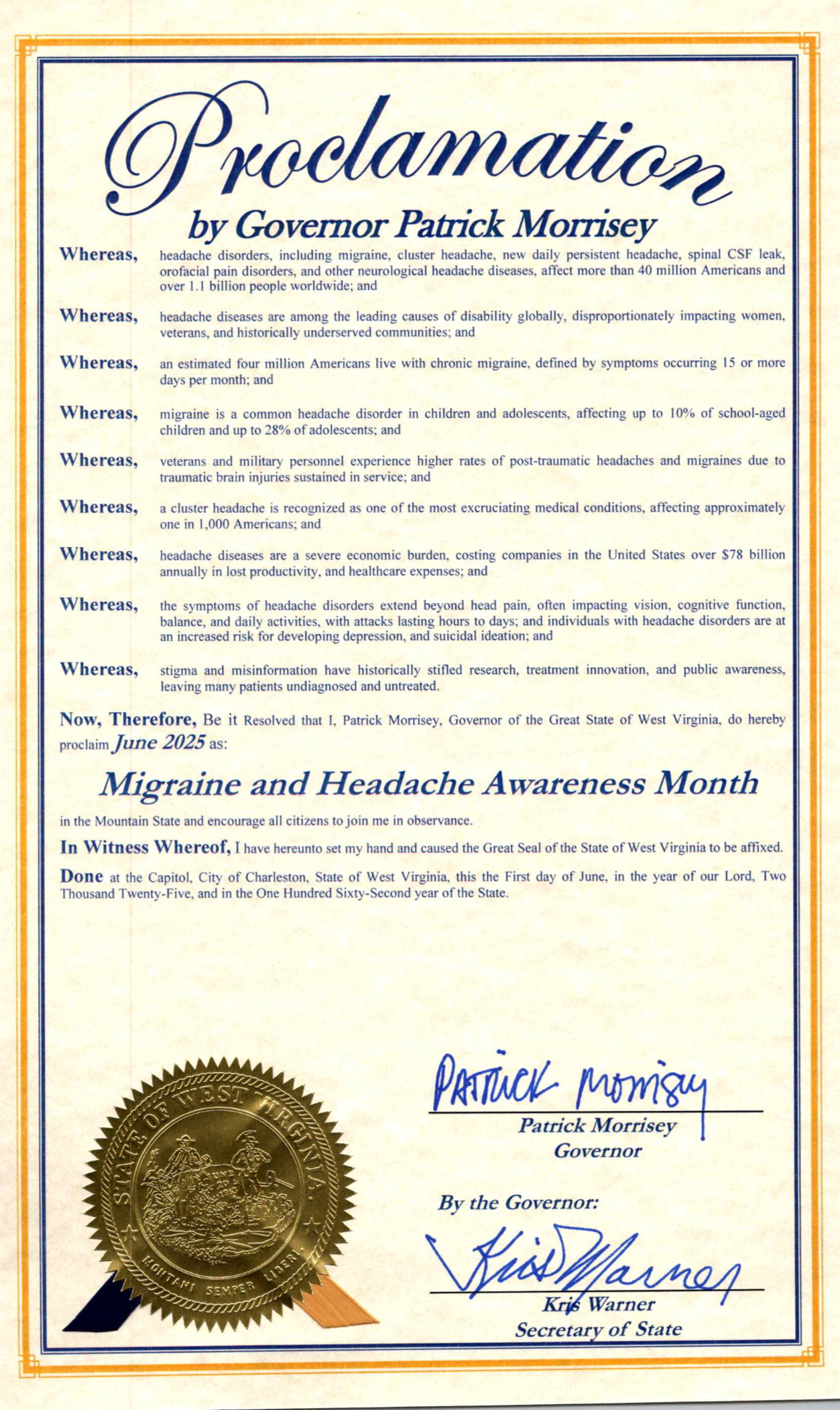
“With over 266,000 West Virginians living with migraine alone, the Governor’s proclamation is a powerful step forward,” said Julienne Verdi, Executive Director of the Alliance for Headache Disorders Advocacy. “It sends a clear message to patients and their families that their pain is no longer invisible; that migraine and headache disorders are serious public health issues that deserve recognition, education, and action.”
“For a disease that so often goes unseen and misunderstood, this kind of public acknowledgment helps reduce stigma and builds momentum toward better care, greater awareness, and meaningful change across West Virginia,” Verdi added.
For more information – including resources, testimonials, and ways to get involved – visit flagsforheadache.org.