Return of the Presidential Fitness Test? Morrisey announces Rural Health Transformation Program application has been submitted
By Autumn Shelton, RealWV
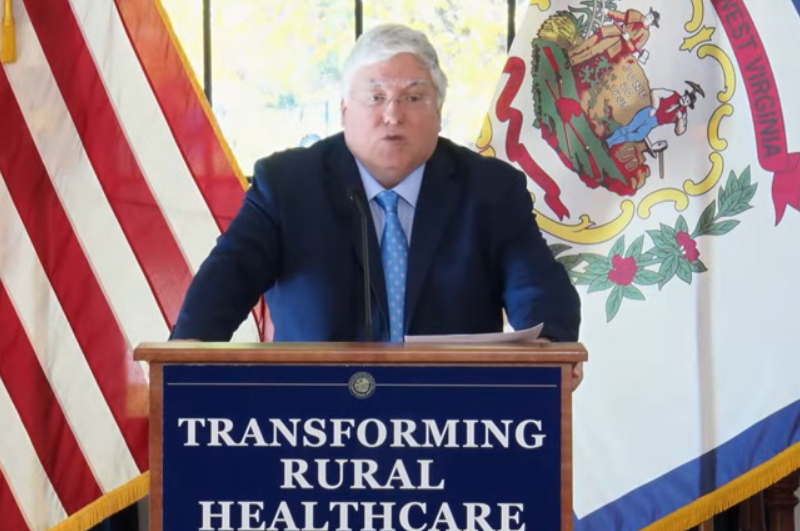
CHARLESTON, W.Va. – On Wednesday, Gov. Morrisey announced that the state’s application for the federal Rural Health Transformation (RHT) Program, designed to provide states with funding to improve rural healthcare outcomes and accessibility, has been submitted.
According to Morrisey, numerous stakeholders provided input to ensure the application, which was due on Nov. 5, was completed quickly and focused on plan ideas that would strengthen the state’s rural healthcare system.
“We’ve got a powerhouse team working on these issues,” Morrisey said, adding that many people spent long nights working on the plan.
Back in September, when the RHT program was unveiled, Morrisey asked West Virginians to provide their input on rural healthcare in an effort to develop this statewide plan, which may secure the state’s portion of $50 billion in federal funding as part of the “One Big Beautiful Bill.”
At that time, Morrisey explained that funding from the RHT program would be “transformational” for the state in terms of rural healthcare.
“The way they set up this program, there’s $25 billion that will be evenly divided among the 50 states,” Morrisey said during a press conference in September, adding that the state’s portion would be $100 million per year for five years. “And then there’s discretionary dollars as well that will be allocated to the states based upon the application that they submit, based upon the rural nature of the state, and also various policies that the states elect to pursue.”
Despite the potential loss of billions in Medicaid dollars in West Virginia, also part of the “One Big Beautiful Bill,” Morrisey has championed the alternate RHT program as well as U.S. Department of Health and Human Services Secretary Robert F. Kennedy Jr.’s Make America Healthy Again (MAHA) movement.
Creating his own four-pillar health initiative, “Clean Up the Food; Find Purpose, Find Health; Move Your Body, Change Your Life; and Reward Healthy Choices,” Morrisey has implemented a ban on certain food dyes through House Bill 2354, now facing a lawsuit; advocated for a soda to be removed as a SNAP entitlement; implemented work, training, and education requirements for SNAP recipients, and founded the “Mountaineer Mile,” a statewide initiative challenging West Virginians to get out and walk a mile each day.
According to Morrisey, the RHT program application plan “builds on the success of his four-pillar health initiative,” has “seven core areas,” including:
- Building infrastructure for on-demand virtual and in-person care, such as telehealth services and EMS treatments
- Developing a “one-stop shop” Rural Health Link that would help those who need transportation to healthcare facilities access rides through public transit, ride-sharing and EMS transport
- Additional recruitment, training, and retaining of healthcare workers
- Supporting technology enabled innovation and regulatory relief, such as facility modernization grants, group purchasing and supporting rural providers to move to value-based payment models
- Creating a “Health to Prosperity” pipeline in order to help residents get healthy, get back to work and transition off Medicaid and into commercial insurance
- Empowering healthy living through food as medicine, movement, and local partnerships, such as through the return of the Presidential Fitness Test and emphasizing the importance of movement
- Incubating “leapfrog technologies that innovate healthcare delivery and unlock economic growth,” such as funding for artificial intelligence tools and partnering with universities and venture firms to create a sustainable rural innovation ecosystem.
More information on these seven initiatives can be found here.
Also, during Wednesday’s press conference, Secretary of the West Virginia Department of Health, Dr. Arvin Singh, said that the state’s plan for rural healthcare has the potential to improve healthcare outcomes, increase healthcare access and create stronger economies.
“Together we’re proving that West Virginia can lead the nation in showing what rural transformation truly looks like,” Dr. Singh said.
A summary of West Virginia’s application can be found here.
“If we do this right, this is an economic initiative in economic development like we’ve never seen before,” Morrisey concluded. “We don’t know the final amount that we’re gonna get, obviously. We believe that the statue will provide what we think will be the minimum of $500 million, but it’s up to CMS (Centers for Medicare and Medicaid Services).”
Morrisey said patience is important.
Award decisions are scheduled to be made by December 31, 2025.