SUNDAY SERMON: Our better angels
By Rev. Stephen Baldwin
Acts 5.27-29
Psalm 48
Ever since I was a kid, the only things I loved as much as pro wrasslin’ were the Christian church and the United States of America.
In between my sophomore and junior years of college, as a result of the generosity of a couple I met through the Presbyterian church, I was able to live in Washington, DC, one summer working on Capitol Hill in the office of West Virginia Senator Jay Rockefeller. It was an unforgettable experience.
I loved riding the train to work each day over the Potomac River, which dropped me off by the Library of Congress. I then walked by the Capitol on my left and the Supreme Court on my right, as I headed for the Russell Senate office building, a place where many of my childhood heroes worked.
One day, I saw Sen. John McCain in the Senate cafeteria and waved to him, as if we were old friends. He smiled and nodded, a gesture of kindness I certainly didn’t deserve.
I loved visiting the Lincoln Memorial on the weekend, using the Capitol Subway System to go back and forth delivering things for the senator’s office, writing letters back home to constituents and using the autopen to add Sen. Rockefeller’s signature, and meeting other young people from all across the nation who were all living their dream as well.
We were the biggest bunch of patriotic nerds you’ve ever seen, and we loved every single minute. Even the job of opening mail outside the building in the street, in case it was laced with anthrax, if you remember that crisis in the post 9/11 era, because we the interns were determined to save we the people.
As we celebrate the 250th birthday of the United States of America this weekend, it takes my back to those days in DC. Everywhere I looked, I saw red, white, and blue. Golden eagles and marble columns. Cherry blossoms and living history. And it filled me with pride for the land of the free and the home of the brave.
I sound like the author of Psalm 48, sharing with anyone who has ears to hear why I love our country so much: “Walk about Zion, go around her, count her towers, consider well her ramparts, view her citadels, that you may tell of them to the next generation. For this God is our God for ever and ever; he will be our guide even to the end.”
Just as we love our country, the Psalmist loved his. And as we’ve experienced when we’ve traveled, so our neighbors love theirs. It is a common human experience, whether we are Americans or Guatemalans or Canadians, to take great pride in our home and all it represents.
If you were to read the Declaration of Independence, which is something I commend to you this weekend, about ⅔ of the way down in the signatures is that of John Witherspoon. A man after my own heart–a Presbyterian minister who was the only clergy to sign the Declaration. He famously said it was more important to sign such a glorious document and be hanged than to die of old age. It was that important to Witherspoon, as a matter of his faith, to sign onto the American experience.
What made him so insistent? Let me read you a quote from his most famous sermon, given in 1776, about that topic. He said, “God grant that in America true religion and civil liberty may be inseparable, and that the unjust attempts to destroy the one, may in the issue tend to the support and establishment of both.”
This is a crucial distinction which most folks these days gloss over. Witherspoon, a Christian minister who was the only clergy to sign the Declaration of Independence, supported the founding of America as a matter of his faith because he thought religion could only be properly practiced in a nation of liberty, where government established no religion but instead guaranteed by right that everyone was free to believe as they choose.
Let me quote him one more time. “There is not a single instance in history in which civil liberty was lost, and religious liberty preserved entirely.”
So Witherspoon devoted his life to the American experiment not as a means of gaining power for his own self or his own faith, but as a means of ensuring that all people in a land of liberty could practice their faith and pursue happiness freely.
The great preacher William Sloane Coffin puts it this way in his book Credo about what patriotism means in today’s America. “How do you love America? Don’t say ‘My country, right or wrong.’ That’s like saying ‘My grandmother, drunk or sober’; it doesn’t get you anywhere. Don’t just salute the flag and don’t burn it either. Wash it. Make it clean.”
In today’s reading from Acts, the apostles are brought before the authorities for spreading the teachings of Jesus. They famously reply, “We must obey God rather than human authority!”
There are plenty of people today equating the two, saying that those who hold authority here on earth do so as a result of divine authority. The apostles teach us otherwise. They teach us that our duty as Christian citizens is to “wash it” and “make it clean.” Our duty is to hold our nation to its highest ideals and better angels.
The very values that made John Witherspoon sign the declaration as a Presbyterian minister. The values that made me fall in love with Washington as a young intern. The values that make us beam with pride as we watch the parade in Alderson each year.
Life. Liberty. And the pursuit of happiness. Not just for some, but for all. Because as Witherspoon taught us, if humans remove any God-given liberty, it’s all at risk.
Thanks be to God for 250 years in our home among the hills. May we humble ourselves before God and one another, just as the apostles did before the authorities, and realize that we are here but for the grace of God alone, with a deep and abiding responsibility to our creator God above all else and everyone else. Amen.
Related Articles
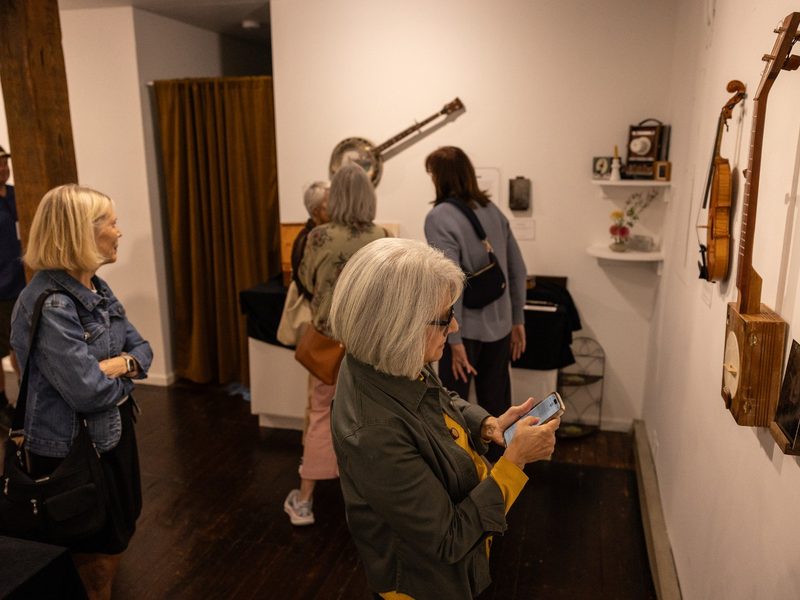
Shepherd University celebrates Appalachian culture at 30th annual heritage festival
Shepherd University celebrated its 30th annual Appalachian Heritage Festival on Sept. 25-27.

Real West Virginian of the Week: Liz Love finds belonging behind the camera in the New River Gorge
This story is part of RealWV’s year-long focus on youth and belonging in West Virginia, exploring the difficult decisions young people face when deciding whether to stay or leave.