Canterbury & McCoy discuss education, robots, & more at Shepherd’s Center candidate forum
By Stephen Baldwin, RealWV
LEWISBURG, W.Va. – With Delegate Todd Longanacre, R-Greenbrier, stepping aside from political office, the citizens of western Greenbrier County will soon have a new representative in the West Virginia House of Delegates.
The candidates are Ray Canterbury–a Republican from Ronceverte who is a farmer and former 16-year legislator, and Kayla McCoy–a Democrat from Lewisburg who is a chef, community organizer, and mother.
Canterbury hopes to tackle unfinished business under the dome, while McCoy dreams of a brighter future for her daughter’s generation.
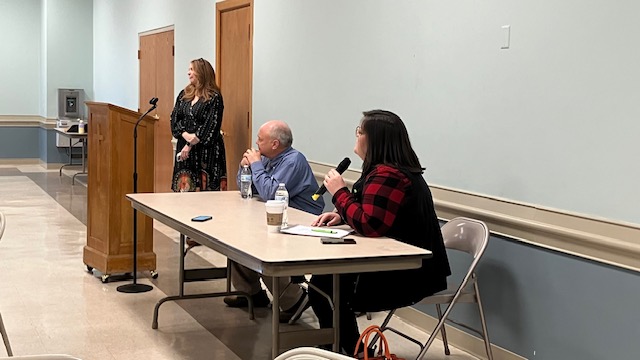
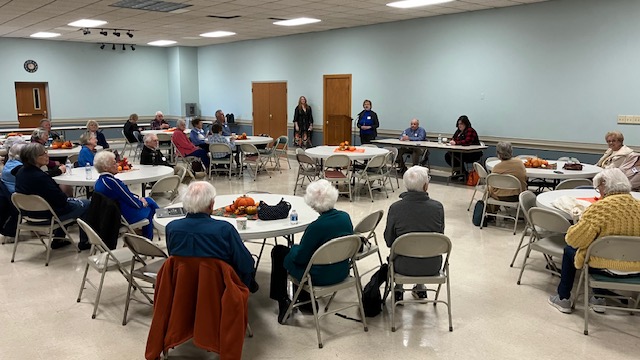
Both candidates accepted an invitation from The Shepherd’s Center, a program which caters to senior citizens, to come and answer questions in last Thursday’s “Current Events” class.
Introductory remarks
Canterbury began the event by offering introductory remarks, which he said would focus more on policy than personal information. “In 2014, the Republican party took control of the legislature for the first time in 83 years,” he said. “Since that time, there have been sweeping policy changes. Those policy changes have made the state a better place to do business and a better place to raise a family and they’ve made the state more fiscally sound.”
Debt, Canterbury feels, is perhaps the state’s most pressing issue in the future. He says the state has a public debt of $10-$15 billion dollars.
McCoy then took the microphone, saying, “I am a lifelong West Virginian, a chef by trade, but a community organizer by necessity. Since 2016, I’ve seen again and again how West Virginia’s government has failed to serve the people and have done my part to be part of the solution.”
McCoy was one of the founders of The Greater Greenbrier Long Term Recovery Committee following the flood of June 2016 and served as its director for several years, overseeing recovery efforts. “I am running because we need more helpers,” she told the crowd. “The letter after your name doesn’t matter; West Virginia needs better leadership.”
Question: Are homeschool requirements too relaxed?
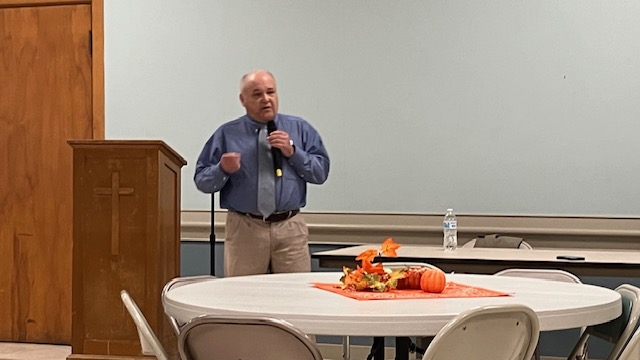
The first question came from a woman who wanted to know the candidate’s stance on whether homeschool requirements were too relaxed? Specifically, she wondered why homeschool students weren’t required to do annual assessments any longer to prove they were learning?
“I don’t know how it’s changed in the legislature but the last time I was there there were assessments,” Canterbury began.
“Well, there aren’t now,” the woman responded.
“I guess we’ll have to look at that,” Canterbury reiterated.
According to public voting records, Canterbury voted in 2016 to remove the requirement that homeschool students do annual end-of-year assessments. HB4175 relaxed academic guidelines for homeschool students, including a provision that end-of-year assessments would only be required three times during a student’s school career rather than annually.
Before McCoy responded to the question, the conversation shifted to another facet of education–benefits for public employees.
QUESTION: What will you do about PEIA?
The same woman then asked the candidates what their plans were to fund PEIA after the recent announcement that health care costs rates are increasing significantly again in the coming year on top of two straight years of double-digit increases?
“That will be a budget issue,” Canterbury replied. “Health care costs are the underlying cause of that. It’s going to be hard to say how we’re going to respond until we actually look at the numbers next year. It’s very complicated.”
McCoy agreed that it is a budget issue, but wants to see public employees be a priority. “If we can’t hire and retain public employees, they will go elsewhere. We border so many states that offer so many better benefits–pay, insurance, health care that allows them to have their spouse on their plan. We need to reprioritize our budget. We need to pay them what they’re worth and make sure they can go to the doctor when they’re sick and get meds when they need them.”
QUESTION: Plans for child care policies and accountability for kids in state care?
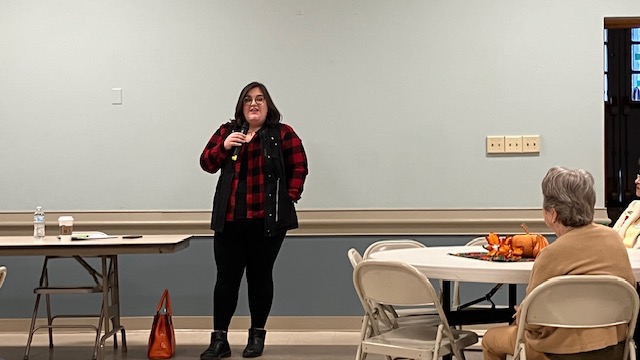
The next question came from a retiree who relocated to West Virginia from Maryland. She wanted to know how each candidate would handle child care costs and accountability for vulnerable children in the state’s care?
“I’ve been a single mother for ten years,” McCoy said. “Child care is a huge problem in West Virginia. I couldn’t afford the $50 for after school care when I had health issues. I don’t 100% know what the answer is, but we need a bipartisan solution.”
“As far as vulnerable children, that comes down to funding the agencies that are responsible for caring for our kids,” McCoy responded. “My daughter lost two friends in a murder/suicide situation. I had to explain to my five year old she wasn’t going to see those two boys again. If that mom had the support she needed, we wouldn’t’ be having this conversation.”
“All these questions begin with governance,” Canterbury said. “When agencies submit budgets, they are very short documents and don’t necessarily specify how they’re going to use that money. What happens is you throw money into these large bureaucratic black holes. A lot of the oversight has to come from the executive branch and that’s never been there. The next governor, Governor Morrissey I believe will be governor, will take the initiative on that.”
As to the Williamsburg murder/suicide, Canterbury said, “Somebody in DHHR dropped the ball. We have to look at that. That’s a governance issue.”
QUESTION: How would you improve educational outcomes?
The conversation then returned to education, with a man asking how the candidates would improve educational outcomes including with homeschool students?
“I think there probably should be some oversight,” Canterbury said. “I’ve found homeschooling to be very, very good. I know people who scored well into the 30s on their ACTs. Parents need to be given as many choices as they need for their kids. Some kids simply cannot thrive in a public school environment.”
“I’ve spoken to people in the education community in the past who say homeschool kids tend to fall in one of three clusters–those who are homeschooled for religious reasons, students who think public school isn’t good enough for their kids, and some who use the system to play hooky,” Canterbury explained. “There needs to be some accountability but the option of homeschooling is a great option.”
“We’ve lost approximately 10% of our public students in Greenbrier County,” McCoy said. “Teacher pay and classroom size are abysmal, which comes back to funding. My generation is leaving. I’ve stayed because I love it, but I worry about having enough manpower to take care of students.”
An attendee asked then asked both candidates if they would be willing to support a recent proposal to use public money (from the School Building Authority) for “private” school building projects?
“I’ve never heard of that,” Canterbury said. “I find it strange you could use public funds for private projects. I don’t think it would be constitutional. If it’s not constitutional, you can’t do it. That’s the answer.”
HB227 became law last month during a special session. It allows the School Building Authority to fund building projects at charter schools in West Virginia. According to state law, charters are categorized as public schools rather than private schools.
McCoy reiterated her belief that, “Public dollars should be used for public education.”
QUESTION: How can we entice retirees to the Greenbrier Valley?
A leader of Shepherd’s Center turned the conversation to senior issues. She said the Greenbrier Valley attracts some retirees but loses others to Virginia and wondered what the candidate’s ideas were to make the area more pleasing to potential retirees?
“I would start with asking the older adults what they would like to see,” McCoy said. “I am in a different place in life. My nose has to be on the grindstone with work and my daughter or I’m not going to make it. If folks have something they’d like to see, I would be glad to help put anything together.”
The questioner replied that a continuous care retirement community would be one idea for legislators to consider, as folks leave and we lose their talents and tax dollars.
“Whether or not I’m elected, that’s a great idea and I would be happy to help work on it,” McCoy said.
“It varies from one person to another in terms of what they need and their income,” Canterbury began. “We’re going to have to set a priority in terms of funding. I saw something that blew me away in the private sector. Elon Musk is producing these robots that remind you a lot of C3PO (from Star Wars). These things walk, talk, they handle things. They can do your laundry.”
“They can mow your grass. As my family gets older, I’m thinking I need one of those,” Canterbury continued. “These things have a price point of $25-$30,000. That sounds like a lot until you look at the cost of an assisted living facility. This could really be a gamechanger for adults who are the cusp of not being able to live on their own. All of the sudden you’ve got this robot where they could take care of the chores, play game with them, talk to them, even look out for them, possibly administer first aid.”
“I’m actually thinking one thing we need to be doing is looking at that kind of technology and figuring out how we can work that into the state budget. It’s going to be much cheaper to provide that technology to the needy. We need stuff like that.”
Concluding remarks
“I’ve said everything I can say, and I would certainly appreciate your consideration this election,” Canterbury closed.
“I’m running for House of Delegates so that my daughter has a better chance at surviving in the state than my generation does,” McCoy told attendees. “It’s been a pleasure to speak with all of you.”
The Shepherd’s Center will host candidates in the 46th District later this week, Delegate Jeff Campbell and Paul Detch.
Early voting is currently underway Monday-Saturday and Election Day is November 5.