Bringing out-of-state foster children back home to West Virginia? Morrisey says there’s a plan for that
By Autumn Shelton, RealWV
CHARLESTON, W.Va. – Depending on the day, there are approximately 500 of West Virginia’s children who have been placed in out-of-state care. And, although that number fluctuates rapidly, the fact is that each child placed out-of-state is the result of a lack of resources at home.
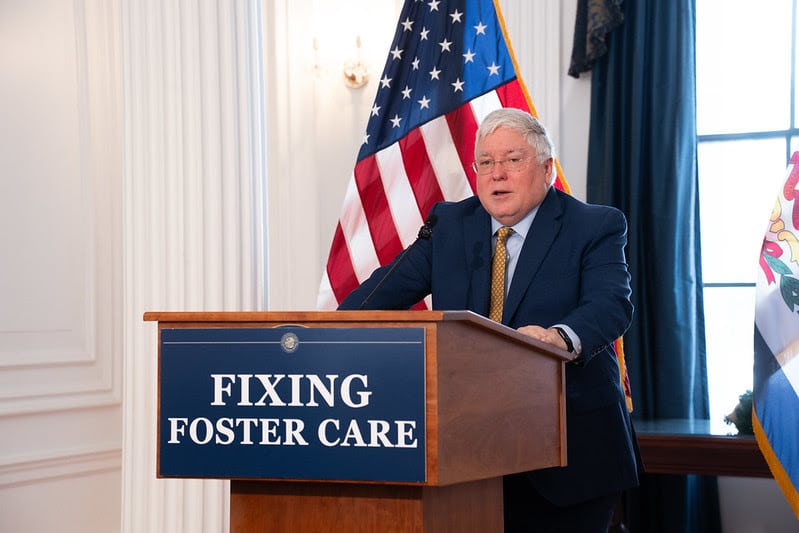
Now, West Virginia Governor Patrick Morrisey has announced a plan for a new revolving fund that may provide the needed resources to help bring these children back to the Mountain State.
“In the past we’ve talked about how the state has failed a lot of the children that are in the care of the state,” Morrisey began, speaking during a press conference held on Tuesday. “To me, that’s unacceptable.”
“That’s why, today, I’m pleased to announce that it’s our intent to work with the legislature this year on a bill to establish a framework for reducing those out-of-state placements,” Morrisey said. “Right now there’s some numbers that we’re seeing of 380 [children] on the out-of-state side. I’m told they average about $156,000 [in state funding requirements per child, per year] or so. But, we need to make sure we get those numbers down.”
Morrisey explained that the “new revolving investment fund” would help build-out “some of the existing state-owned facilities.”
“Those dollars are going to be used to renovate, repair existing state properties by providing high-acuity psychiatric, neurodevelopmental and trauma services for kids in West Virginia,” Morrisey said. “We’re also gonna be providing treatment programs that match the clinical profiles of our kids.”
Morrisey said the goal is to place money, about $6 million initially, into a revolving fund to refurbish the state’s facilities. Then, as those facilities are refurbished, the plan is to bring children home. Each dollar saved, which would have been spent on out-of-state care, will be placed back into the revolving fund.
Ultimately, Morrisey said, this will end out-of-state placements, but he didn’t identify a date for when this will take place, instead saying that more information will become available when he finalizes his budget.
“This is important, and I think it demonstrates a willingness on our effort to work with the legislature and others who know about the challenges that affect our CPS (Child Protective Services) and our foster care system,” Morrisey said.
During December’s interim legislative sessions, Senator Vince Deeds, R-Greenbrier, and Delegate Adam Burkhammer, R-Lewis, spoke about some of their plans to bring out-of-state foster children back home, including the first mention of a fund to help bring these kids home.
“We spend a fortune on those kids out of state,” Deeds said. “We actually have a bill that invests in the thought process […] about bringing those kids home and developing a facility – and you have to have the healthcare providers.”
“You gotta have the doctors to be able to treat those kids here,” Deeds continued. “We do have that, and I believe we can flesh that out to where we have some effective legislation this upcoming session.”
“We’re going to have to begin those conversations of what this investment is,” Burkhammer added. “But I really believe, when we put pen to paper – and we say we’re spending X amount of dollars out of state, and we can invest Y amount of dollars here – that it’s going to make sense for everybody.”
During Tuesday’s press conference, West Virginia Department of Human Services Secretary, Alex Mayer, said that “children do better when they can stay connected to family and community whenever it is safe to do so. That is why we are investing in kinship care, adoption, and in-state capacity instead of relying on stopgap solutions.”
He also said the reforms that have been made in the state’s child welfare system are creating a strong foundation that will lead to a better future for the children it serves.
Back in May, four months after Morrisey took office and following a series of stakeholder meetings held statewide, it was announced that his administration would be making changes to improve the state’s child welfare system. Those changes included full compliance with the federal Child Abuse Prevention and Treatment Act, an overhaul of the state’s child welfare dashboard, the launch of the Leadership Education and Development initiative for monthly reviews, the creation of a critical incident review team, the development of a standardized statewide framework called the comprehensive practice model, and giving caseworkers the ability to gather more information on cases.
According to Morrisey, these changes have been making things better.
Some of the improvements include a 50% statewide reduction in the CPS backlog as well as a reduction in the number of children in placement (from 6,148 children in placement to just under 6,000 in the past year).
There have also been fewer removals of children from their homes, Morrisey noted, stating that number is now 324 removals per month instead of 365 per month, which was the average in 2024.
Substance abuse related removals from the home are now down to 37%, the lowest level since 2007, Morrisey said.
“We also know that there were 1,100 adoptions completed this year, so we think that’s very positive,” Morrisey said. “We’re told that one of the highest numbers on record.”
Despite this modest movement in a positive direction, Morrisey admitted that more work is needed.
“These are not quick fixes, and they are not cosmetic changes,” Morrisey said. “They are deliberate steps to build a child welfare system that is stable, accountable, and worthy of the children and families it serves.”
Related Articles
West Virginia Herpetology Symposium brings enthusiasts, researchers together at New River Gorge
Headlamps pierce the dark on a trail that runs along the cliff faces of New River Gorge National Park and Preserve
BLACK BY GOD: Call to Action: PSC sets public meeting date to hear concerns regarding data center construction
The PSC (Public Service Commission) of West Virginia will hold a public hearing later this month regarding House Bill 2014 – otherwise known as the “Certified Microgrid Program” – a widely debated piece of legislation passed during the 2025 legislative session.
Dear Grace: Conversations that matter
I work full-time, but I can’t afford to live. Will the economy ever get better?