WV artist concludes book tour celebrating the ‘Tiny Worlds of Appalachia’

By Joe Severino, RealWV
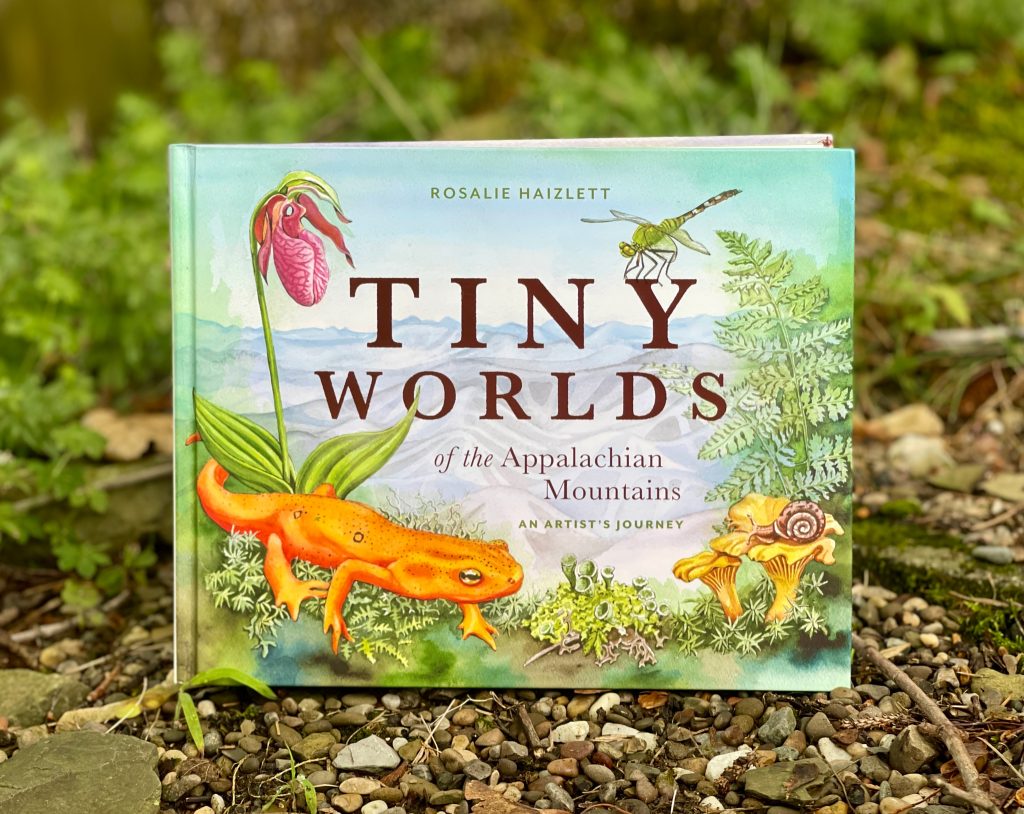
Elkins-based artist and author Rosalie Haizlett spent many days traveling Appalachia’s winding roads this Fall to promote her recently-published book: Tiny Worlds of the Appalachian Mountains: An Artist’s Journey.
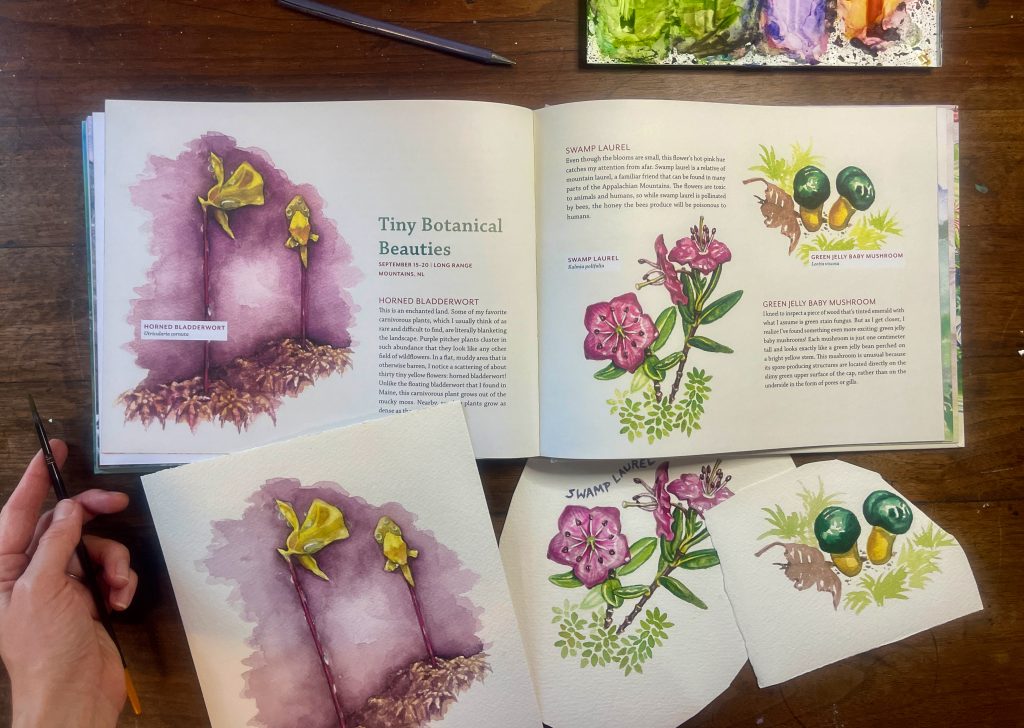
This tour wrapped a bow on Haizlett’s hard-earned journey in creating a nearly 240-page hardcover book, which took years to write and illustrate, she said. Featuring hundreds of amphibians, insects, plants and much more, Tiny Worlds celebrates the region’s often-forgotten small creatures and greenery from Southern to Canadian Applachia.
Haizlett’s map sketches, watercolor paintings, journal entries and conversations with biologists, ecologists and rangers explore the unobserved beauties of the billion-year-old Appalachian mountains. Haizlett personally observed and photographed nearly every subject depicted in Tiny Worlds during a six-month trip through the Appalachian mountains, according to her book.
Researching, planning, drawing, writing and publishing Tiny Worlds inspired even more appreciation for her home region, Haizlett said. But the book tour – which spanned to all corners of West Virginia, to western Pennsylvania, the Southwest and Shenandoah regions of Virginia, and lastly Nashville, Tennessee – was icing on the cake.
“It really felt like a full circle thing,” Haizlett said. “From working on this book by myself for multiple years to then being able to physically hand it to people and see their reaction, and see their eyes light up in response to certain plants or animals that they saw was just really rewarding.”
She noted how isolating an artist’s work can be, especially with a project of this undertaking. At the conclusion of her tour, Haizlett said she was thankful to share these cherished findings with strangers across Appalachia instead of opting for a social media-only rollout – an increasingly common route for authors.
Meeting children and attending school events were some of Haizlett’s favorite moments.
“You could tell that it was really special for [children] to see an adult that was interested in kind of like the quirkier side of nature that I think a lot of kids are drawn to but a lot of adults don’t seem very interested in,” she said.
First and foremost: the average nature-loving child’s appreciation of salamanders.
“As soon as I start talking about salamanders, they all just start talking over each other and get so excited,” Haizlett said.
She often includes an art workshop along with a conversation about her book, where she witnessed many children draw salamanders similar to the creatures found throughout Tiny Worlds.
“Which is cool because the Appalachian Mountains are nicknamed the salamander capital of the world,” Haizlett said. “There are more species here than anywhere else in the world.”
Her connections with these children mirror some of the interests Haizlett said she developed as a young kid. She grew up in the Northern Panhandle on her family’s beef farm outside Bethany, where she came to love art and illustration at a young age.

“I wanted to be an illustrator first. From the time I was little, when I found out that was a job, I was like, ‘Oh yeah, that’s what I want to do.’ But I wasn’t really confident that I could actually make that happen,” Haizlett said. “It seemed sort of like the odds were stacked against you if you grew up in a rural place; like I didn’t know any full-time illustrators as a kid.”
Haizlett’s first publication, a watercolor workbook, released when she was 26 years old. While this was an art-focused project, a lot of writing was required to bring the work together, she said. This was especially the case in creating Tiny Worlds as she felt all her artwork needed connecting.
“I feel like I kind of became a writer as I wrote this book,” Haizlett said.
Tiny Worlds pulls together three of Haizlett’s favorite interests: Art and illustration, an appreciation for vulnerable animals and plants not often spotlighted, and a deep love for the Appalachian mountains.
“[I had a] desire to show that this is still a place that’s worth conserving, even though so much industry has happened here and a lot has been lost,” she said.
Many species of plants and animals have been extirpated in the name of industry development in West Virginia and Appalachia, but that has not stopped the region from being still one of the most biodiverse places in the United States, she said.
“I wanted to tell the story of those little creatures through my art and kind of show people who live here, and people who don’t live here, that the Appalachian mountains are very much alive and very important for a lot of different animals and plants,” Haizlett said.
Haizlett’s plans for 2025 include working toward opening a studio and showroom in downtown Elkins, illustrating the signage on the trail at the Huntington Museum of Art, publishing an illustrated column for Highland Outdoors magazine about wildlife biologists in West Virginia, among other ventures.
A traveling Tiny Worlds art exhibit recently left the Clay Center in Charleston and will be on display at West Liberty University from Jan. 15 to Feb. 12. This summer, the exhibit will be housed at the North Carolina Arboretum in Asheville, North Carolina. In spring 2026, the exhibit will travel to the Pittsburgh Botanic Garden.
Tiny Worlds can be found throughout Appalachia at local book shops, and is also available for purchase on Amazon.