Greenbrier Valley Conservation District holds annual banquet to honor farmers
By RealWV Staff,
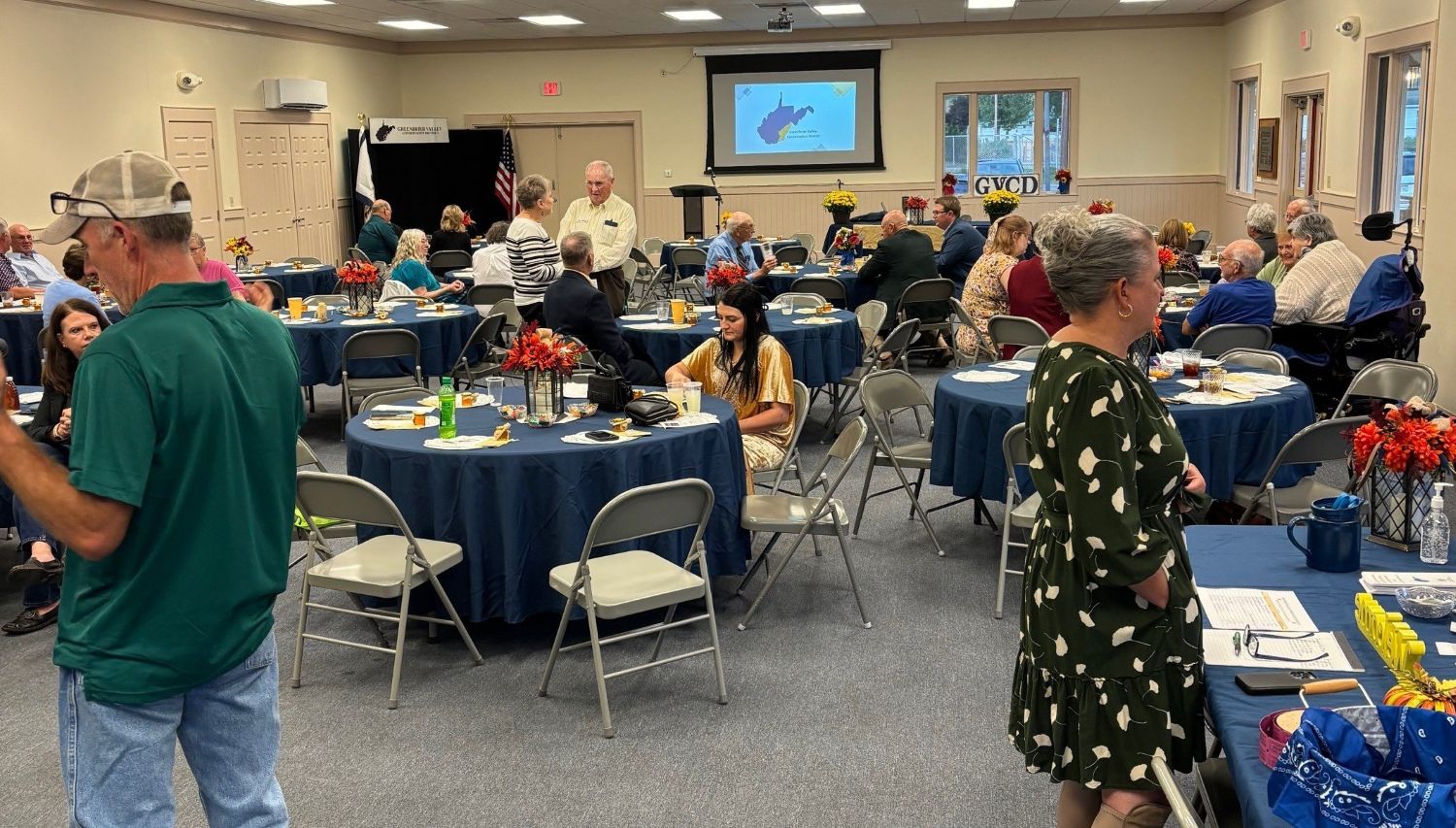
The Greenbrier Valley Conservation District (GVCD) held its annual Legislative and Awards Banquet at the West Virginia University Building on the West Virginia State Fairgrounds on September 25, 2025. The Greenbrier Valley Conservation covers Greenbrier, Monroe, and Pocahontas counties.
The purpose of the GVCD banquet is to recognize district farmers who have done an exceptional job advocating and implementing conservation to boost farm earnings, as well as updating local legislators on the previous year’s work and requesting their ongoing support.
Public officials in attendance included: Members of the WV House of Delegates, Jeff Campbell and Ray Canterbury; The West Virginia Commissioner of Agriculture, Kent Leonhardt; The Natural Resources Conservation Service, State Conservationist, Jon Bourdon; Greenbrier County Commissioner, Tammy Shifflett Tincher; and Area Director of the West Virginia Conservation Agency, Jeremy Salyer. Certificates were also issued to each award recipient by the office of Congresswoman Carol Miller.
The event began with a “meet and greet” where guests joined together in fellowship while they enjoyed music, refreshments, and informative displays showcasing district projects and events.
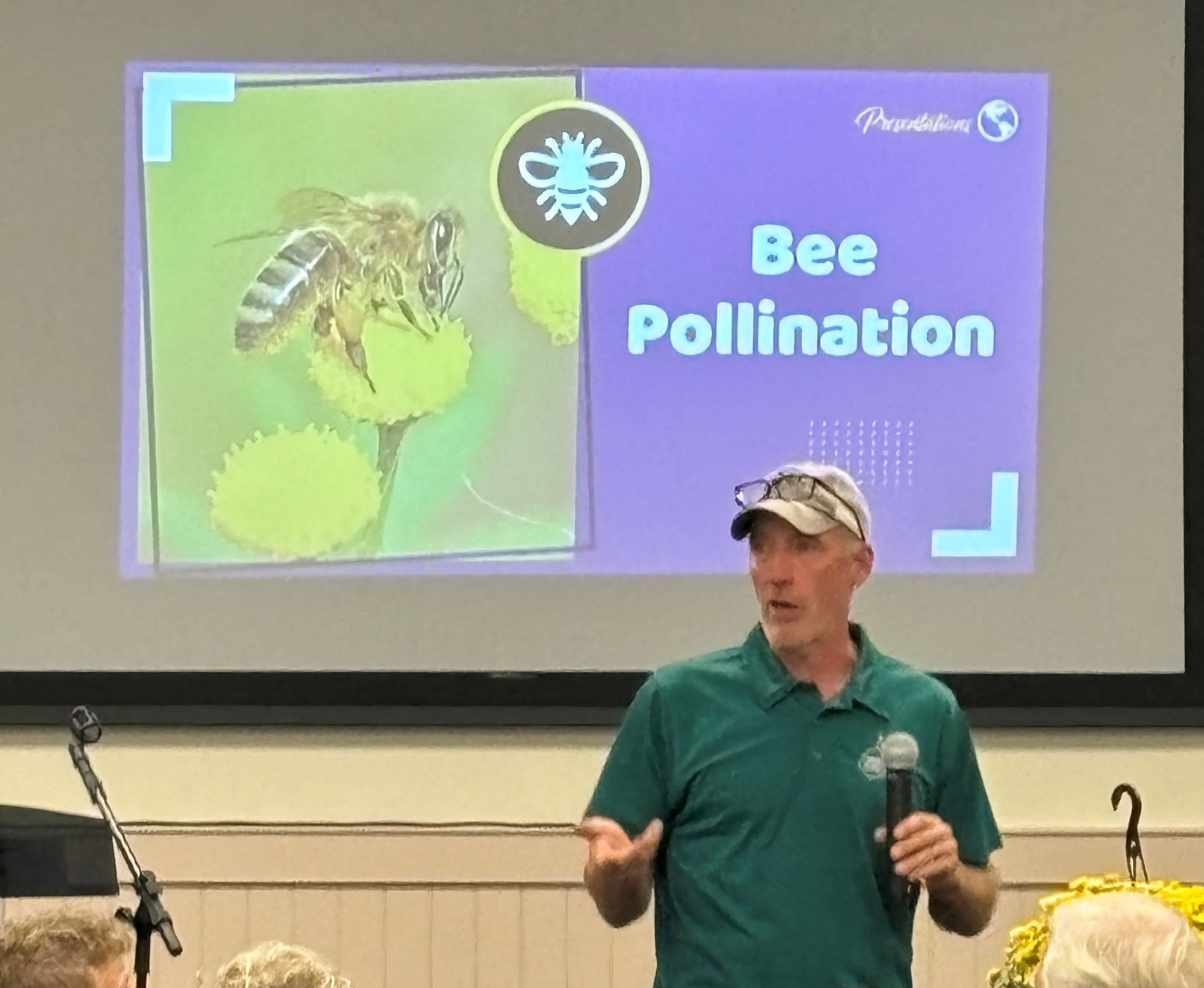
Jack and GeorgeAnne Morgan of Shawlin Hills Farm provided honey from their local farms for guests to sample, and Jack delivered a brief presentation on beekeeping and honey production.
Award Winners
Greenbrier County Grassland Farms 2025
Holwick Farm
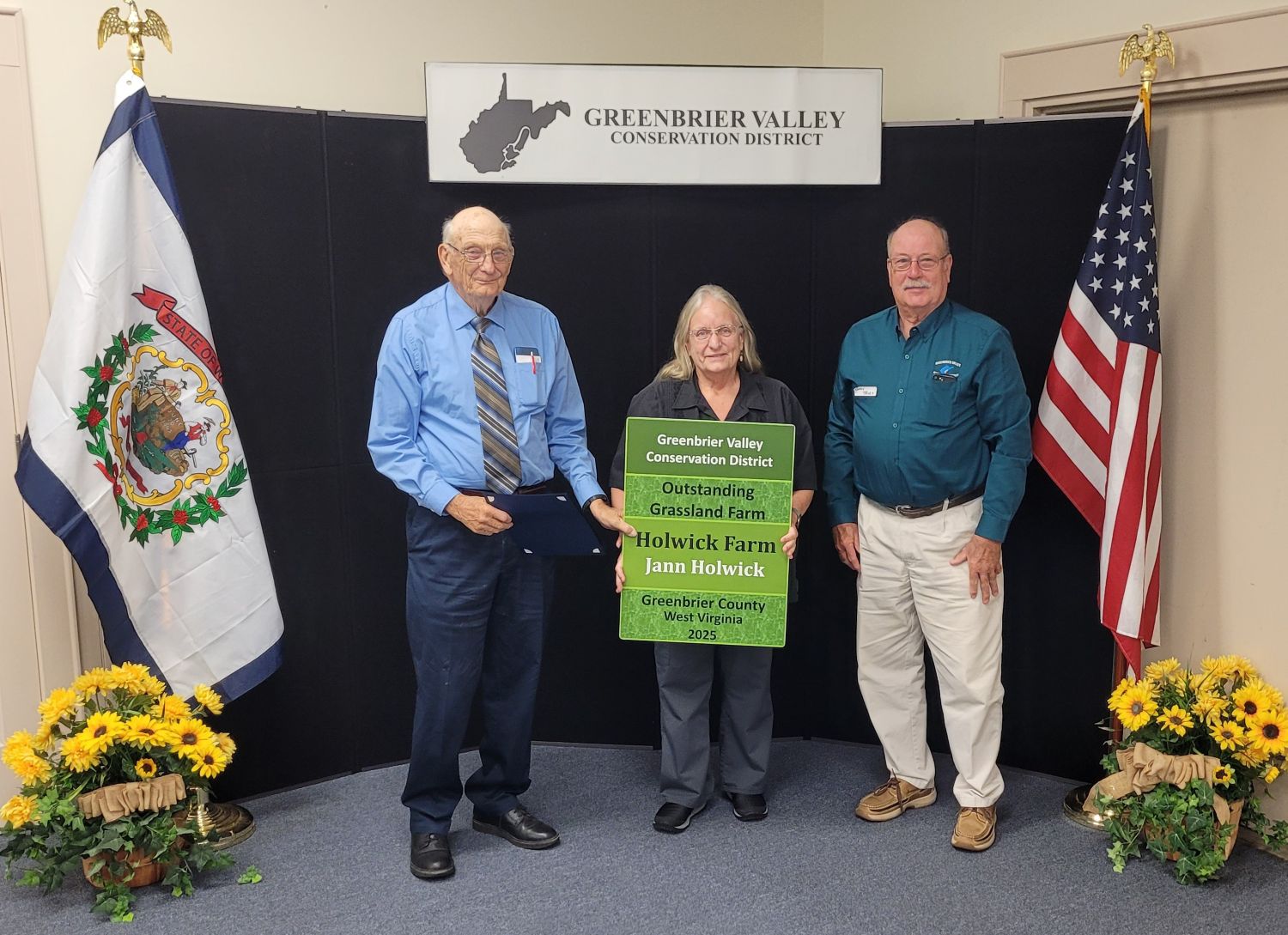
Pictured left to right: Gary W. Sawyers, Jann Holwick, and Gary L. Truex.
The Holwick Farm, owned by Jann Holwick located in Raders Valley, near Williamsburg in Greenbrier County is a Greenbrier Valley Conservation District 2025 Outstanding Grassland Farm.
Jann is meticulous about caring for her farm. The 930-acre farm contains about 300 acres of open pasture. Although Jann rents the farm to local beef farmers, there is no doubt who is in charge of caring for the farm. Jann conducts regular soil sampling and applies nutrients as required. She participates in the Greenbrier Valley Conservation District’s Agricultural Enhancement Program and many Natural Resources of Conservation Service programs to help maintain the property and ensure its well-being. She has recently installed 3,450 feet of permanent fencing to exclude livestock from the woodlands and repaired a significant portion of the pasture division fencing on the farm.
The farm currently carries 85 cows, which is an ideal stocking rate of 3.5 acres for each cow/calf pair. This allows for larger paddocks and longer pasture recovery times, both leading to increased forage production, decreased feed cost and more filtration for cleaner water and healthy soil. Dr. Holwick sets an excellent example of farm management when leasing her farm.
Jann also maintains a partnership with The Nature Conservancy and the Greenbrier County Farmland Protection Program.
Rising Sun Ranch
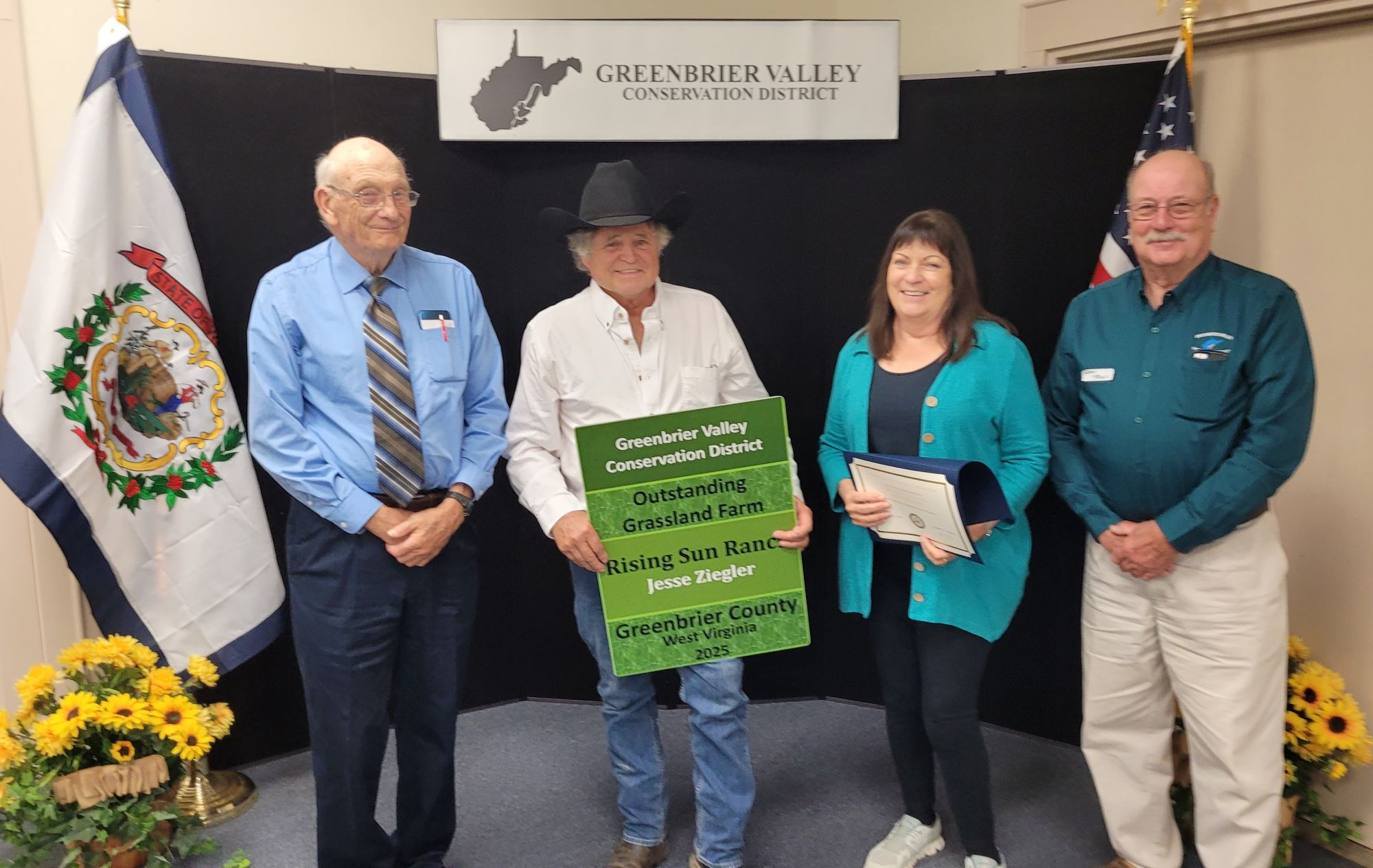
Pictured left to right: Gary W. Sawyers, Jesse Ziegler, Anne Ziegler, and Gary L. Truex
Rising Sun Ranch, owned by Jesse and Anne Ziegler, is a Greenbrier Valley Conservation District 2025 Outstanding Grassland Farm. Jesse grew up on a dairy farm in Campbelltown Pa., which is four miles east of Hershey. He loved the farm, but the farm could not support his seven Siblings’ families and himself, so Jesse started his own excavating company and worked 41 years building it to the point he could retire. When he was ready to retire from developing, he wanted to go out West and live on a ranch, but Anne had other ideas which were much closer to Pennsylvania. Jesse began his search for his ranch and found it near Alderson. In the summer of 2014, Jesse began his dream job. He was now truly a rancher. The Ziegler’s sprawling ranch consists of 875 farm acres and 1,000 timber acres. They run between 275-300 heads of beef cattle and 8-10 bulls. Jesse retains about 50 replacement heifers per year and continues to build fences to divide his pastures and installing water troughs in support of rotational grazing. He currently has 16 tire troughs, and three are made from milk tanks. To care for his calves in the winter, he also has 12 cattle/calf boxes. There are also over 100 gates on the ranch. He also utilized the hub watering method, where a central trough is accessed from many fields, one at a time.
Monroe County Recipients
James McGrady Farm
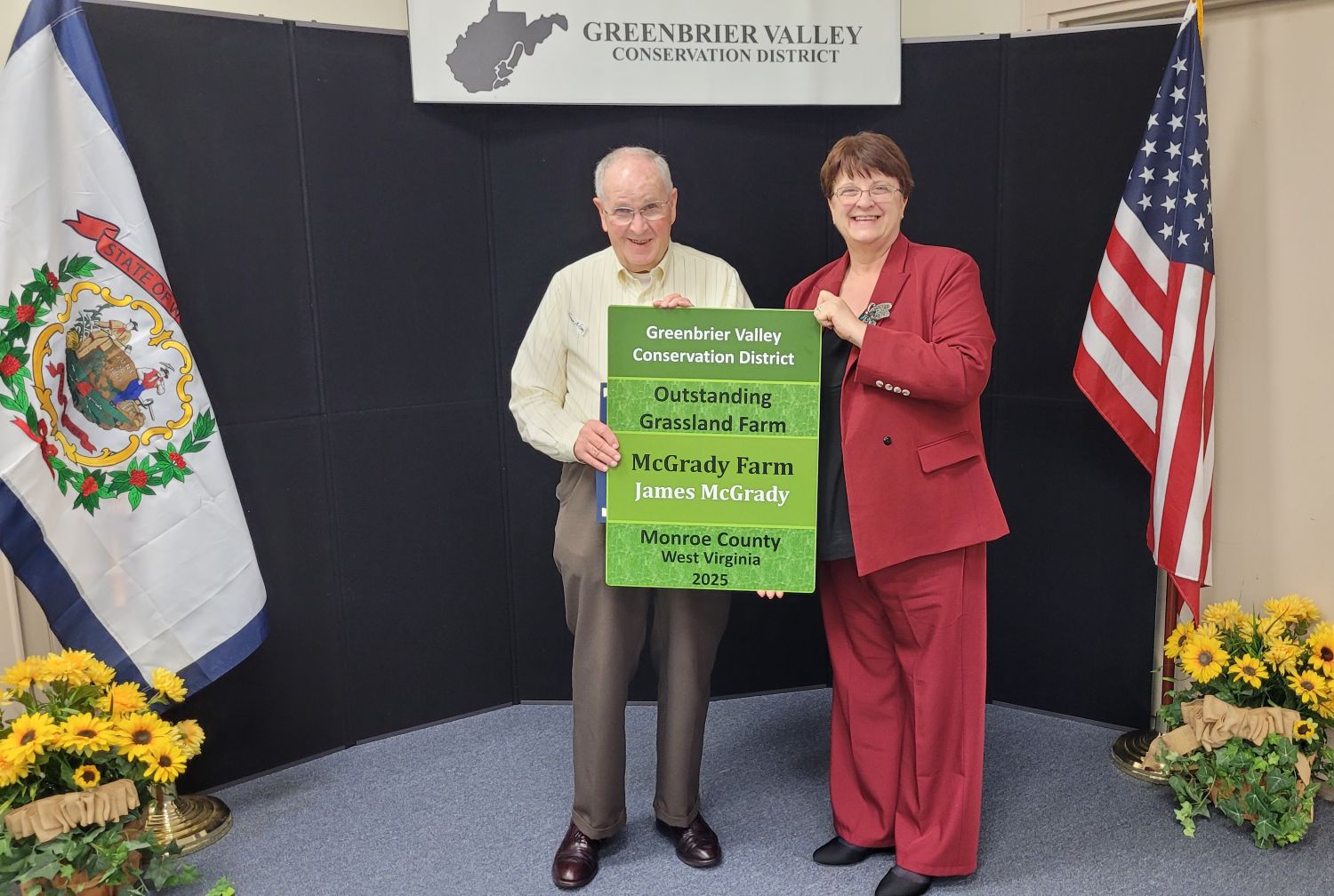
Pictured left to right: James McGrady and Carolyn Miller
James McGrady, owner of the McGrady Farm, started raising beef cattle in 1973 on a small farm in Raleigh County with the goal of owning a farm in the Greenbrier Valley. He spent his Sundays exploring farms in Summers, Greenbrier and Monroe counties. He developed a plan and saved what he could and finally found his 290-acre farm with a 10-foot layer of alluvial soil on Hans Creek in Monroe County in 1994. This farm and its soil profile are ideal for its grass-fed beef operation. Mr. McGrady also leases 282 acres for hay.
After working 46 years as an educator, with the last 16 years driving 84 miles one way to work in Wyoming County, he retired in 2013 and became a full-time farmer.
His cattle numbers currently range from 100-200 and James believes his ideal stocking for the farm to be about 75 head. He rotates his cows between five large boundaries and is able to sustain continuous grazing for most of the year. This approach promotes deep root systems, increases soil organic matter, and prevents soil compaction, which is especially important on creek-adjacent land.
Thanks to competent and hard-working help, James can maintain, depending on snowfall, his rotational grazing system through February by stockpiling grass and not overgrazing. Even with the 2024 drought, James was able to graze through January. The goal for winter 2025 is to graze straight through to the spring.
He maintains 600 bales of stockpiled hay and did not make a second cutting this year because he has enough hay.
James takes advantage of all programs that fit his needs and strives to continuously increase his knowledge in all aspects of farming operations. His approach to his farm is to do the very best he can for the animals and the land. He is pleased with where he is with the farm and the serenity it provides in the Hans Creek Valley; he only wishes to stick around a little bit longer to enjoy it.
Heritage View Farms
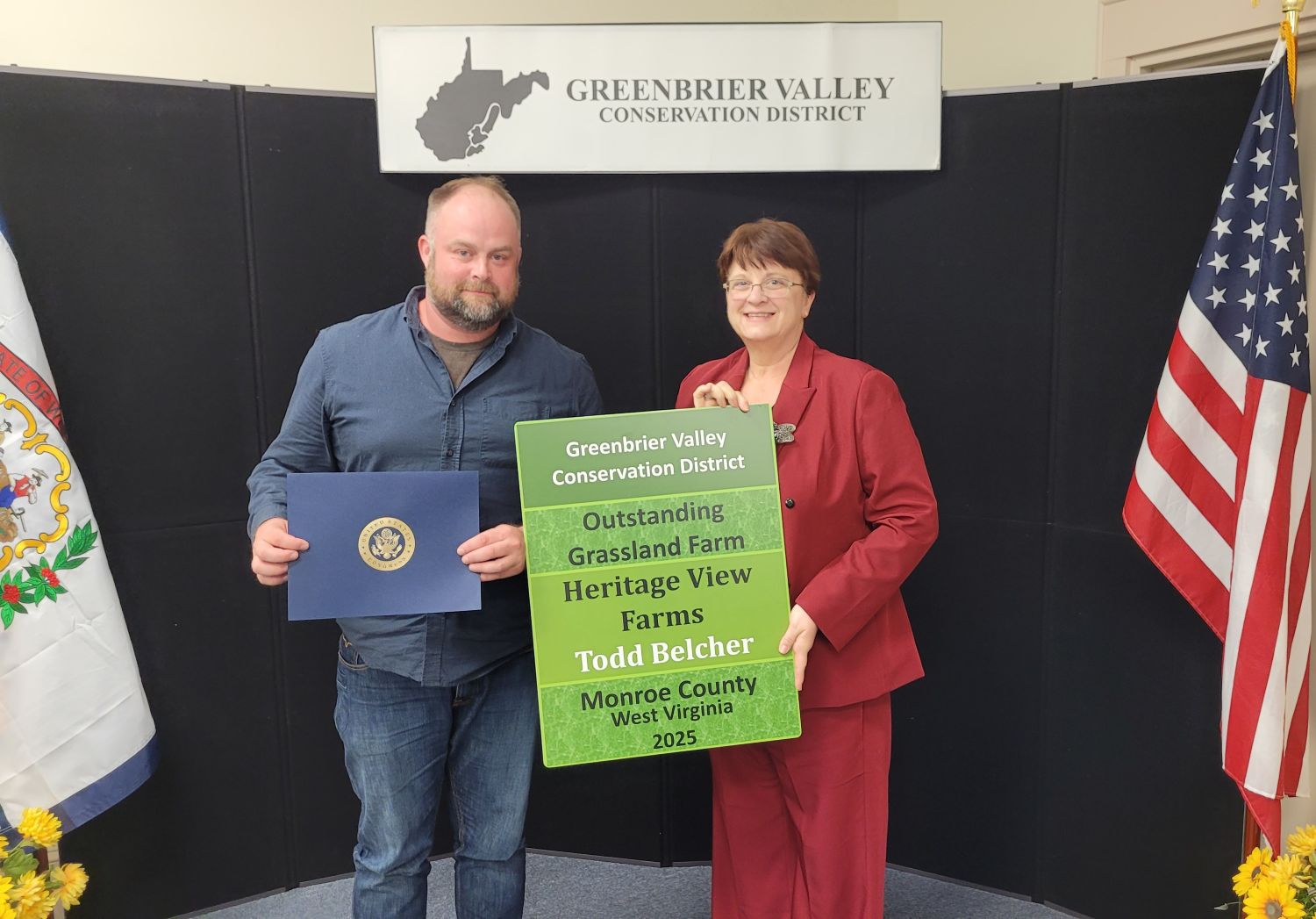
Pictured left to right: Todd Belcher and Carolyn Miller
Todd Belcher is the manager and operator of Heritage View Farms. Which is a combination of six family farms in the Sinks Grove Area. Todd took control of the farms in 2019 and is laser focused on clean-up and developing pastures for rotational grazing, farming nearly 700 acres.
Through the Emergency Conservation Program, Environmental Quality Incentive Program or EQIP, and AgEP, Todd has made great strides on making the family farms productive again. His drive to return the properties to production is truly impressive. All in total, on six farms, he has overseen the installation of four wells, 35 water troughs, and nearly 37,000 feet of fence. During this massive reconstruction effort, Todd also maintains livestock. He maintains 170 cow/calf Pairs, 110 stocker steers, 60 stocker heifers and 40 sheep. Todd plans to increase cow calf numbers to 250 once the land is prepared. He will maintain the stockers and sheep at their current level.
Pocahontas County Recipients
Tupelo Grove Farm
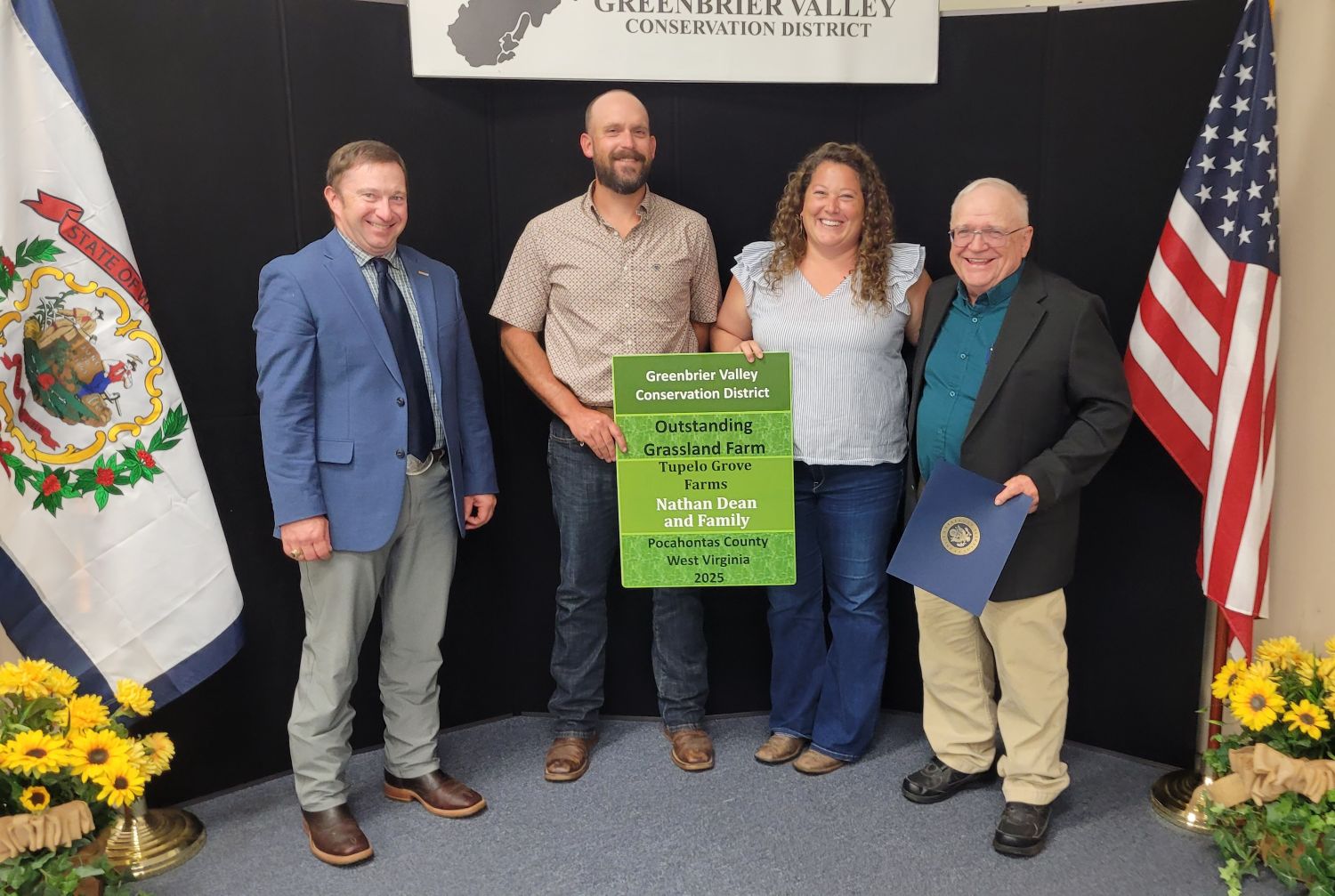
Pictured left to right: Timothy VanReenen, Nathan Dean, Luci Mosesso, and Donald McNeel
Nate Dean and Luci Mosesso, along with their sons Silas and Victor Dean operate a forage-based livestock business in Buckeye, WV. Hair sheep are the center piece of their operation with 360 ewes and replacement ewe lambs running on 20 owned and 114 leased acres. Depending upon ewe numbers, cattle are sometimes seasonally added to the operation to help manage the spring flush of forage. Recently, targeted grazing has become a new enterprise for this family, and their breeding ewes are currently grazing a utility scale solar site in north central WV.
Managed grazing is at the forefront of their practices. Livestock move through a series of 13 permanently fenced paddocks on the leased farm. Each of these paddocks has a water point and is broken into 2-4 strips with temporary electric fence. Livestock are generally moved every 2-5 days. This interval is dependent upon the time of year, class of livestock being grazed, and the forecasted forage availability ahead of the livestock in the grazing plan.
Ellie Gay, owner of the leased land that makes up most of the Deans operation, has been very supportive of working with NRCS and the Deans to install 4,500’ of pressurized waterline and six additional tire troughs to make managed grazing an easier task on her Buckeye, WV., property. All available forage on this property is utilized for grazing purposes, with winter hay and/ or supplemental feeds being purchased. Winter hay is unrolled on areas that need additional fertility. The Deans aim to utilize stockpiled forage to meet much of their winter feed needs, with snow cover generally being the determining factor on whether hay is fed or not.
The Deans plan to continue to expand the ewe flock, utilizing more intensive managed grazing on their homeland base, while adding additional targeted grazing opportunities in order to expand their business into a viable entity for the next generation to become a part of, should they choose to do so.
The Clifton Farm
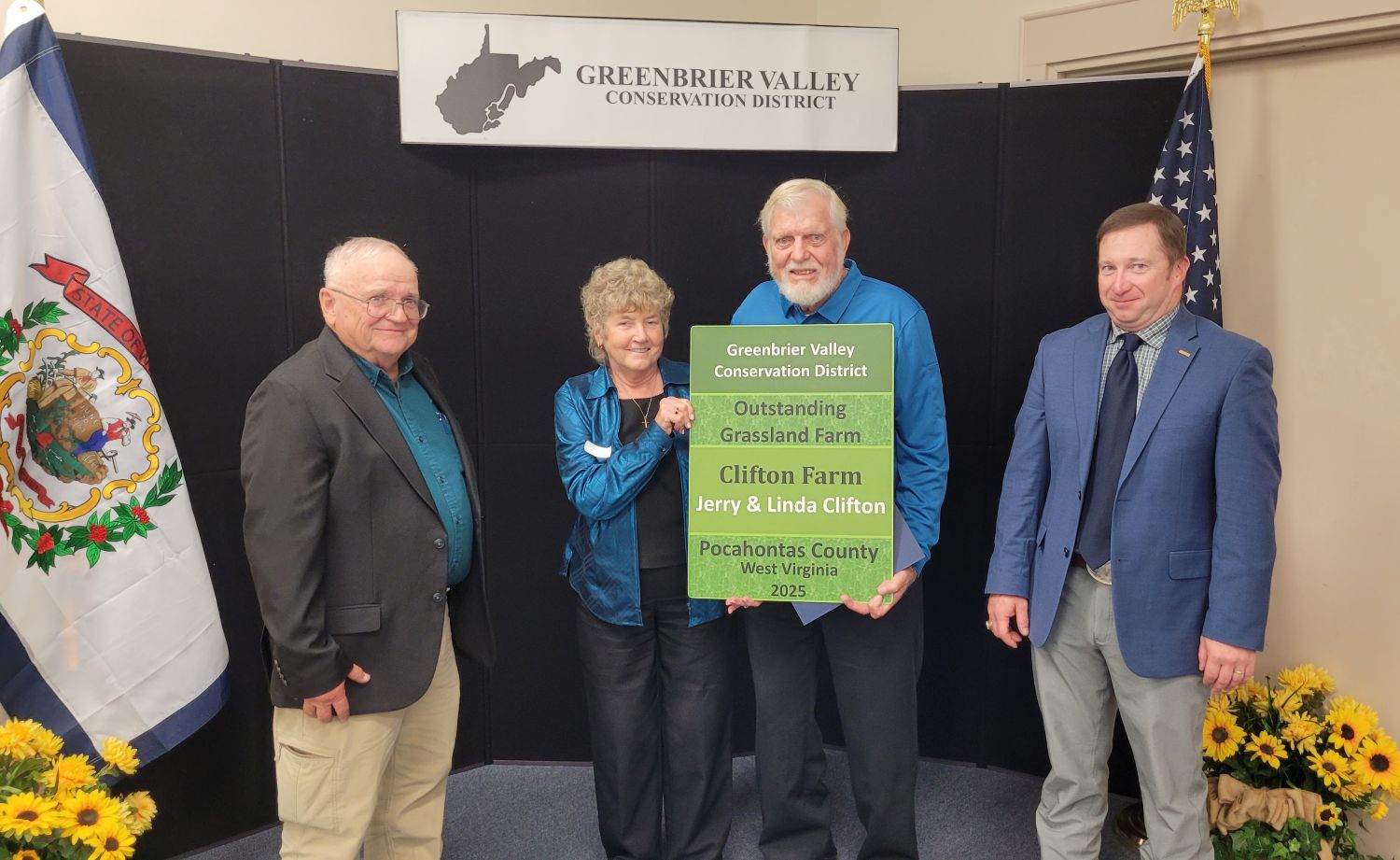
Pictured left to right: Donald McNeel, Linda Clifton, Jerry Clifton, and Timothy VanReenen
The Clifton Farm is owned and operated by Jerry and Linda Clifton with help from their daughter Selena. Linda’s parents operated the farm beginning in 1967, with help from Jerry, Linda and their children. Jerry and Linda took legal possession in 2004. Early on it was a commercial sheep and purebred Suffolk plus cattle farm. The sheep were sold in 1992, and they have raised beef cattle since. They currently maintain about 60 brood cows and two bulls with calving both in the fall and spring. The grandchildren show both sheep and cattle. The main farm is 280 acres; they also own Linda’s homeplace of 8.5 acres and hold half interest in Jerry’s homeplace of 446 acres, which is used for hay production. By utilizing rotational grazing, the Cliftons are able to improve soil health, increase forage productivity, and achieve better water quality while also improving livestock health and reducing cost by decreasing reliance on supplemental feeding and reducing expenses related to manure and fertilizer. The Cliftons have been actively involved in conservation initiatives with the Greenbrier Valley Conservation District through the Farm Service Agency, the Natural Resources Conservation Service and the Clean Water Act section 319 Program over the years. These initiatives include the development of springs, wells, watering troughs, liming, exclusion of the creek, invasive species control, and the installation of exclusion fences for rotational grazing. They have created redundancy for the dry season by connecting most of their troughs to both well and spring water sources with a reserve tank of 1,500 gallons to facilitate this. Jerry Clifton served as a supervisor for the Greenbrier Valley Conservation District, servicing Pocahontas County 2010 through 2024. His participation as a farmer was critical in influencing other farmers to take part in the conservation practices that balance production with conservation. Farmers are the backbone of any farm-centric conservation district and garner immediate respect for being able to comprehend and relate to what farmer’s experience on a daily basis.
The Century Farm Program
The West Virginia Century Farm Program is designed to recognize those families who have been farming the same tract of land for at least 100 years. Century Farms, Sesquicentennial Farms and Bicentennial Farms and Sestercentennial Farms will be recognized. A Century Farm is one that has been in continuous operation by the same family for at least 100 years. A Sesquicentennial Farm has been in continuous operation by the same family for at least 150 years. A Bicentennial Farm has been in continuous operation by the same family for at least 200 years, and a Sestercentennial Farm has been in continuous operation by the same family for at least 250 years.
Bicentennial Farm
Arrowhead Farms – Pocahontas County
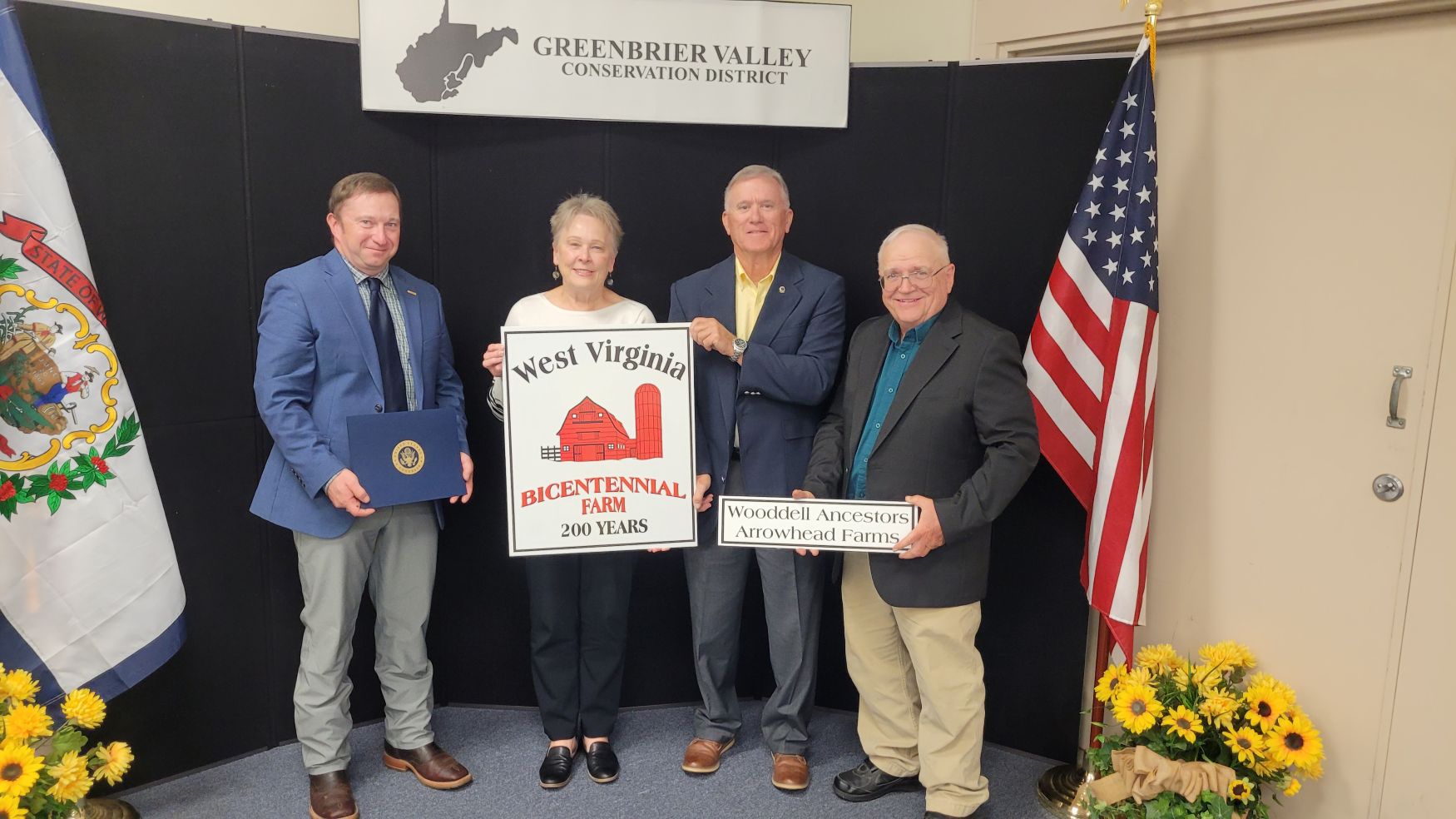
Pictured left to right: Timothy VanReenen, Renae Wooddell, Rick Wooddell, and Donald McNeel
Arrowhead Farms in Green Bank in Pocahontas County was purchased by Joseph Wooddell in 1801. Mr. Wooddell paid 800 pounds for the 546-acre farm. The family produced hay, corn, livestock and timber.
Two hundred and twenty-three years later we gather to recognize the seven generations actively farming the land. James F. “Rick’ Wooddell ran the farm primarily as a beef farm until 2005, with crops of alfalfa, orchard grass, oats, corn silage. He raised cattle, chickens and hogs and since 2005, has produced and sold hay. The original smokehouse on the farm was built in 1801 and confirmed by analysis of the logs by the WVU Geological Department in 2017. The current house was built between 1910 and 1913 and stands where the original log house was built in 1801. The 150 acres of the original Wooddell Farm is still owned by the family, with the total current acreage at 180. Rick is the Commander of the Pocahontas County Veterans Honor Corp, the Treasurer of the Durbin Lions Club, Adjutant for the Allegheny American Legion Post 117, Trustee: Arbovale United Methodist Church and Vice-President of the Arbovale United Methodist Church Cemetery. Renae Wooddell is Treasurer of the Arbovale United Methodist Church.
Service Awards
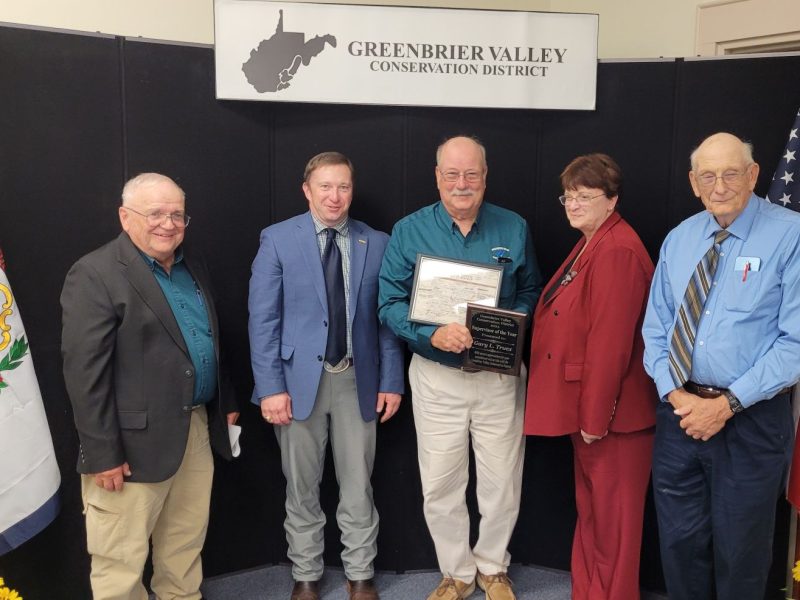
2025 Supervisor of the Year – Gary L. Truex.
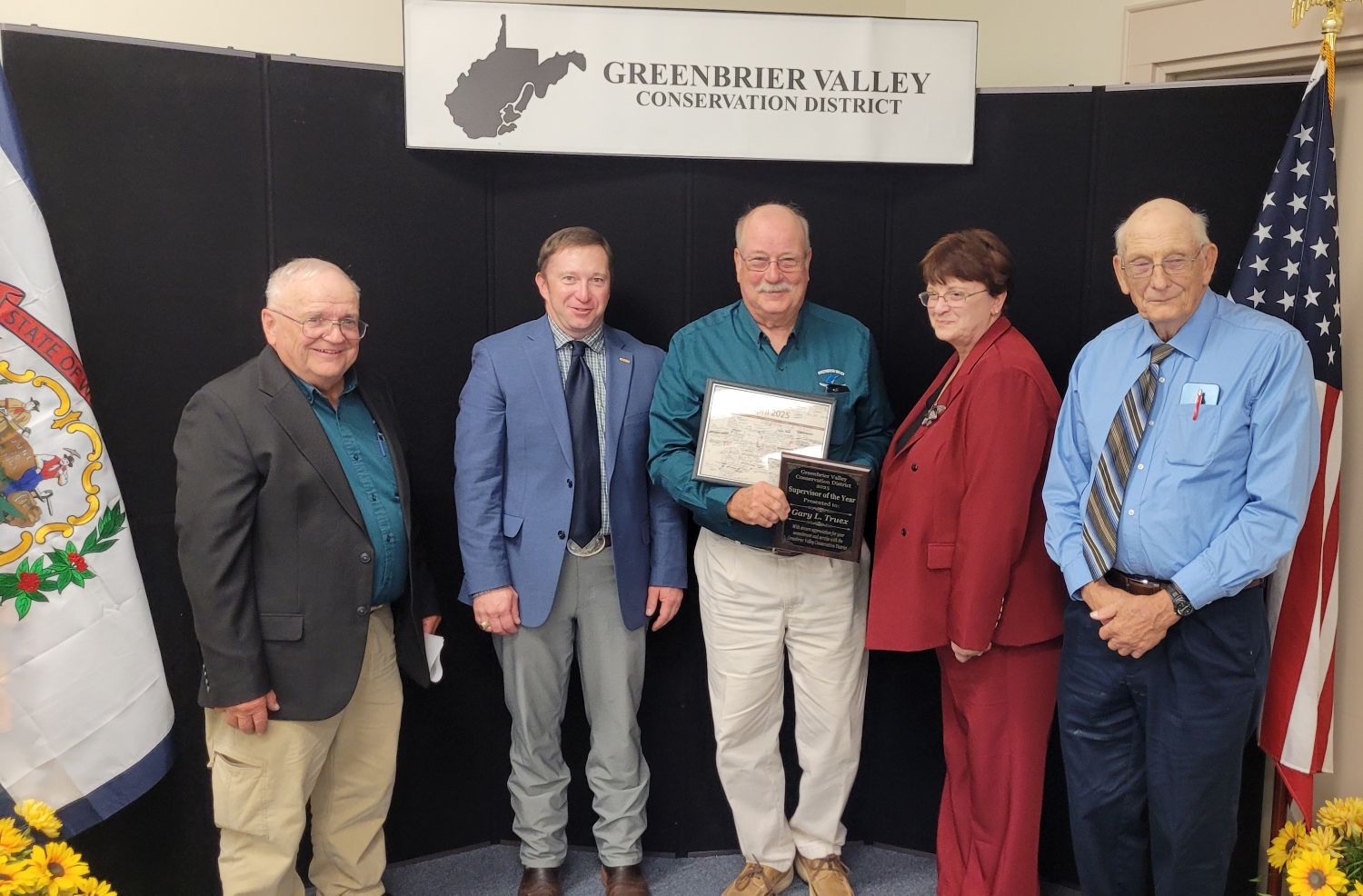
Pictured left to right: Donald McNeel, Timothy VanReenen, Gary L Truex, Carolyn Miller, and Gary W. Sawyers.
Gary Truex has been a very active and dedicated district supervisor for nearly 24 years. He has served as the chair of various standing and special committees and currently chairs both the Building & Equipment Committee and the Finance Committee and holds the position of Secretary/Treasurer of the board. He has played an integral role in servicing the District’s Equipment Program and filled in as the equipment coordinator during the month of April until a new equipment coordinator was hired. He worked tirelessly and set a record for the largest month the district has experienced in years. His district service and accomplishments are best evidenced by his receipt of the prestigious Carroll Greene Award in 2015.
Gary not only serves the district but also actively participates in community, church, and family activities. You can always count on him to volunteer for duties and go above and beyond to ensure the success of projects. He and his wife own a cow/calf operation and have developed their own conservation plan and implemented a number of BMPs over the years, serving as excellent role models for cooperators.
2025 Employee Appreciation Award – Barrett L. Level
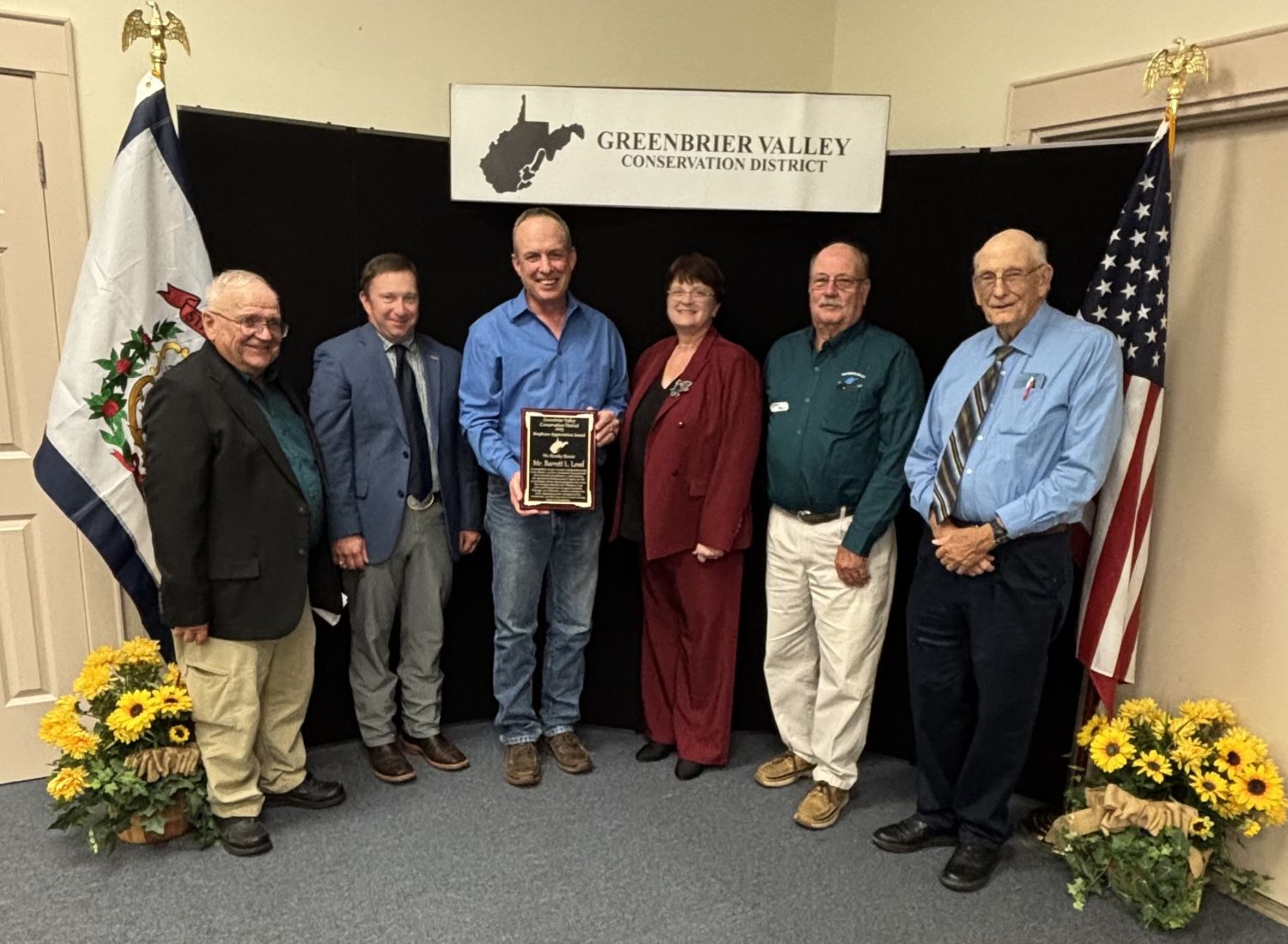
Pictured left to right: Donald McNeel, Timothy VanReenen, Barrett L Level, Carolyn Miller, Gary L. Truex, and Gary W. Sawyers
Barrett Level was recognized for 10 years of dedicated service to the Greenbrier Valley Conservation District. Mr. Level currently serves as the grassland technician for the district and is responsible for administering the Agricultural Enhancement Program. Always going above and beyond, he has played key roles in managing various other district programs and initiatives. His strong leadership and dedication to conservation will forever leave a positive impact, not only to the community he serves, but for the staff of the Greenbrier Valley Conservation District.