State leaders trying to find solution for Hancock County Schools, it’s not easy

By Autumn Shelton, RealWV
CHARLESTON, W.Va. – After it became known that Hancock County Schools was facing a financial emergency, and would have trouble making February’s payroll, West Virginia’s state leaders have been working on potential solutions to ensure that students continue to receive an education and that school personnel continue to receive their paychecks. But, so far, it hasn’t been an easy task.
Since September, members of the West Virginia Board of Education (WVBOE) and the West Virginia Department of Education (WVDE) have been discussing ways to advance funding from the school aid formula to help Hancock County meet payroll.
Meanwhile, since December, members of the state’s legislature have been working on bills to provide emergency state funding to the county due to the alleged “maladministration,” a legal definition meaning inefficient or improper conduct, of funds by Hancock County Schools officials.
Ultimately, this “maladministration” has resulted in the termination of the county’s financial director, the county’s superintendent of schools and the county’s assistant superintendent of schools. And, since the start of the West Virginia Legislative Session, members of the House have been progressing two emergency school funding bills rapidly through the legislative process. However, since the bills were received by the Senate, they have decided to take a much slower approach to their passage – with one Senator, Laura Wakim Chapman, R-Ohio, saying this slower approach isn’t the way to go.
So, how did Hancock County Schools get into this financial emergency, and what exactly has been happening state side to reassure school personnel and students that they will be taken care of?
The West Virginia House of Delegates
On Monday, Jan. 19, the West Virginia House of Delegates voted to suspend state constitutional rules that require each bill be read three times before passage. Following this vote, the House immediately passed House Bill 4574 and House Bill 4575. From this point, these two bills quickly made their way over to the Senate, where a slower approach was taken, and the bills were assigned to committees.
House Bill 4574 is currently awaiting discussion in the Senate Education Committee, chaired by Sen. Amy Grady, R-Mason, and House Bill 4575 is currently sitting in Senate Finance, chaired by Sen. Jason Barrett, R-Berkeley.
What is House Bill 4574?
This bill’s lead sponsor is House Minority Leader Pat McGeehan, R-Hancock. The bill would create a state fund, the “Temporary Shortfall Supplement Fund for County Boards of Education,” that “financially distressed” counties may apply for if their “reserve funding has fallen below five percent of available funding.”
Money from the fund could only be used to pay personnel and essential operating expenses for the remainder of the county’s fiscal year, according to the bill. The funding would be considered a loan that the county would need to pay back at no less than three percent, and funds would be expended to the county through the WVBOE.
If state funding is given to a distressed county, the county must be accountable for how it is spent, including following all reporting requirements in WVEIS (West Virginia Education Information System), be subject to the Freedom of Information Act, implement the State Auditor’s West Virginia Checkbook fiscal reporting system, and the WVBOE would be required to report to the Legislative Oversight Commission on Education Accountability (LOCEA).
Additionally, per the bill, any county employee directly responsible for the “maladministration” of funding may be removed from their position with the county, including those who serve on the county’s Board of Education.
What is House Bill 4575?
This bill provides for an initial $8 million in funding to be placed into the Temporary Shortfall Supplement Fund for County Boards of Education. The funding would be appropriated “out of the Treasury from the balance of moneys remaining as an unappropriated surplus balance in the State Fund, General Revenue, to the State Board of Education – State Department of Education, fund 0313, fiscal year 2026, organization 0402,” the bill states.
The House’s quick vote to pass these bills
During Monday’s discussion on the bills, prior to their ultimate passage, House Minority Leader Sean Hornbuckle, D-Cabell, asked House Majority Leader McGeehan to provide an explanation as to why Hancock County is in distress.
McGeehan responded that he first became aware of financial problems in Hancock County back in December when he was handed a report from the WV Department of Education that “detailed, basically, gross mismanagement over the last two years with the newest administration that took over Hancock County Schools two and a half years ago,” McGeehan said.
According to McGeehan, Hancock County Schools was financially stable three years ago.
“They had a multi-million dollar surplus,” McGeehan said. “Since that timeframe, this new administration that came in, managed through a number of we’ll just say through gross incompetency managed to take that very healthy, financially healthy school system, and turn it into what will be at the end of this fiscal year about a $7.3 million deficit.”
The reasons for this deficit are many, McGeehan continued, stating that the county has 143 positions over the school aid formula and made large expenditures out of their revenue fund, between $6-8 million, for athletic facilities at the high schools.
“There were a number of other things that took place and there may have been, potentially, some, well it was gross mismanagement,” McGeehan added. “Hopefully, it’s not more than something worse than that.”
The biggest concern at the moment is that Hancock County Schools will not be able to make February’s payroll, McGeehan stated. Even if the state were to allocate school aid formula money to Hancock County, that “may not get them through March.”
Despite the emergency takeover of Hancock County Schools by the WVBOE on Jan. 16, and the termination of County Superintendent Dan Enich and the Assistant Superintendent of Hancock County Schools, the WVBOE can only legally advance school aid formula money, which they will do, McGeehan said, adding that it will continue to take time to get the county back on financial track.
“It’s just an anomaly really,” McGeehan continued. “The state school board officials that I’ve been working with have told me they’ve never seen anything like it in recent history, and the same with officials from the Department of Education. So, that’s why, I guess, this is sort of a unique situation which required some sort of thinking outside the box.”
McGeehan also said that he became aware of other county districts that are on a financial distress “watch list,” and noted the legislature should pay attention to this situation as well.
After McGeehan’s explanation, Hornbuckle urged passage of the bills, but noted he wanted caution.
“The reason for urging passage – there are kids involved,” Hornbuckle said. “There’s kids involved, simply put, and we have to do everything we can to help them. But, then there’s also jobs that are at stake in a part of our state that we love and hold very dearly. But, I would also say, to piggyback off of [McGeehan] looking at oversight measures in what we can do in auditing, but more importantly than that, I would recommend to this body, we need to reevaluate also what we have done and what we will do to make sure that we are not putting financial hardships or counties so that we are not sitting here once again having to make emergency action.”
State takeover of Hancock County Schools, termination of superintendent
During an emergency meeting on Friday, Jan. 16, the WVBOE voted to takeover Hancock County Schools as a result of the financial crisis.
Additionally, they voted to vacate the positions of county superintendent and assistant county superintendent effective at the close of business on Friday, and State Superintendent of Schools, Michele L. Blatt, appointed Walter Saunders as the new Hancock County Superintendent of Schools.
Members of the Hancock County Board of Education were also limited in their authority, including making financial decisions on behalf of the county school system.
Uriah Cummings, School Financial Operations Officer for the WV Department of Education, explained during the meeting that Hancock County Schools has been placed on state needs and assistance for three years, but nothing suggested major concerns.
“I think it should be noted that the county has always had a fairly clean audit report on the county’s audited financial statements that we receive from the district,” Cummings said. “Just for the Board’s knowledge, county boards who are placed on needs assistance for financial purposes receive a detailed email monthly that compares budget data to actual expenditures. They are required to submit responses to those emails in which Hancock County Schools has not submitted a response over this three year period as other counties have responded to those.”
Cummings explained that in September, Hancock County officials contacted him to say that they would not be able to make September’s payroll, and requested a financial advance from the state through the school funding formula.
However, the advance wouldn’t have occurred in time to make payroll, Cumings noted.
“They had thrown out an idea potentially shifting funds from the CTE center to the Board coffers in order to meet that payroll,” Cummings continued. “I had advised them [of] some of the significant issues that could occur with that at that time, but at the time they needed to make the decision they were most comfortable moving forward with due to the fact that there was not going to be enough time to advance state aid for them to cover that payroll.”
Cummings said he understands that Hancock County did make a transfer of funds from the CTE center in order to make payroll, and have since transferred the money back to the CTE center.
Cummings added that as the state began to look at numbers, Hancock County was about 140 positions over formula in both fiscal year 2025 and fiscal year 2026.
“The cost of operating that many personnel over formula is approximately $10 million in each of those fiscal years,” Cummings said. “Among other things . . . there have been numerous construction projects going on in the county, specifically sports related projects including a turf lease that they now have obligations to pay those debts off annually, as well as the fact that they overspent on a construction project that was going on at Weir High by almost a little over a million dollars. All of those lead to, about, an increase of approximately $8 million in expenditures from FY24 to FY25. Coincidentally enough, we just received their unaudited financial statements on January 6, and that is about the difference in the decrease in fund balance that the county has experienced – going from approximately $5.5 million fund balance in FY24 to now a projected $2 million deficit in FY 25.”
WVBOE President Hardesty speaks – says employees will receive pay
Despite Hancock County Schools Superintendent Dan Enich requesting that the WVBOE give him and his team the opportunity to right the wrongs, saying “I’m well aware that this has happened under my watch,” the Board still voted to vacate his position.
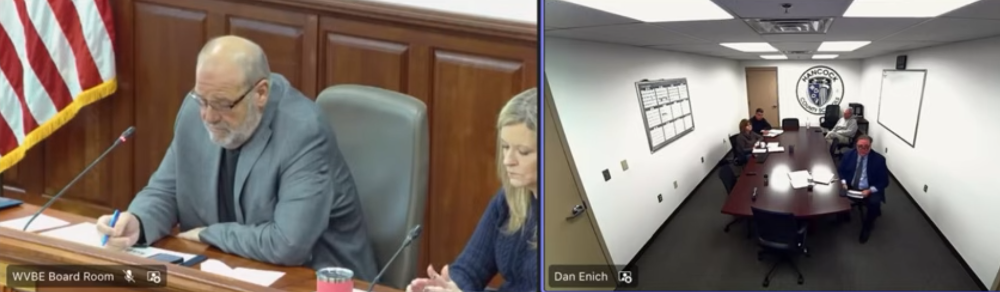
After asking some preliminary questions of Enich, Hardesty said that even though he had a plan for reductions in force, it never came to fruition.
“You’re 140 people over today,” Hardesty said to Enich. “You all have escalated your overage by significant amounts. There’s been nothing done in regards to RIFs and transfers in Hancock County. I find it also troubling that Mr. Cummings tells us that you’ve taken on projects such as turf and projects at Weir High when you obviously didn’t have the money to do so. I’ve also been doing some research that you all have got a bond issue going on in your county to where those bond payments are going to pay that bond and that money would have normally came to your school system.”
Hardesty said he was “troubled” that the audits for the prior three years didn’t reflect what was going on in Hancock County Schools.
“I just don’t know how that can possibly be happening, and what I would ask is our finance department to find out who has done the last three audits in Hancock County – whatever that outside firm is – bring them to Charleston and have them explain how they arrived at their findings that the finances are good in Hancock County, because, obviously, they were not,” Hardesty said.
As for Hancock County school employees, Hardesty said they will be paid.
“There’s a lot of people, including the legislature, that is working on a solution as we speak to try to do a long term fix in Hancock County,” Hardesty said, adding that he begged people to not take federal Elementary and Secondary School Emergency Relief Funds (ESSER) following the COVID-19 pandemic, because “it was going to run out.”
“Ladies and gentleman, Hancock County and the malfeasance of the administration is a direct reflection on what has happened with regards to people that continue to use ESSER funding, when ESSER funding had run out,” Hardesty said. “I don’t know any other way to put it.”
The West Virginia Senate and remarks by Senators Chapman and Woelfel
On Wednesday, Jan. 21, during the Senate’s floor session, Senator Laura Wakim Chapman, R-Ohio, said that she supports moving the two House bills forward quickly.
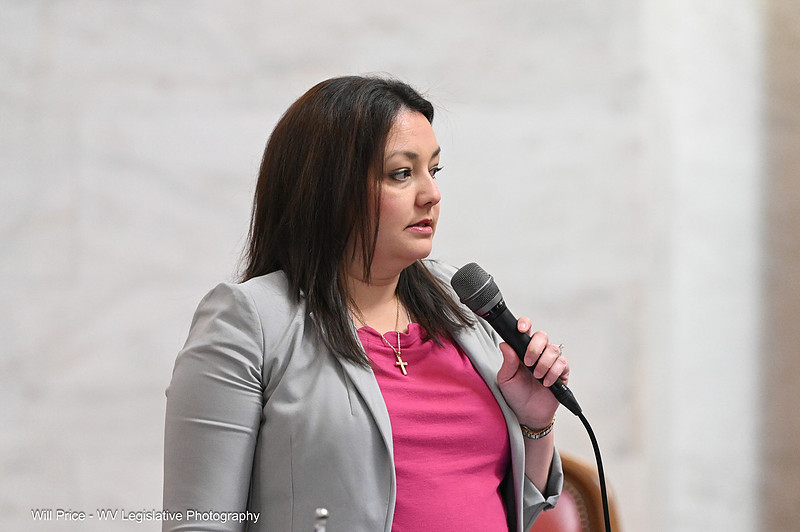
“Yesterday, during the third order of business, you could’ve knocked me over with a feather,” Chapman said. “No one informed me that there was no intention of honoring the agreement to suspend constitutional rules and immediately pass House Bills 4574 and 4575. These bills would provide an emergency $8 million loan – and I want to emphasize loan – so that Hancock County teachers, bus drivers, custodians and cooks could be paid. To add insult to injury, those bills were not referred to one committee, but two. This is outrageous.”
Chapman recalled that in the past, in 2023, the Senate suspended rules to pass Senate Bill 127, which cost the taxpayers roughly $70 million to ensure a hospital wouldn’t close.
“The only difference between that emergency fix and House Bills 4574 and 4575 is that one was for the medical community and the one at hand helps a public school system,” Chapman said. “These actions show the public exactly where our priorities lie. While we have no problem passing school choice measures, some families choose to send their children to public school. Do we expect our teachers and staff to show up to work when they won’t receive a paycheck? What about the children when schools are closed for lack of staff? The Hancock County teachers and staff did nothing wrong. They were not a part of the administration’s decisions. They are innocent and deserve to know that they will receive their paycheck.”
Chapman said she has been working on this bill with those in the House for over a month, and urged immediate consideration of the bills.
“I will not stay silent and I won’t stop fighting for the teachers, staff and children of Hancock County,” Chapman said.
Sen. Mike Woelfel, D-Cabell, countered Chapman a moment later, stating that although he wasn’t “necessarily opposed” to what she was advocating, he commended the Senate and Senate President Randy Smith, R-Preston, for “using due caution” and for taking their time to thoroughly examine the bills.
Woelfel added that local accountability is important and that the Hancock County Prosecuting Attorney should become involved in the matter.
“I would call on the local prosecuting attorney to conduct an investigation into whether or not there was any criminal wrongdoing here, not saying there was. But, I just wanted to take a minute to say that the Senate is a deliberative body, and I commend you for being deliberative on this particular bill,” Woelfel said. “In this case we’re going to take our time in thanks to your leadership, and we’re gonna do it right.”
Related Articles

PHOTOS: Red Bull Chariot Race brings high-speed fun to Morgantown
Take a look at photos from the Red Bull Chariot Race in Morgantown, W.Va., which was held on High Street this past Saturday, Oct. 24, 2026.

BLACK BY GOD: Youth Voices Rising: Black By God Helping Amplify Youth Voices in West Virginia
This October, during National Arts and Humanities Month, Black By God: The West Virginian is launching Youth Voices Rising, a series of student articles, interviews and videos that gives audiences a view of West Virginia through young people’s eyes.