Bear Spirit Mountain working to raise awareness of Native American heritage in WV
By Vanta Coda III, Real WV
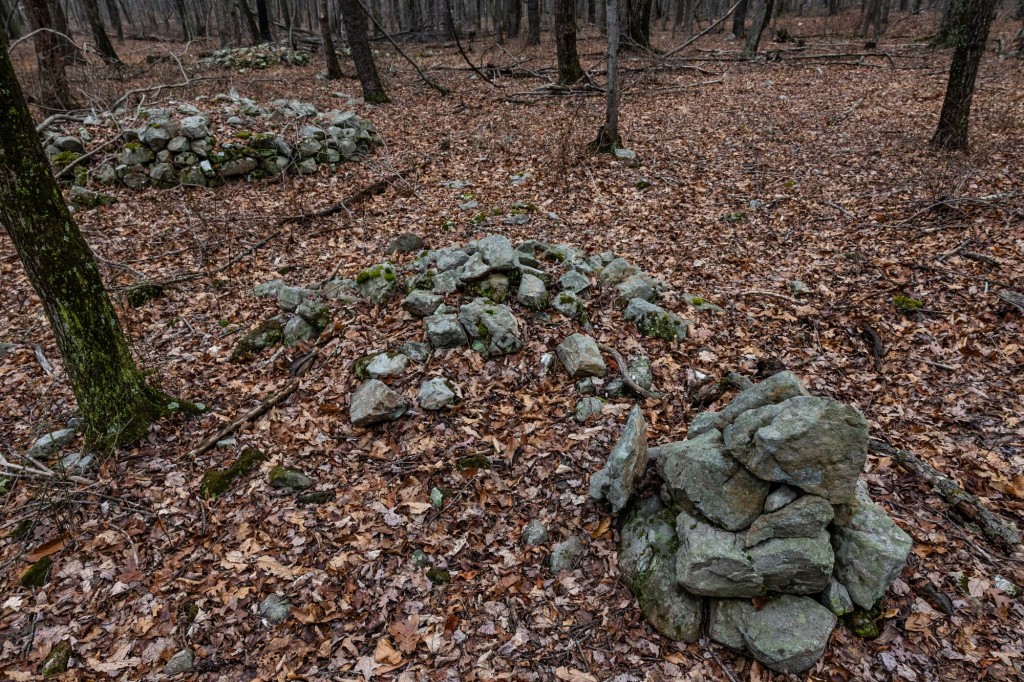
Native American burial mounds dot the forest floor at one of Matthew “Maasaw” Howard’s archaeological sites, part of his organization, Bear Spirit Mountain Inc. The smaller mound in the foreground aligns with the sun on the summer solstice, when it sets. The mounds are also adorned with white quartz on top, and some reach up to three feet off the ground.
As time passes and “stick season” ends, Matthew “Maasaw” Howard walks through the barren understory, pointing to stone mounds and oddly shaped rocks. “These stones are not naturally occurring; human hands worked on them,” Howard said.
Native Americans placed and carved these stones during the Paleoindian (12,000 to 8,000 B.C.), Archaic (8,000 to 3,000 B.C.), and Woodland periods (3,000 B.C. to A.D. 1000). Sites of religious significance were marked by shaped stones arranged in stone-mound graves, still visible thousands of years later. Some of these sites lie scattered on private lands in eastern West Virginia.
Howard’s 501(c)(3) nonprofit, Bear Spirit Mountain Inc., collaborates with landowners to protect these sites with a group of volunteers. Together, they also educate the public about the region’s history and donate their findings to local museums. To avoid disclosing site locations, the descriptions used in this story will only rely on broad regional terms, such as eastern West Virginia. This approach preserves the integrity of these sacred sites for Native American culture, heritage, and the educational understanding of Indigenous history within W.Va. and the greater eastern United States.
“We have archaeological sites between here and Canada, with the majority in eastern West Virginia. So we go out into the field, we look at properties that people think have Indigenous evidence. Once we determine they are Indigenous, at that point, we start investigating, studying, and recording. We do not disturb these sites,” Howard said.
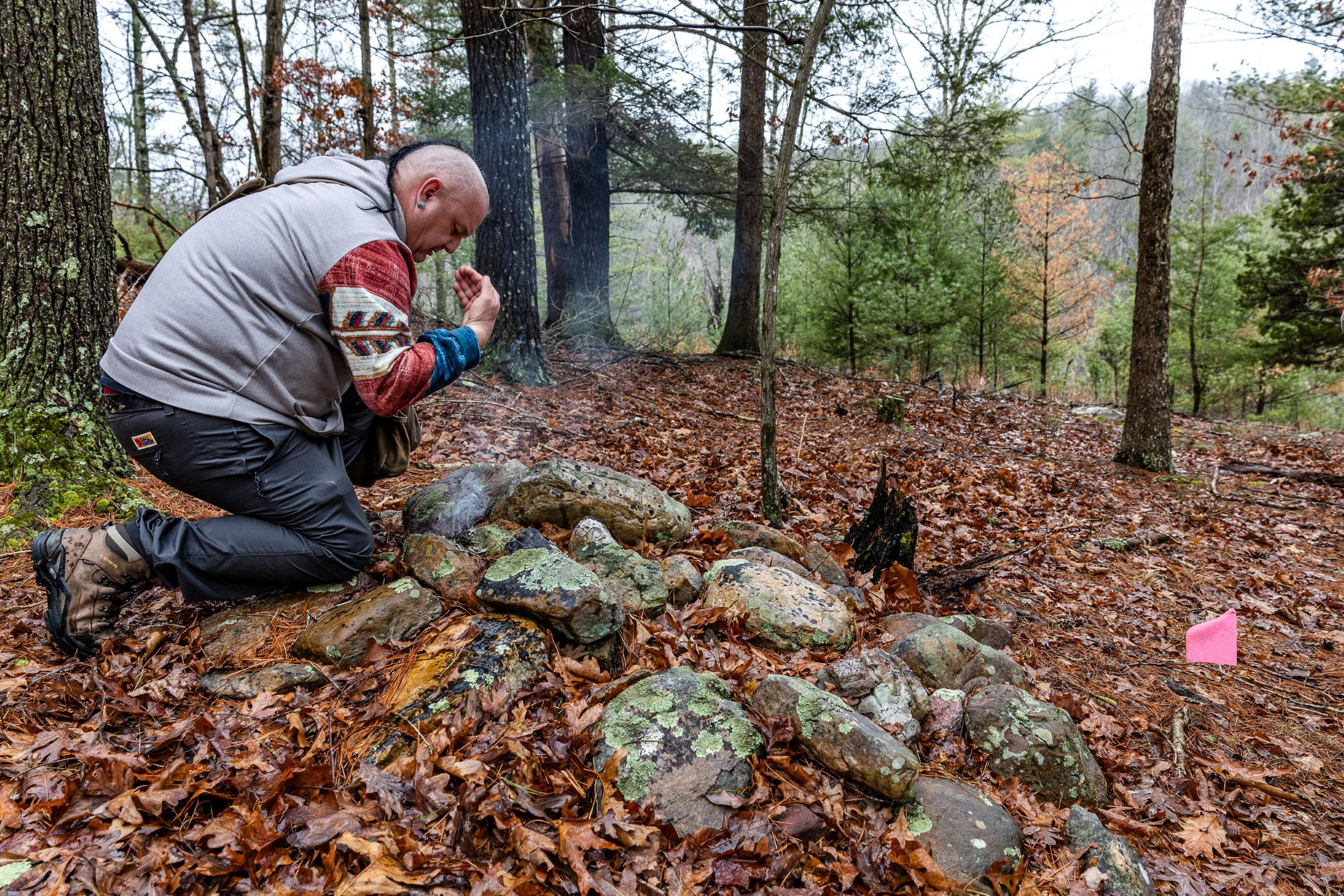
Matthew “Maasaw” Howard burns tobacco and sage at one of the mounds at the Talala (“woodpecker” in Cherokee) site in eastern West Virginia as an offering to those buried there. This particular site features 60 burial mounds arranged in rows, intricately spaced in linear bands up a hill. Due to debris and soil movement on this site, many of these mounds are only visible from above, so Howard and his team use flags to mark their locations.
Matthew “Maasaw” Howard, whose Indigenous Maasaw name means “protector of sacred land,” has Cherokee, Lenape, Choctaw, and Tuscarora heritage. He is a member of the Echota Cherokee Tribe of Alabama. Howard began his journey when he purchased two tracts of land in eastern West Virginia, known as Bear Spirit Mountain. On the property are 300 Native American burials, including an earthen mound measuring more than 200 feet long, as well as animal effigies, such as a “Serpent Wall” and a turtle-based stone cairn. The site also features pecked petroglyphs and regular petroglyphs depicting animals that went extinct thousands of years ago. This site led Howard to reconnect with his genealogy and discover his Native American heritage. Since then, Howard has shared his findings with archaeologists and other researchers, offering valuable insights into the Native American history of the region. He has also spoken at archaeological conferences and universities, presented his research findings, and given lectures in several countries around the world on Indigenous burial practices.
Many of the properties that Howard and his 15 volunteers from the Bear Spirit Mountain organization have looked at include burial sites. To avoid using invasive archaeological practices at these sacred sites, ground-penetrating radar is used on all stone burial mounds to determine if there is a void where bodies once were, along with any associated possessions and tools.
With these graves being thousands of years old, combined with the high soil acidity found across the Appalachian region, the bodies that once occupied the void in the mound are long gone.
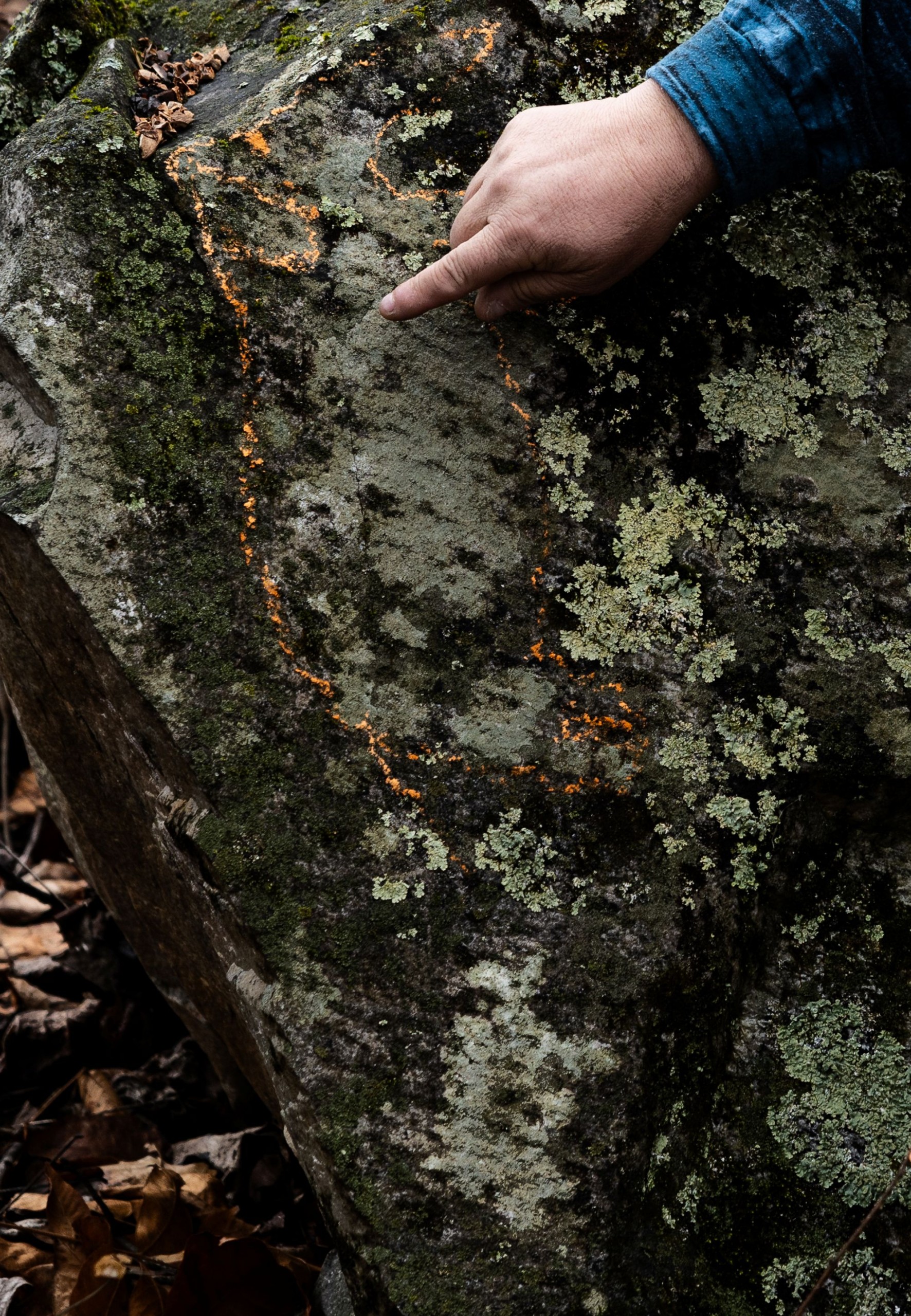
Howard points to a pecked petroglyph of a woolly mammoth, a species that went extinct in the Northern Hemisphere 10,000 years ago, according to Harvard University’s Visualizing Climate and Loss website. Howard outlines the pecked petroglyph with an orange chalk stick, and below it is a lighter gray pecked petroglyph against the darker, lichen-stained rock — an outline of a juvenile woolly mammoth (bottom of image).
After recording these sites, Howard works with landowners through various conservation groups to have their land placed in protected trusts. In eastern West Virginia, Bear Spirit Mountain has helped to protect 2,300 acres of land tied to Indigenous history, ensuring these properties can never be developed. One of these organizations is the Land Trust of the Eastern Panhandle, led by President Jeff Feldman, which is tied to the national organization, the Land Trust Alliance.
“Conservation easements often attribute ties to natural or environmental features, agricultural land, forest systems, waterways or wetlands, sinkholes, critical habitat and even scenic viewsheds,” Feldman said.
Many larger tracts of land meet those requirements, and while Howard has investigated other properties, his own property does not qualify for easements through organizations affiliated with the Land Trust Alliance or Land Trust Accreditation Commission. This is because the property is preserved entirely for historical protection and heritage.
“A site like Matthew’s that contains areas of cultural significance is a bit different, especially given the Indigenous heritage of the site. This is new ground for many land trusts,” Feldman said.
This has prompted the local chapter of Land Trusts where Howard’s properties fall, Cacapon & Lost Rivers Land Trust, to reach out to various organizations to help connect Howard with the right one to protect his land. Emily Warner Merrill, executive director of Cacapon & Lost Rivers Land Trust, finds this case to be the first cultural case that their organization has received.
“We are trying to find an Indigenous organization or tribe that could serve as a long-term steward of the site, and we are exploring additional verification options, such as getting the site on the State Historic Preservation Office’s map of cultural sites,” executive director Emily Warner Merrill said. “That would open the door to protecting the site with a formal deed of conservation easement.”
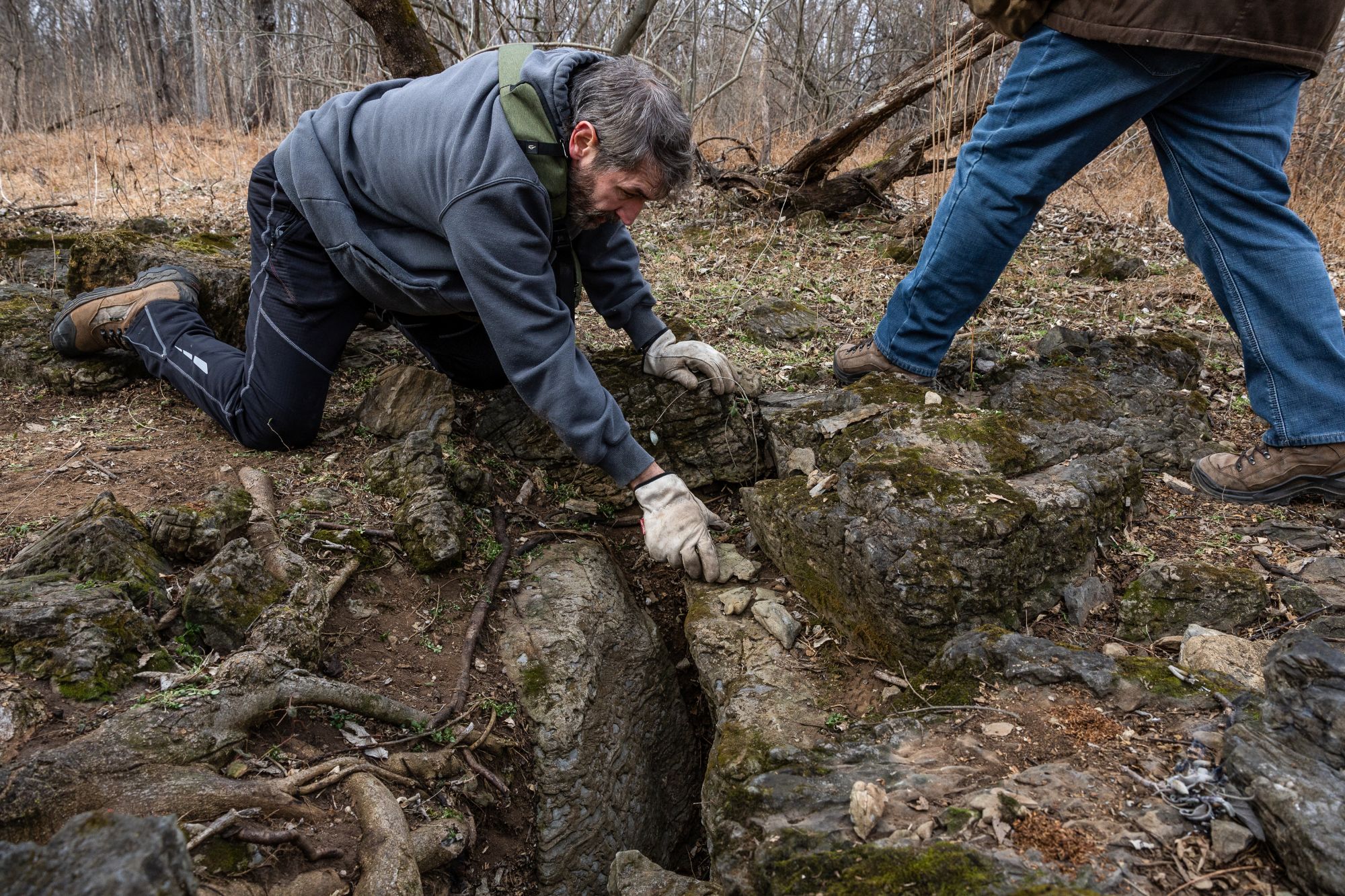
Steve Kitner, property owner of the site Yona (“bear” in Cherokee), places stone-carved figurines on a ledge of a sacred site. Rocks are placed in a spiral pattern from the crack in the limestone through which Kitner is reaching. Howard said the site is called a “split stone” and was used for religious purposes and believed to be a thin plane, or “portal” through which ancestors could enter thisworld and return to theirs.
Although state, local, and Indigenous groups are still determining how to protect Howard’s land at Bear Spirit Mountain, he remains undeterred in his search for additional Indigenous heritage sites within the state. He actively engages landowners and works to safeguard these sites, striving to uncover and preserve the legacy of both his ancestors and those of North America, ensuring future generations can learn from and understand their history.
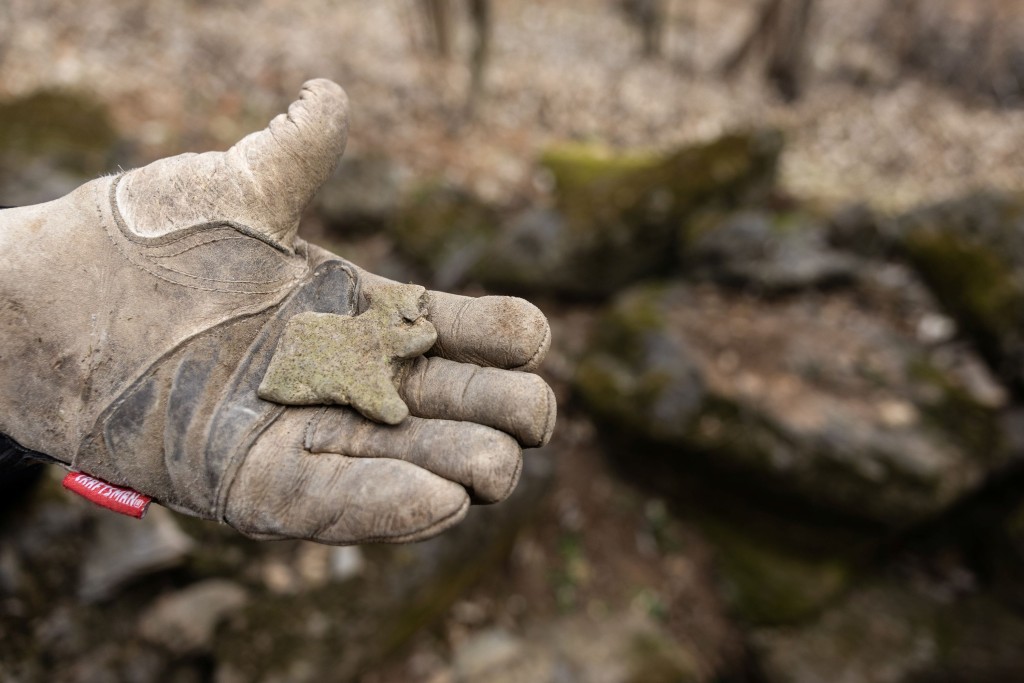
Steve Kitner holds one of the carved figurines that was lying on the edge of the crack. Many of the pieces Kitner and Howard have found around the site feature animal motifs. One of the figurines they found was a group of rocks carved to resemble a duck, with eyes pecked into its head.
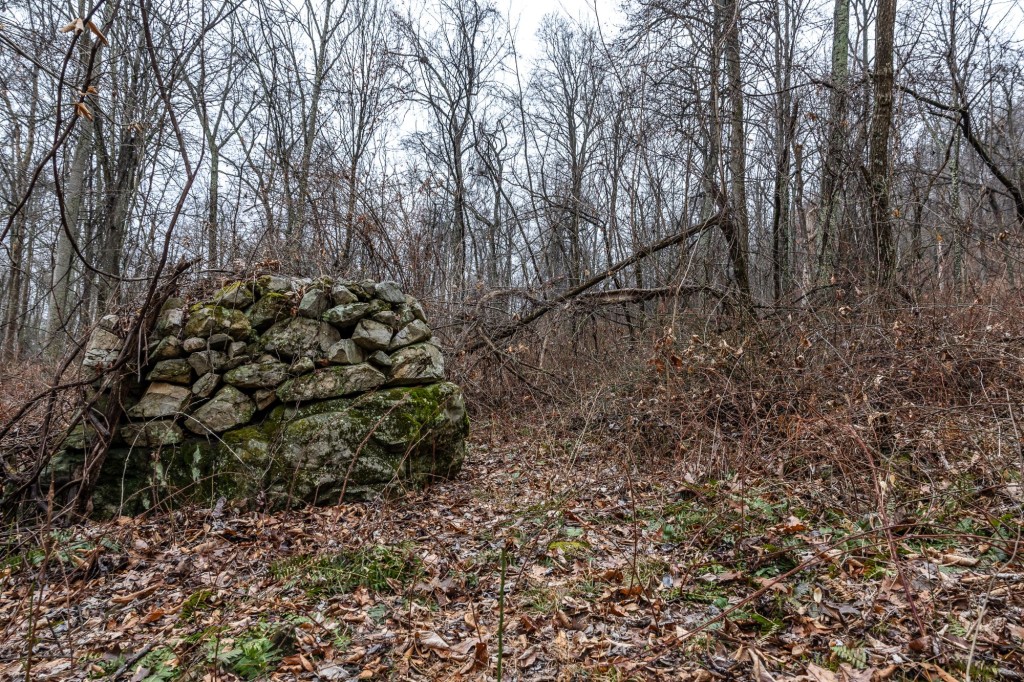
A Native American base stone cairn lies on the property of Bear Spirit Mountain in eastern West Virginia. The cairn is known as the “Turtle Cairn,” a sacred site for Native American bands, tribes, and organizations across the eastern United States. The exact age of the cairn is not known, but the two sites that make up Bear Spirit Mountain, Howard and other archaeologists estimate, were built during the Pleistocene period, commonly known as the last Ice Age, which ended 11,700 years ago. From then on, the sites were used by different tribes for thousands of years until Europeans colonized the Americas.
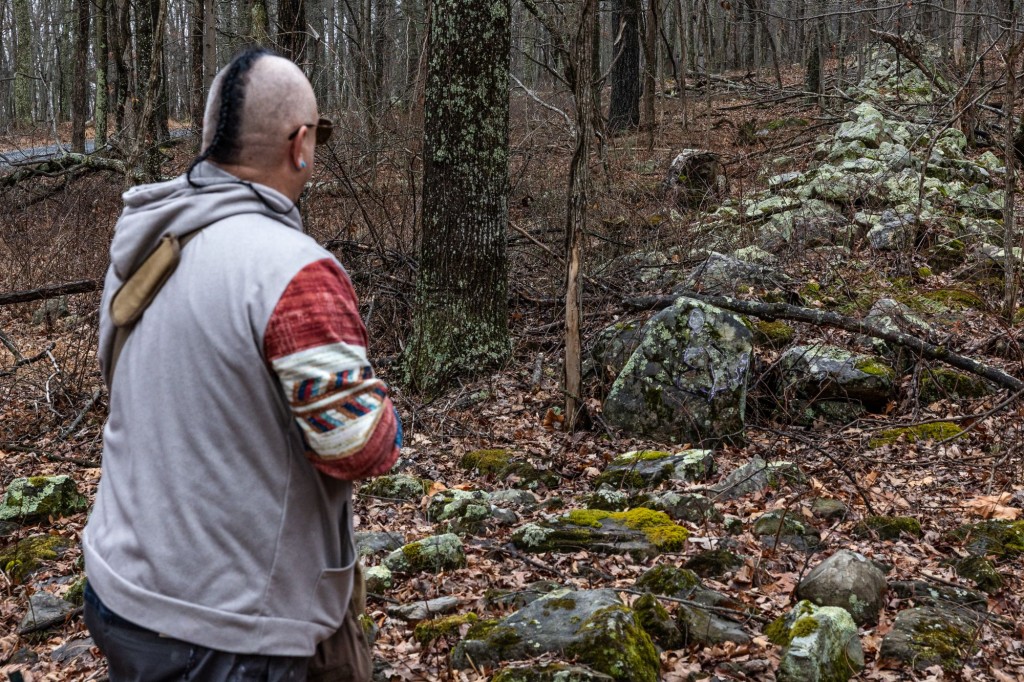
Howard stands at the end of a Native American structure called a “Serpent Wall.” These walls are different from European boundary walls. They were formed to create an effigy resembling a serpent. Howard says this was made to mimic celestial and sky anomalies that Native Americans would see, like comets, meteors, the sun, and the moon. The serpent wall also serves as a warning to anyone passing through that the area is sacred ground. The wall, along with other sites on Bear Spirit Mountain, is adorned with bright green lichen, which takes hundreds to thousands of years to grow across much of the rock surface, adding to the visual evidence of how old these structures are.
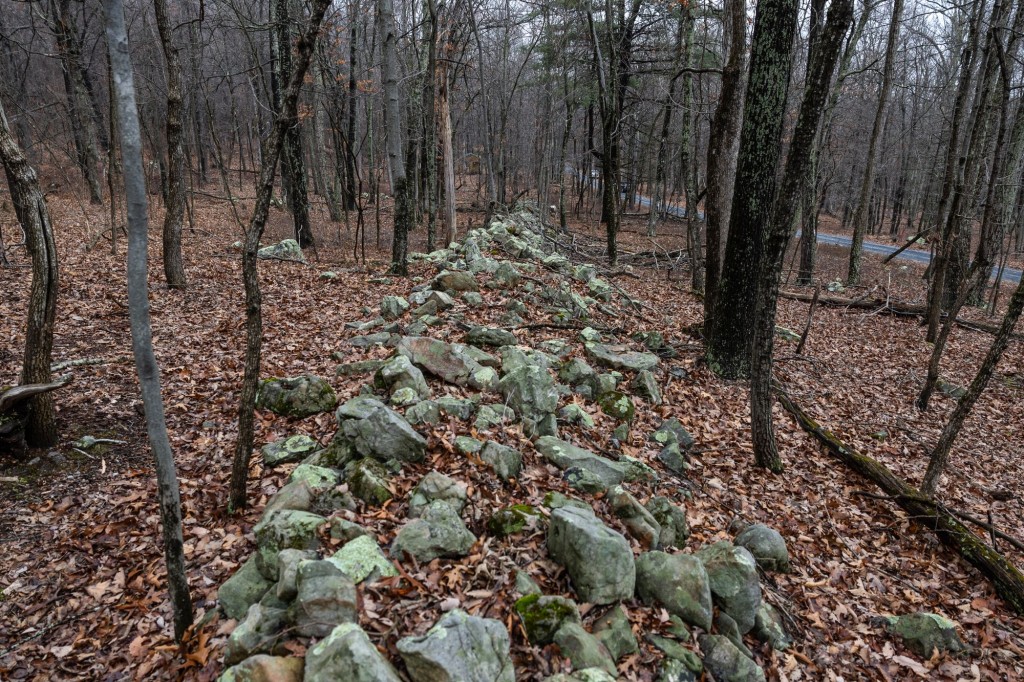
The Bear Spirit Mountain “Serpent Wall” extends through the trees for 92 yards.
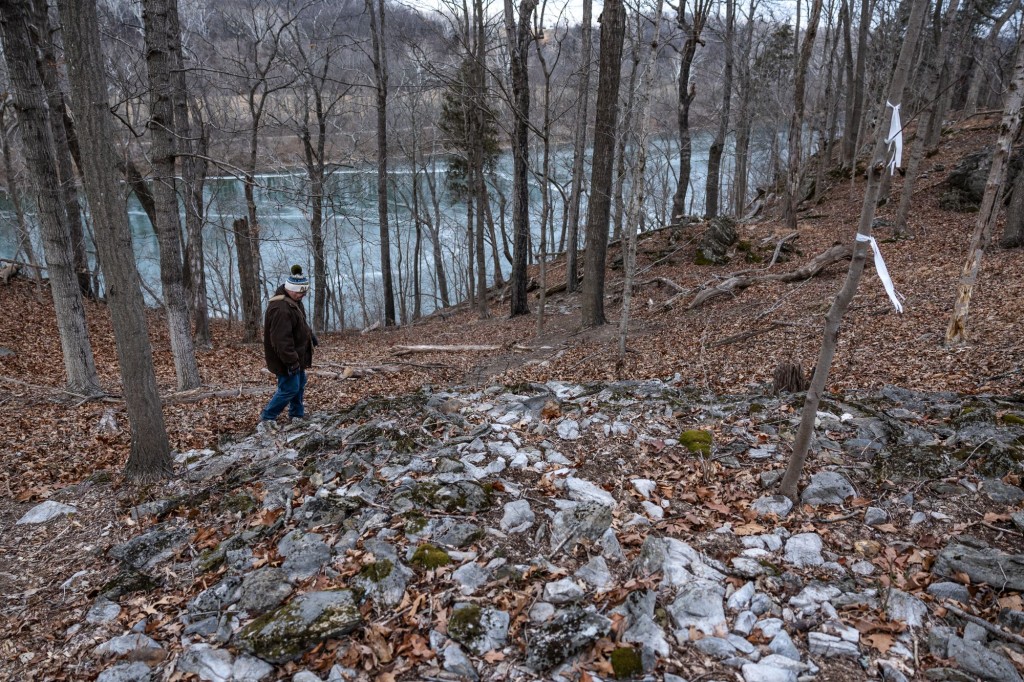
Matthew “Maasaw” Howard walks past one of a series of large burial mounds that sit on top of cliffs overlooking the Potomac River.
Related Articles
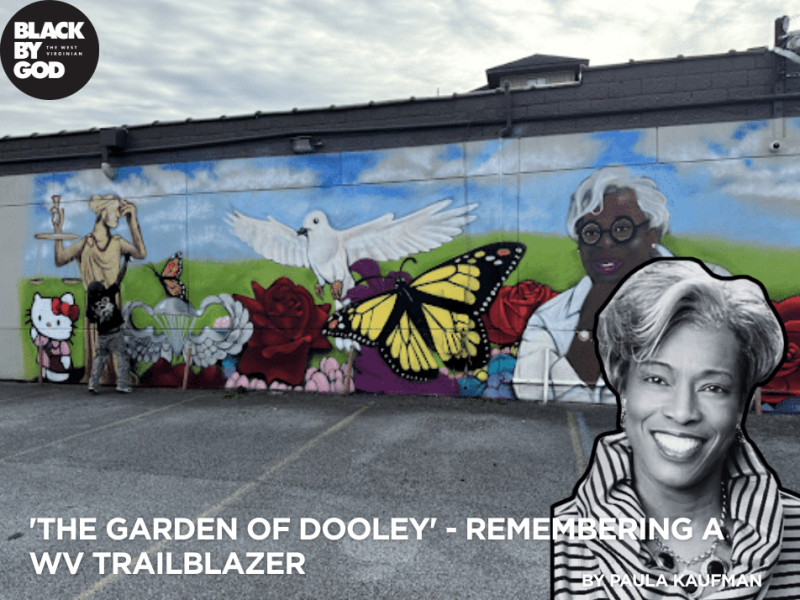
BLACK BY GOD: ‘The Garden of Dooley’ — Remembering a WV trailblazer
Respected activist and Charleston attorney, Katherine Louise “Kitty” Dooley passed away on October 10th, 2025. Five days later, the public awakened to “Garden of Dooley.”
THIS WEEK IN WV HISTORY: Sept. 27–Oct. 3
The following events happened on these dates in West Virginia history.