Ford discusses funding, Sportsplex, and transparency at primary candidate forum
By Hannah Yost, The Real WV
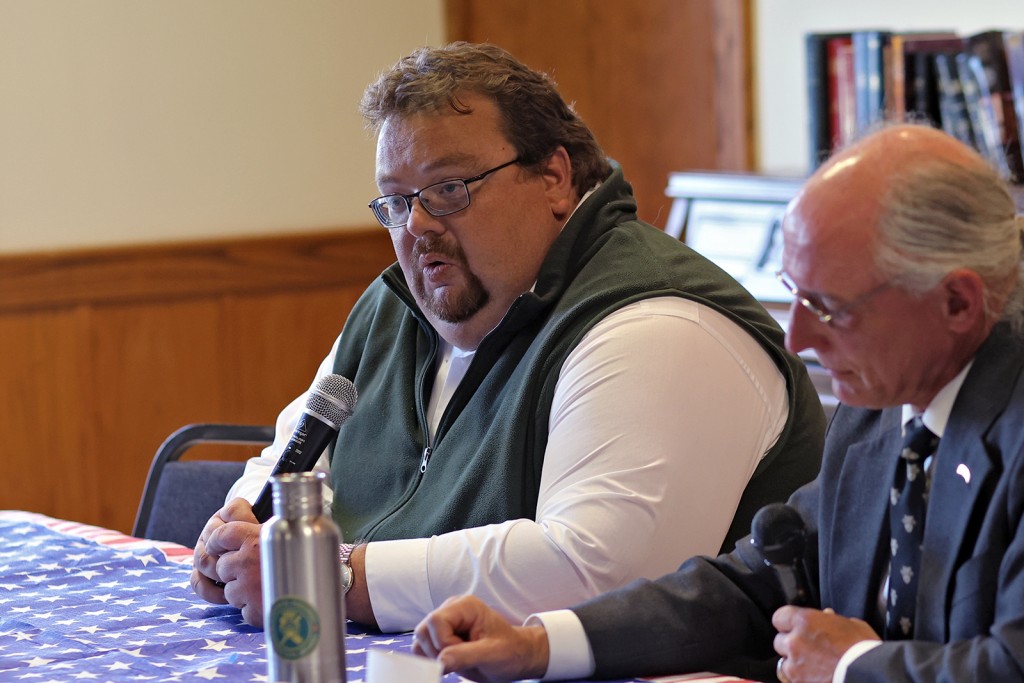
MAXWELTON, W.Va. – Matt Ford was the only county commission candidate in attendance at a recent primary candidate forum, where he outlined his views on economic development, transparency and major county projects. Ford’s primary opponent Bill Bell was invited to participate but did not attend.
A Republican candidate for the Western District seat, Ford addressed topics including the proposed Sportsplex, county spending practices and the role of local government in overseeing development.
A graduate of Greenbrier West High School and West Virginia University, Ford earned a master’s degree from Marshall University. He has worked in environmental consulting and contracting and started his own company in 2019.
He also pointed to his involvement in flood recovery efforts across the county.
Question: Do you support completing the proposed Sportsplex at its current location?
Ford addressed the long-discussed Sportsplex project, which began more than a decade ago and has already received significant investment. About $2.5 million has been spent on the project, with county officials estimating at least $10 million more would be needed to complete it. Ford said he does not support moving forward with the project in its current form or location.
“I do not support it at its current location,” he said. “As a project manager, I think we need to take a step back and evaluate the project as a whole.”
While not opposed to the concept of a sports complex, Ford said the county should take a broader approach.
“I’m not opposed to building a sportsplex in Greenbrier County, but we need to ask how we can salvage the project by looking at the bigger picture,” he said.
Ford suggested the project should be part of a larger regional strategy.
“The county needs an outdoor recreation plan,” he said, noting efforts he has been involved in both western Greenbrier County and eastern Fayette County.
He also emphasized the importance of seeking outside funding rather than relying solely on local tax dollars.
“If the county wants a Sportsplex, we need to look at outside dollars,” Ford said. “That money needs to be dispersed instead of spending it all in one place.”
Question: Would you support Greenbrier County participating in the West Virginia Checkbook system to make financial records publicly accessible?
Ford called for greater transparency in how county funds are managed.
“I would support that. If you’re spending county tax dollars, you should be able to justify how that money is spent,” Ford said. “I think it’s very important — it builds trust.”
“You can’t ask for new projects to spend tax dollars on if you can’t tell people what you’ve already spent,” he added.
Question: What can local authorities do to reassert control over data center development in their communities?
Ford also discussed the role of county government in decisions related to data center development.
Coming from a “seven-generation family of coal miners,” he said the region has a long history of outside interests shaping local outcomes.
“We have a long history of being exploited,” he said. While not opposed to development, Ford said projects must benefit the community.
“I’m not opposed to it, but economic development needs to improve our current situation,” he said.
Ford suggested counties should push for more local input at the state level.
“We need technology, but we need to be smart about where we place it,” he said. “We should be petitioning the state for more local input.”
He also noted potential environmental considerations.
“Data centers require a lot of water for cooling,” Ford said. “We should look at placing them in areas where we can also help address legacy environmental issues.”
Question: There is often a perceived divide between the eastern and western parts of the county. What can each side learn from the other?
Ford acknowledged differences between the eastern and western parts of the county, including economic and geographic factors.
“The economy is different. The geology is different,” he said.
He said collaboration between regions is key.
“I’ve never liked hearing that ‘the eastern side gets everything,’” Ford said, pointing to funding for projects such as Rupert Elementary.
“We put a team together and raised almost $6 million, all from people in the western part of the county,” he said.
“We can do anything we need to do if we put our minds to it.”
Question: Would you consider yourself a team player, or a maverick challenging the status quo?
“If you can’t work with a lot of people, you’re going to be a failure as a county commissioner,” Ford said.
When asked about his approach to leadership, Ford said he sees value in both collaboration and challenging existing systems.
“A little bit of both,” he said.
He pointed to projects such as Rupert Elementary and the Meadow River Trail as examples of successful teamwork involving multiple partners.
“That’s a team effort,” Ford said.
He also emphasized the importance of public input in major projects.
“There needs to be a lot of teamwork in planning and zoning for projects like the Sportsplex,” he said. Ford also noted he was hired to assist with the public participation portion of the county’s comprehensive plan.
“I’m good at getting people together, getting them to talk and getting things done,” he said.
Ford described one of his strengths as bringing people together.
Early voting has now begun and will proceed through Election Day for the primary on May 12. As no Democratic candidates filed to run for the open county commission seat, which was vacated by former Commissioner Tammy Tincher, the winner of the Republican primary will run unopposed in the general election this fall.