Morrisey issues guidance on school mandated vaccines, debate over executive order continues
By Autumn Shelton, RealWV
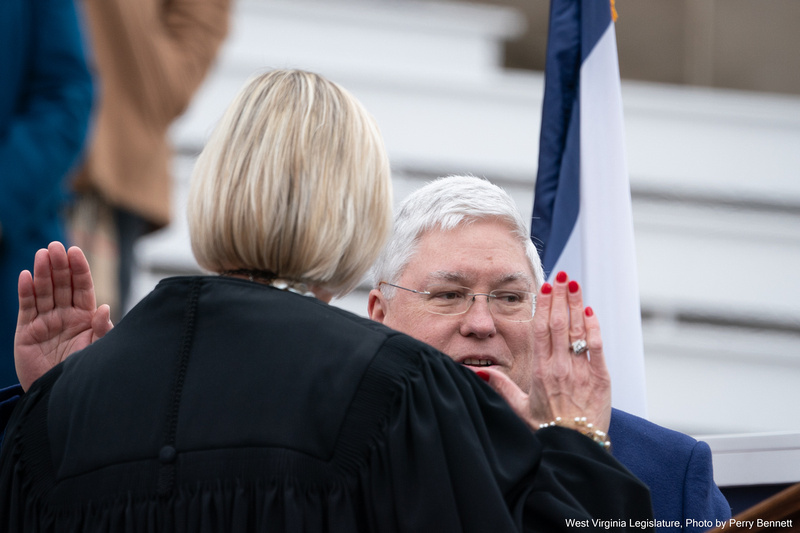
CHARLESTON, W.Va. – On May 9, Gov. Patrick Morrisey issued a press release stating that his January 14 executive order on religious exemptions for school mandated vaccines “remains in place and will not be rescinded.” Shortly after, the West Virginia Democratic Party issued a press release of their own condemning the Governor for “issuing an irresponsible and politically motivated directive” that defied the majority opinion of the state’s legislative body.
Both press releases stemmed from a May 2 memo to all 55 county superintendents from West Virginia State Superintendent of Schools Michele Blatt stating that because the legislature did not pass Senate Bill 460, a bill requested by Morrisey which would have allowed religious exemptions for vaccine requirements, school districts should follow state law – meaning there would be no religious exemptions for vaccine requirements.
Later that same day, Blatt changed course by issuing a new memo to county superintendents stating “At the governor’s request, I am rescinding the memo I sent earlier today regarding vaccine exemptions.”
The new memo explained that the Governor would be issuing guidance on how to comply with his executive order.
According to Morrisey’s guidance, provided in his May 9 press release, and in a letter to school officials, “students will not be denied access to public education because of their religious objections to compulsory vaccinations.”
Additionally, he stated that his executive order is “based on the free exercise of religion guarantees of the United States and West Virginia Constitutions and the Equal Protection for Religion Act of 2023.” He continues that the Equal Protection for Religion Act has “primacy over other conflicting state statutes. State and county officials are therefore bound to respect students’ exercise of religion when enforcing the state’s vaccine requirements.”
Morrisey added that parents who wish to obtain a religious exemption for their child should send a signed letter to the state’s Bureau for Public Health with general details about their child, including name, birth date, and school. The Bureau for Public Health will then send a return letter, notifying the parent or guardian of a granted exemption.
Currently, state code provides that students be vaccinated against chickenpox, hepatitis-b, measles, meningitis, mumps, diphtheria, polio, rubella, tetanus and whooping cough.
In the press release sent from the West Virginia Democratic Party, Del. Anitra Hamilton, D-Monongalia, was quoted as saying “The legislature has already spoken clearly on this matter – Governor Morrisey has no authority to perform an end run around their decision. It’s disturbing that our Governor is prioritizing political pandering over the health and safety of West Virginia students and school personnel.”
The press release continues that Gov. Morrisey’s “ongoing failure to appoint a Chief Public Officer underscores his reckless approach. The position remains vacant because Morrisey knows it’s virtually impossible to find a qualified professional willing to endorse the Governor’s unscientific and medically unsound policies.”
Considering the disagreement between the legislature and the Governor on vaccine mandates, whose decision takes ultimate precedence?
The West Virginia State Constitution sets forth a series of checks and balances for the three branches of government – the executive branch, the legislative branch and the judicial branch.
Article VII of the Constitution states that “The chief executive power shall be vested in the governor, who shall take care that the laws be faithfully executed.” Article VI of the Constitution states that this lawmaking power be “vested in a Senate and House of Delegates.” Article VIII of the Constitution provides the judicial power “be vested solely in a supreme court of appeals and in the circuit courts, and in such intermediate appellate courts and magistrate courts as shall be hereafter established by the Legislature, and in the justices, judges and magistrates of such courts.”
West Virginia state code only provides guidance on the issuance of executive orders in “a state of emergency or state of preparedness by the Governor or the Legislature.”
Taking a look at recent West Virginia history, former Governor Jim Justice faced a somewhat similar debate over his issuance of an executive order on July 6, 2020, during the COVID-19 pandemic, mandating that all persons age nine and over wear masks while in confined, indoor spaces. That executive order was later amended to include only those who hadn’t been fully vaccinated.
Some lawsuits brought against the governor over this executive order, citing First Amendment rights, were ultimately dismissed, and a subsequent bill, House Bill 4071, proposed during the 2022 regular session, which would have provided that elected or local officials not mandate masks for students or employees, didn’t pass. (Similar bills have also been introduced in the state’s legislature, but have not passed.)
Ultimately, Justice terminated the mask mandate through an executive order on June 18, 2021, citing public health expert guidance as one of the reasons for ending the mandate.
Justice’s executive orders, however, were issued during a state of emergency, unlike the current executive order on vaccine exemptions.
As the debate continues between the state’s executive and legislative branches on the ultimate law-making authority, it leaves one to wonder when the judicial branch will become involved – if at all.
RealWV will continue to provide updates as they become available.