How are new student loan caps affecting medical students?
Students at state’s three medical schools coping with caps on federal loans – so far, medical schools say.
Students at state’s three medical schools coping with caps on federal loans – so far, medical schools say.
By Sara Crickenberger for RealWV,
LEWISBURG, W.Va. – As the newly matriculating class of 2030 at West Virginia’s three medical schools stressed about finding housing, locating their classrooms, and figuring out where to park, many encountered one big, brand-new source of anxiety: Would they be able to pay for medical school tuition and living expenses with the new federal caps on student loans that took effect on July 1?
While facing all the normal stresses of starting a rigorous professional program, the students who started medical school in July also are facing some additional challenges. 2025’s Public Law 119-21, which the Trump Administration calls the “One Big Beautiful Bill Act,” set new limits on how much money medical and other professional school students can borrow from federal loan programs each year to pay for their tuition, fees, and other expenses starting July 1.
It also eliminated Graduate PLUS loans, capped federal loans for undergraduate and graduate students in other programs, and imposed a lifetime federal loan cap across all programs, undergraduate and graduate.
In a state like West Virginia, which suffers from critical shortages of physicians and other medical providers in many areas and specialties, the changes in federal student loan rules have created a new environment both students and administrators have to figure out how to navigate.
But, at least for now, officials from the West Virginia School of Osteopathic Medicine and West Virginia University say students who accepted seats in their medical school classes of 2030 have been able to figure out how to pay the costs to attend.
Officials from both schools still have concerns about how the new rules will affect their students and institutions as new lifetime caps on loans and time limits on graduate education come into play in the future.
With new caps, federal loans don’t cover the cost of tuition/fees and living expenses
The law caps annual federal medical school loans at $50,000 per year with a four-year limit of $200,000 on all graduate education and a lifetime cap on all federal loans across all undergraduate and undergraduate programs at $257,500.
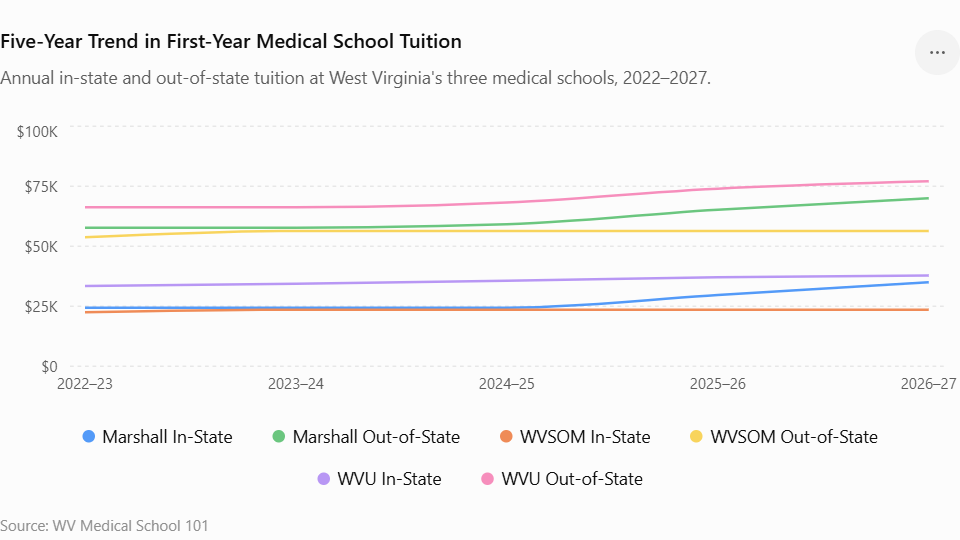
While the annual loan cap is more than the in-state tuition at West Virginia’s three medical schools (see chart above), it is less than the out-of-state tuition at the schools. And it is considerably less than both in-state and out-of-state students generally need each year to also cover their rent, utilities, and other expenses.
Students and school administrators have been left trying to figure out how to close the gaps and keep medical school within the reach of students who may have worked for years to gain admission to medical school.
Over the past five years, the average in-state medical school debt has been less than the $200,000 cap at all three schools while the average out-of-state debt has exceeded the cap across the board (see chart below).
WVU offers three-year med school option and rural health stipend

Clay B. Marsh, M.D., WVU Health Sciences chancellor and executive dean, said that all of the students who were admitted to WVU medical school this year and chose to accept the seat have been able to obtain the financial resources they need so far.
“In general, we have a variety of opportunities to help some students with financial aid,” Marsh said. “We also have a track where you can finish medical school in three years versus four, which can save students an entire year of tuition.”
Both in-state and out-of-state students can apply for the three-year program, Marsh said.
“And then there are opportunities through our Rural Health Institute to offset students with a $10,000 a year stipend to stay and practice in rural West Virginia or be able to change the delta from the out-of-state to the in-state level of tuition for out-of-state students that want to practice in rural West Virginia,” Marsh said. “And that’s a one for one each year that you practice, you can get an extra year of that funding.”
WVSOM moved early to create a path to private loans
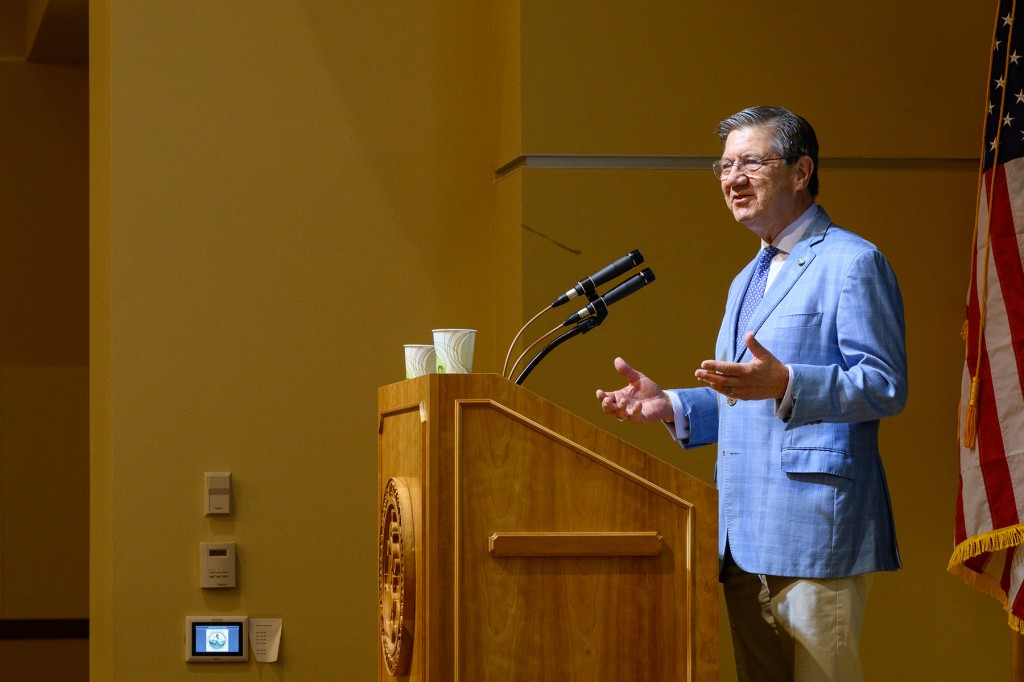
James W. Nemitz, Ph.D., president of West Virginia School of Osteopathic Medicine, said his school started preparing for the changes well in advance of their taking effect. One major step was hiring a new staff member with significant experience in the private loan industry, where some students successfully attained loans with lower interest rates than federal loan programs.
Nemitz said that WVSOM, the state’s largest medical school, was successful in helping all committed students find the funding they needed to enroll for the current school year. He called medical school students a great investment for the commercial loan industry because they rarely default on school loans.
“Our default rate is near 0 percent. It’s less than 0.1 percent,” Nemitz said. And while WVSOM has the lowest in-state tuition cost in the state at $23,594 for 2026-2027, he warned that the idea that the new rule does not affect in-state students is false since most in-state students still need to borrow more than the federal caps allow to pay for their living expenses.
WVSOM’s total estimated budget for an in-state student is more than $65,000 a year, he said. The school estimates that out-of-state students need about $96,000 to cover tuition and living expenses, nearly $50,000 of which must come from non-federal sources.
According to their websites, Marshall University and WVU medical students need similar amounts to pay tuition, fees, and living expenses. Marshall University, for instance, estimates an in-state medical student needs $67,846 to cover all costs while an out-of-state student needs $102,846, according to MU’s website.
Private loans filling the gaps for some students
“My point is that even for the in-state students, they have to look for extra money,” Nemitz said. “So now, what’s the solution? Well, the solution is actually not a new one. The reality is higher ed for a long time has been funded by banks.”
Nemitz said private loans have always been part of financing high education in the U.S.
“If you talk to our financial aid people, they’ll tell you, there are some people that don’t go after federal loans. They just get private loans,” Nemitz said. “Why? You can sometimes cut better deals. And that’s what’s happening for medical students…The idea of going to private banking is not a new idea. But that’s what the feds have done. The Feds have pushed people back into the private market.”
Justin McAllister, Vice President of Finance and Facilities and Chief Financial Officer at WVSOM, said that a few students have struggled through the loan process because of their unique situations, but more than 60 students have successfully applied for private loans for more than $3 million with some interest rates in the 4-6 percent range rather than the more than 8 percent rate on the federal loans.
“The ironic thing about the private lending is, you know, we’ve heard all of these rumors and fears about private lending,” McAllister said. “I think this is the best example that I can give. We had an international student that there was this huge fear of he didn’t have a cosigner. We knew he needed private loans. What would that look like? He got an interest rate in the 6 percent range, full amount requested… So it was the best case scenario. His interest rate with the private loans was less than what he would have received as a Grad Plus (federal loan).”
Nemitz said medical students may enjoy a more positive position than many other borrowers.
“You think about this population of students. They tend to be really good students. They tend to be professional,” Nimitz said. “They are a good risk. And so what banks are doing is they want medical students. They want to loan money to medical students because it’s a lower risk than almost any other profession…If they get through the program, they’re almost guaranteed a job.”
Questions remain moving forward
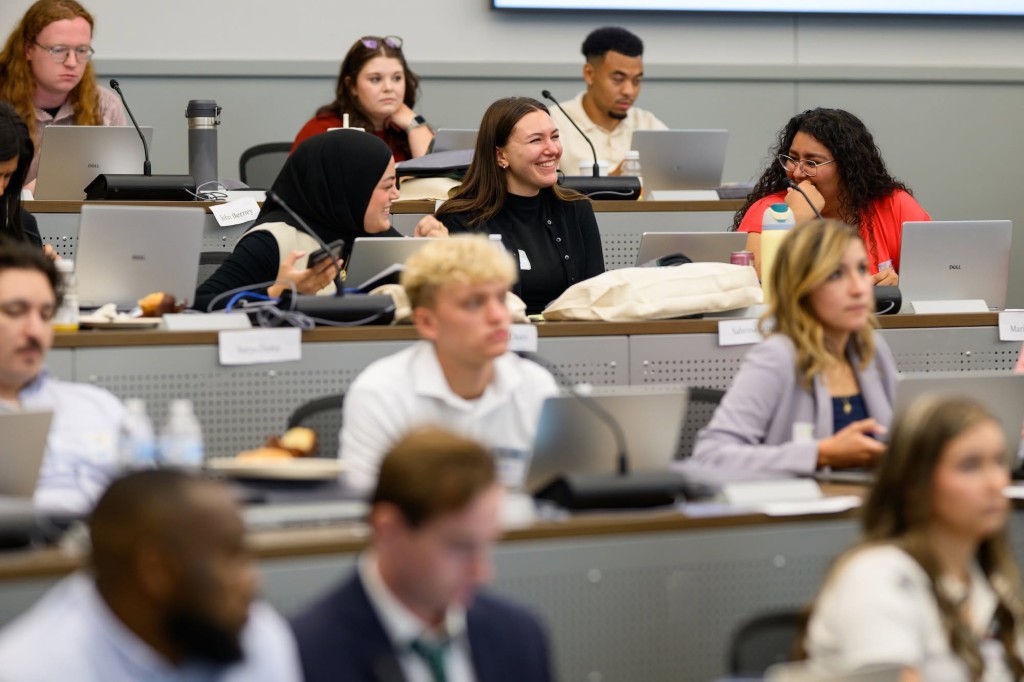
Both Marsh and Nemitz warned that there are other complications under the new rules that leave a cloud over some medical students moving forward. Nemitz pointed out that those with poor credit and no co-signer may run into difficulties at some point.
And both officials were concerned that students with significant loans for other graduate school programs might exceed the federal caps before they complete medical school.
“We see a fair number of applicants that have already done some graduate study,” Nemitz said. “So, if they’ve done a year of graduate (study), say the students in our MSBS program, they’ve already used up a year (of eligibility). So they’re now down to three years of funding from the Feds.”
Nurses, physician assistants, dentists, and others also facing funding challenges
Marsh said he has deep concerns about other professional programs, such as undergraduate and advanced nursing degrees, that also are affected by these rules. For instance, undergraduate nursing students, who are not considered “professional” under the federal legislation, are limited to federal loans of $20,000 a year even though the state has a critical shortage of nurses. West Virginia alone is estimated to need an additional 1,000 to 1,500 new nurses a year.
The question of whether nurse practitioners, nurse anesthetists, physician assistants, and other advanced health care practitioners are “professionals” and qualify for the higher loan amounts already has been the subject of litigation. New U.S. Department of Education rules limit “professional” roles – and higher educational loans – to pharmacy, dentistry, veterinary medicine, chiropractic, law, medicine, optometry, osteopathic medicine, podiatry, theology, and clinical psychology.
A federal judge ruled in June that the Education Department’s definition of “professional” is “misguided” and stayed the provision, according to Inside Higher Education. However, the ruling is temporary, pending final resolution of the lawsuit.
Marsh said he also is concerned about the impacts on dental school students, whose tuition and fees are higher than medical students as is the average debt of graduates.
All of these are issues that students and schools will have to face in coming semesters and years.
Marshall University weighs in
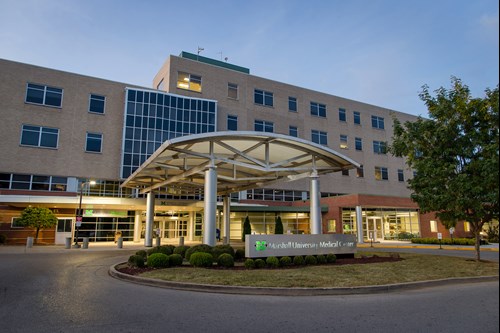
Marshall University declined to make anyone available for an interview for this story despite multiple communications over several weeks. Officials also largely declined to answer questions submitted by email. The school provided links to some pages on its website and Michele McKnight, Director of Communications at Marshall Health Network/Marshall University Joan C. Edwards School of Medicine, provided a two paragraph statement by email. The first paragraph says the university informed incoming students about the loan changes and that “Cost-of-attendance estimates, including living expenses, were shared as early as possible to assist students in making informed decisions.”
The statement continued: “Marshall is focused on helping each student understand the options available and develop a financing plan that meets their individual needs. For students seeking funding beyond the federal limit, the financial aid office is providing one-on-one guidance on private loans, outside scholarships and other resources. The School will continue to monitor borrowing patterns and student needs as the new limits take effect, while evaluating how best to support access to medical education.”
Author

Related Articles
Making a ‘GIANT’ impact on the local community
“The Giants’ visit didn’t seem all that important to me at first–until I got to be a part of it,” said Abby DeGraff, a local business owner. “I quickly realized how wrong I was about their impact on our local economy.”

Scenes from the 79th annual Berkeley County Youth Fair
Take a look at the photos from the 79th annual Berkeley County Youth Fair in Martinsburg, W.Va., which took place from Aug.1-8.
THE FRONT PORCH: How are the opioid settlement funds being spent in West Virginia?
West Virginia was one of the states hit hardest by the opioid epidemic.