
FORUM: Beard takes questions from community
Doug Beard, candidate for Greenbrier County Magistrate, answered questions from voters on Tuesday evening.
By Hannah Yost, RealWV
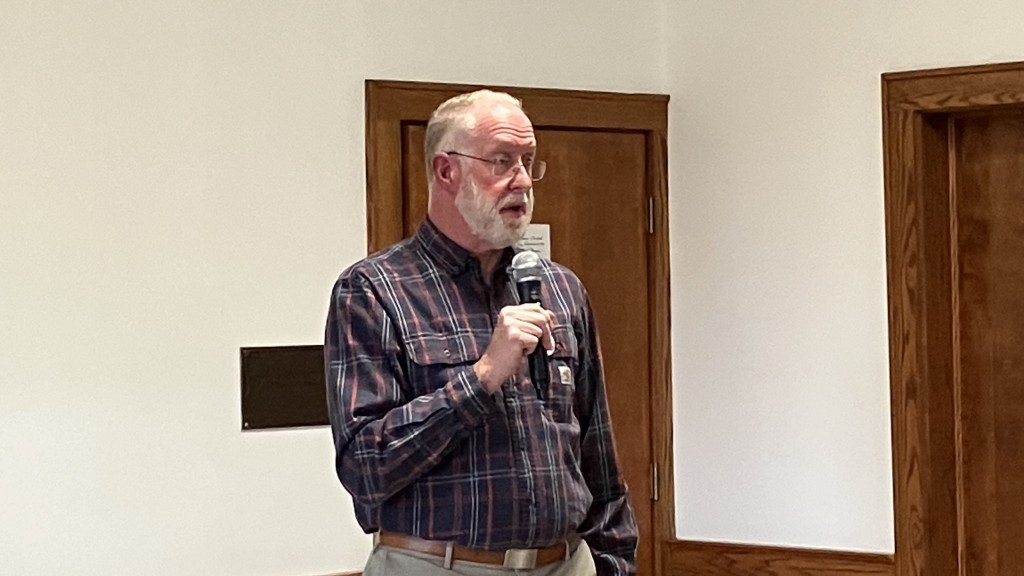
MAXWELTON, W.Va — Doug Beard, candidate for Greenbrier County Magistrate, was the only candidate to attend a community forum on Tuesday night in Maxwelton.
His opponent, Andy Evans, who was appointed to the position this fall, did not attend. Evans was invited in September, initially agreed to be there, then said he might have a conflict, and finally cancelled last week when a Republican-backed “Meet & Greet” was announced for the same night in Alderson.
Beard, who was born and raised in Greenbrier County, explained that he previously served five consecutive terms as magistrate, accumulating 19 years of experience in the position. During his time in office, he said he handled a wide variety of cases and gained extensive experience navigating the judicial system.
Question: How do you see the role of the magistrate in the judicial system?
Beard described magistrate court as the people’s court, often serving as the first point of contact for individuals entering the judicial system.
He explained that magistrates handle a significant caseload, frequently working with individuals who are filing grievances or appearing in court without legal representation. Because many people are unfamiliar with court procedures, Beard said he believed it was important to provide explanations and exercise some flexibility with procedural rules while maintaining appropriate boundaries.
He emphasized the importance of helping individuals understand what is permitted in court and the reasoning behind judicial decisions.
Question: Why do you want to serve as magistrate again?
Beard, who currently works with White Sulphur EMS, said his desire to return to the position stems from his 19 years of experience and the extensive training he received throughout his judicial career.
He believes that experience remains valuable and wants to put his knowledge of the judicial system back to work serving Greenbrier County residents. He also noted that his opponent does not have a background serving in the judicial branch.
Question: The role of the magistrate is nonpartisan. Do you agree with that, and why?
Beard expressed strong support for maintaining impartiality within the judicial system, emphasizing that magistrates serve as judges and must approach every case without political bias or personal prejudice.
Drawing on his 36 years of experience working with the public, Beard said he understands the importance of setting aside personal opinions and evaluating cases based solely on the facts presented.
He stressed that magistrates should not favor one political party or another and must remain fair to everyone who enters the courtroom.
Question: Are there any actions you would take as magistrate to maintain that impartiality?
Beard explained that the rules governing judicial elections and the magistrate position are established through legislation and are not something he has the authority to change independently.
However, he reiterated his belief that the position should remain nonpartisan, emphasizing that magistrates must remain as impartial and detached as possible when making decisions.
Question: How is a magistrate different from a judge?
Beard explained that one of the primary distinctions between a magistrate and judges serving in other courts is the educational and professional requirements for the position.
Unlike judges in higher courts, magistrates in West Virginia are not required to be licensed attorneys before taking office.
Question: Magistrates frequently make bond and bail decisions. How do you determine a fair bond?
Beard explained that setting bond requires reviewing the details of each individual case and considering several factors before making a decision.
He said he begins by examining the criminal complaint and the circumstances surrounding the allegations. He also considers an individual’s criminal history, previous arrests, and whether the person has failed to appear for court proceedings in the past.
Beard noted that not every charge requires a bond and stressed the importance of considering the specific circumstances of each case rather than applying the same approach to every defendant.
Question: West Virginia’s jails are overcrowded. Does that impact your decision-making on the bench? If so, how?
Beard said jail overcrowding does not influence his judicial decisions.
He recalled hearing concerns about jail expenses and the financial burden placed on county commissions during his previous time in office. However, he maintained that those concerns should remain separate from the responsibilities of the court.
Beard emphasized that his responsibility as magistrate is to make decisions based on the circumstances of a case. If incarceration is warranted, he said, concerns about overcrowding or the county’s jail expenses would not prevent him from ordering it.
Question: Are magistrates required to complete training? What does that training involve?
Beard explained that magistrates receive training through the West Virginia Supreme Court of Appeals, including conferences that address various aspects of the law and judicial procedures.
He said newly elected magistrates undergo training to become familiar with applicable laws, courtroom procedures, and the responsibilities of the position. Additional training conferences provide opportunities to review legal updates and procedural changes.
According to Beard, understanding the West Virginia Code is essential to performing the job effectively.
He explained that when presented with a criminal complaint, magistrates must carefully review the allegations and determine whether the information provided supports the complaint and the legal requirements for proceeding.
Question: How is the number of magistrates in each county determined? Is it based on population or caseload?
Beard explained that Greenbrier County has three magistrates, although the number varies from county to county. He said some counties have only two magistrates, depending on their size and the demands placed on the court system. According to Beard, caseloads play a role in determining how many magistrates are needed, and those demands can fluctuate over time.
Voters will choose either Beard or Evans to serve as Magistrate. The General Election is November 3. Early voting is underway now.
Related Articles
FORUM: Commission candidates not present to take community questions
Candidates Lowell Rose and Matt Ford are both running unopposed for county commission seats. Neither attended a community forum for county candidates on Tuesday to answer questions from voters.

Dear Grace: Conversations that matter
I like this guy but I can’t get past his bad teeth. Should I end it?
PHOTOS: Red Bull Chariot Race brings high-speed fun to Morgantown
Take a look at photos from the Red Bull Chariot Race in Morgantown, W.Va., which was held on High Street this past Saturday, Oct. 24, 2026.