Roads to Prosperity a bad financial move for WV? Morrisey says maintenance will now be priority
By Autumn Shelton, RealWV
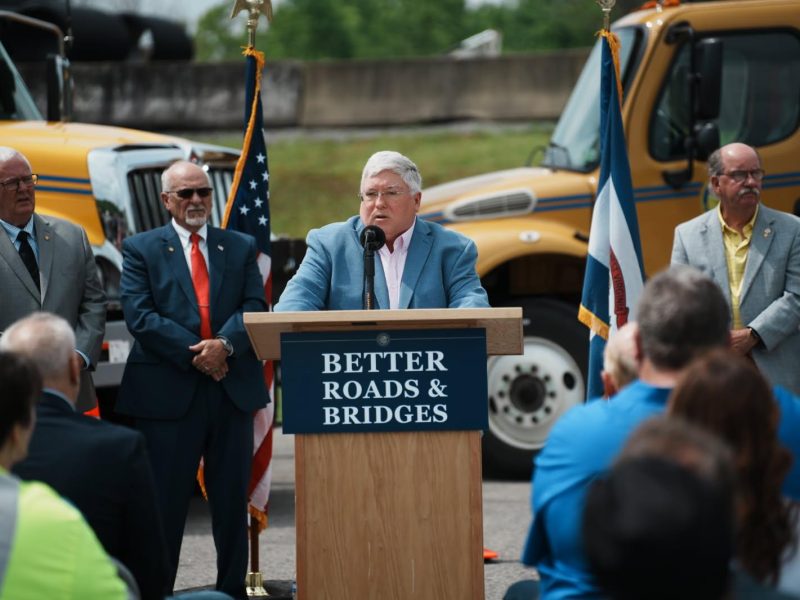
BRIDGEPORT, W.Va. – On Monday, Gov. Morrisey said that the focus of the West Virginia Department of Transportation (DOT) would now be on maintenance of existing infrastructure, instead of building new roads.
“The state of our roads and bridges is critical,” Morrisey said during a press conference held in Bridgeport. “It affects everything we do – our ability to connect with one another, our ability to drive to work, what we do when we go out to restaurants, how we live, how we play. We need to have a strong infrastructure in our state to compete.”
According to Morrisey, when he took office, he discovered that the current condition of West Virginia’s highway infrastructure is a symptom of a much larger problem.
“One of the most disappointing things we found when we took office was despite the billions of dollars that was spent in the last eight years over highways and bridges, there was a lot of debt that was racked up without making the progress that we need to maintain West Virginia’s roads, bridges and highways,” Morrisey continued, citing mismanagement of funding and the designing and construction of highways that the state had no money to pay for as major contributors to the problems.
As a result, Morrisey said that the DOT is now “effectively out of money.”
“When you look at the Roads to Prosperity, that was a 30 year bond,” Morrisey explained of former Gov. Jim Justice’s push for new roads, which was announced in 2017. “Effectively, all of the money . . . was already committed within seven years. The public didn’t know that. Now, I’m here to tell you that the Roads to Prosperity money it’s all gone, it’s done in terms of it’s not available into the future because it’s effectively committed in all but one project left.”
(To view the Roads to Prosperity revenue and expenditure sheet, click here.)
Additionally, Morrisey said that the federal government warned his administration that they would cease some funding for the state’s roads unless the state began to manage its finances better.
“Basically, the state was spending so much on new highways without a clear plan for getting them done, when a basic look at our financial dollars made it obvious that we can’t even afford a lot of the existing highways that are on the books,” Morrisey said.
According to studies conducted on the state’s highway infrastructure, 14% of the bridges in West Virginia are rated in poor condition, Morrisey said, noting that by 2028, the state must get that percentage down to under 10%.
“We also have to ensure that we are no longer ranked at the bottom of all these infrastructure rankings,” Morrisey added. “We know that this year, we have $1.2 billion that we’re spending overall for roads and bridges and infrastructure. What’s interesting, though, about that, is we are spending about $120 million per year in interest costs. You think about that, add that up over a 30 year period, that’s a lot of money.”
Morrisey said that West Virginia has become, essentially, the “most bond-indebted state highway system in the country.”
The focus will now be on maintenance of current infrastructure, Morrisey continued, including patching potholes, paving roads, and fixing bridges.
“We are also going to be building new roads, but we are going to do so in collaborative ways, like reaching out to some of the counties and forming relationships in order to address that,” Morrisey said.
In addition to finding ways to reduce DOT spending, Morrisey said that an overhaul of the department would take place, this includes removing red tape, restructuring debt repayment, providing transparency and reducing the number of department managers.
“Quite frankly, the Department of Transportation had too many assistant directors, vision directors, relative to the money that is has to spend and money that is better spent on highways and bridges,” Morrisey stated. “There were some divisions in the DOT that had five assistant directors. In most cases it was completely unnecessary.”
Secretary of Transportation Todd Rumbaugh added that the state must shift its focus to the maintenance of existing infrastructure.
“One in five bridges in West Virginia is classified as structurally deficient or rated in poor condition placing us among the top five states in the country with the highest percentage of aging bridges that need significant repair,” Rumbaugh said, adding that the state must ensure that infrastructure is safe and resilient for generations to come.
“When we invest in infrastructure, we are investing in West Virginia’s future,” Rumbaugh said.
The DOT projects map can be viewed at https://transportation.wv.gov/Pages/WVDOT-Projects.aspx