
Residents press Greenbrier County Commission for answers on proposed zoning changes
The Greenbrier County Commission held the public hearing Sept. 15 as it continues considering a new zoning ordinance.
By Hannah Yost, RealWV
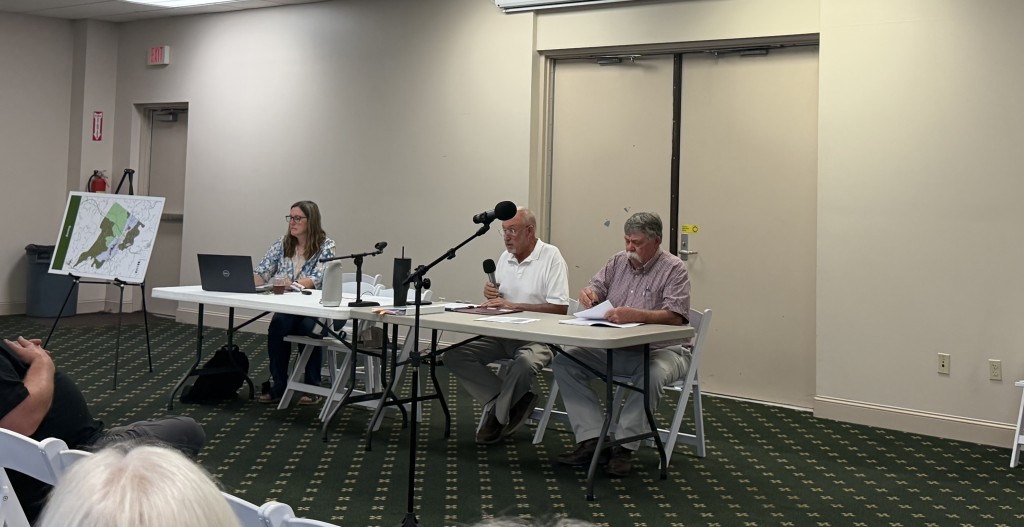
LEWISBURG, W.Va. — Questions over commercial development, property rights, farmland preservation, and the reasoning behind proposed changes to Greenbrier County’s zoning ordinance dominated another public hearing Monday evening, as residents urged county commissioners to explain why certain uses were added to a proposal developed over years by the Greenbrier County Planning Commission.
The Greenbrier County Commission held the public hearing Sept. 15 as it continues considering a new zoning ordinance. Commissioner Lowell Rose and Commission President Woody Hanna attended in person, while Commissioner Richie Holliday participated via Zoom.
Much of the public discussion centered not simply on individual uses proposed under the ordinance, but on why the county commission made changes after receiving the planning commission’s proposal.
Laurie Lively, who spoke alongside her sister, said her family has farmed in the county for generations. Lively said her concern was less about individual commercial uses than what she viewed as the broader assumption underlying their inclusion.
“Greenbrier County is not an empty frontier,” Lively said, pointing to the county’s rural communities, landscapes, neighborhoods, and the Greenbrier River as assets that already have value.
She questioned what problems the additional commercial uses were intended to solve and whether there had been public demand for them.
“More development does not mean better,” Lively said. “Greenbrier County does not need to be conquered by development to prosper.”
John Francis said he had attended previous hearings and heard residents explain their opposition but believed commissioners had offered too little explanation in response.
Francis said the county’s comprehensive plan is intended to establish community goals, with the planning commission helping translate those goals into land-use recommendations. He questioned why commissioners departed from portions of the planning commission’s proposal.
“What is behind the idea?” Francis asked.
Francis also referenced previous assurances that the zoning changes were not intended to accommodate artificial intelligence-related development and asked what purpose the changes were intended to serve if that was not the reason.
Francis asked commissioners to publicly explain their reasoning for departing from portions of the planning commission’s recommendation, arguing that residents deserved to understand why the changes were made.
Mimi Turner raised similar questions, asking commissioners whether someone requested the additional uses after an earlier public hearing, whether professional planners recommended them, and whether the county had identified a documented need.
Turner said potential effects on traffic, infrastructure, rural character, and property values deserved consideration before the ordinance was adopted.
“Transparency does not weaken government,” Turner said. “It strengthens public confidence in government.”
Linda Ball focused her comments on property rights, saying the term can apply not only to the owner seeking to develop property but also to neighboring property owners.
For many people, Ball said, buying a home is the largest investment they will make, and zoning can play a significant role in that decision. Commercial uses can have effects extending beyond an individual property’s boundaries through traffic, noise, lighting, and other activity, she said.
“When we talk about property rights, we should ask whose property rights,” Ball said.
Mel Waggy raised concerns about public awareness of the hearing, saying she had difficulty finding it on the county’s online calendar and learned of it through the newspaper. Waggy called for additional opportunities for residents to ask commissioners questions and receive answers.
Kim Kowalkowski urged commissioners to consider the ordinance’s implications beyond their current terms in office.
“You’re writing the rules that shape the county for decades,” Kowalkowski said.
Once a use is established as a conditional use within a zoning district, she argued, future commissions, zoning boards, developers, and courts could rely on that designation. She questioned the need to establish additional development opportunities without a demonstrated present need.
“There is no reason to create development rights today in case someone wants them tomorrow,” Kowalkowski said.
Susan Graham described growing up in Putnam County when much of the Teays Valley area remained farmland and watching development transform the area over time. She warned that changes to transportation infrastructure could similarly make currently rural Greenbrier County land more attractive for commercial development.
“Keep residential zoning residential,” Graham said, arguing that the county should deliberately determine where commercial development belongs rather than allow it to emerge incrementally.
Larry Levine emphasized farmland preservation and noted that much of Greenbrier County remains outside the county’s zoned areas. He asked commissioners to protect open-space conservation, recreation, and farm-residential districts.
Not every speaker opposed expanding the uses permitted under the proposed ordinance.
Dawn Kieninger said the existing ordinance is not adequate as written and contains inconsistencies that should be addressed after decades of use.
Kieninger said some conditional uses could help farmers supplement their agricultural income while remaining on their property. A farmer, for example, might operate a bakery or another home-based enterprise that provides additional income needed to keep a family farm viable.
She also pointed to apparent discrepancies of the proposed ordinance and questioned restrictions affecting activities such as art, music, or dance studios while other home-based businesses are allowed.
Naomi Yang, who said she and her husband previously lived in California, expressed concern from another direction — that increased regulation could place unnecessary burdens on individual homeowners.
Yang said she was confused by a proposal that she believed could simultaneously allow more commercial activity in some areas while increasing restrictions on personal residential property. She cautioned against regulations that limit homeowners’ flexibility unless they address a demonstrated danger or community concern.
Taso Stavrakis, owner of the West Virginia Renaissance Festival, also spoke in support of changing the existing zoning system, describing the festival property as a working farm throughout the year and the festival itself as an example of how nontraditional activities can help sustain agricultural property.
Stavrakis said the festival faced significant opposition during its early years but now draws approximately 20,000 visitors during June and employs roughly 200 people, generating business for other establishments in the region.
“This isn’t theoretical,” Stavrakis said, arguing that Greenbrier County needs room for cultural and artistic ventures alongside traditional agriculture.
Britt Ludwig, who said she owns a small farm in a forest recreation district, said residents on different sides of the issue share concerns for their property and community.
Her concern, Ludwig said, was the process by which additional commercial uses appeared in the county commission’s version of the ordinance after the planning commission had spent years working on revisions.
Ludwig questioned why those uses were added to residential districts and said residents wanted an explanation of why the commission did not simply advance the version recommended by the planning commission.
Robert Gronan challenged the characterization of the county’s existing zoning ordinance as essentially unchanged for roughly four decades, noting that it has been amended over time.
Gronan also argued that the zoning ordinance must remain consistent with the county’s comprehensive plan and said departing from it could create legal questions.
Jack Tuckwiller encouraged commissioners and the planning commission to work together before moving forward.
“We’re all in the same position,” Tuckwiller said. “We want to benefit Greenbrier County long term, and what we do today will affect the next generations.”
Tuckwiller recommended that commissioners return to discussions with the planning commission and develop a proposal both bodies could support.
Toward the end of the hearing, commissioners responded to some of the concerns raised throughout the evening.
Lowell Rose said the commission had heard competing views from residents, including people who want greater zoning protections and those in less densely populated areas who do not want additional restrictions placed on their farms and property.
Rose said areas such as Fairlea, Fort Spring, and Caldwell present different land-use concerns because homes, businesses, and other properties are located close together. More rural areas of the county, he said, can raise different questions about how much authority government should exercise over private land.
He characterized the commission’s task as finding a balance between overregulation and underregulation.
Rose also offered the example of a small child care operation in someone’s home. If such a use was not permitted under the existing rules, he said, commissioners questioned whether it should instead be available as a conditional use subject to review by the Board of Zoning Appeals.
Rose said the commission would provide additional information on the county website explaining why it made particular changes to the proposal.
Woody Hanna said he had taken notes on residents’ comments throughout the hearings and would consider those concerns when making a final decision.
“I make a note of each one and take those thoughts and concerns into my decision-making when the time comes,” Hanna said.
Hanna also said he opposed adopting the planning commission’s original proposal without changes because he believed some provisions placed restrictions on agriculture that conflicted with state law.
Hanna pushed back on allegations that the commission had developed its revisions behind closed doors.
He said the proposed changes had been brought before the public so residents could review them and provide feedback before commissioners make a decision.
The Sept. 15 hearing was the latest in a series of public meetings on the zoning rewrite. Commissioners did not take final action on the proposed ordinance during the hearing.
Read The Real WV’s coverage of the previous public hearing on the proposed Greenbrier County zoning ordinance here.
Related Articles

Affordability driving Gen Z to WV?
This story is part of RealWV’s year-long focus on youth and belonging in West Virginia, exploring the difficult decisions young people face when deciding whether to stay or leave.

West Virginia Herpetology Symposium brings enthusiasts, researchers together at New River Gorge
Headlamps pierce the dark on a trail that runs along the cliff faces of New River Gorge National Park and Preserve
BLACK BY GOD: Call to Action: PSC sets public meeting date to hear concerns regarding data center construction
The PSC (Public Service Commission) of West Virginia will hold a public hearing later this month regarding House Bill 2014 – otherwise known as the “Certified Microgrid Program” – a widely debated piece of legislation passed during the 2025 legislative session.